

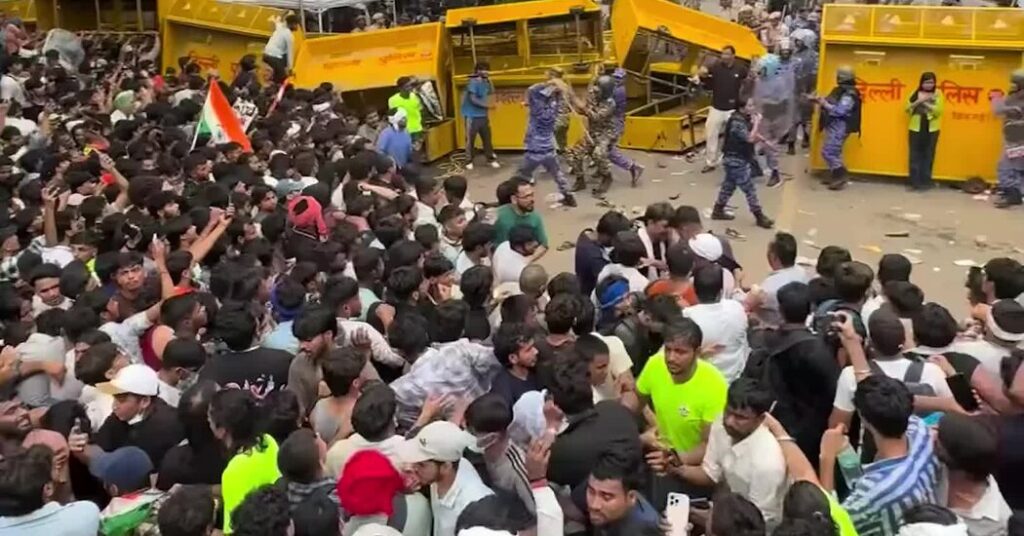
When thousands of unarmed students marched toward the Indian Parliament building last month in a rare challenge to the government, they were met by a wall of riot police officers determined to stop them.
Officials had blocked internet in the area, initially slowing the emergence of details of the crackdown. But videos taken by protesters and witnesses began circulating, revealing that security forces beat people with sticks and fired tear gas and pellet guns at them. The footage led to accusations of excessive force being wielded against peaceful demonstrators.
The New York Times has verified and analyzed images and video footage shared by protesters, along with witness accounts, to examine how the Delhi Police, the Rapid Action Force and other paramilitary forces handled the crowds. Several Times reporters were also present at the scene on July 20, the day of the march.
The evidence suggests that security forces exceeded many guidelines for law enforcement in peaceful demonstrations established by the United Nations and also those from India’s home ministry, which state that force “should be used when it is absolutely necessary, it should be minimum and proportional to the situation.”
While police brutality is not unusual in India, especially against minority groups, there was public outrage over how the authorities repressed a vast crowd of young people demanding accountability for the nation’s flawed education system. Protest organizers said at least 150 participants were hospitalized and many more injured. Rahul Gandhi, the leader of the opposition in the lower house of Parliament, has condemned the use of “brute” force, saying, “the assault on students is a stain on our democratic country.”
The Delhi Police has said that no permission had been sought or granted for the march, which demonstrators called for after several weeks of peaceful protest at a site near Parliament. The police said the march was “strictly prohibited” and that force had been used as a last resort. They said that 118 police personnel had been injured and that 70 people had been detained for violations of law and order. The Delhi Police did not respond to requests for comment on the video findings documented by The Times.
Batons and Bamboo Sticks
Security forces used lathis — long batons made out of bamboo or polycarbonate — to hit protesters, a tactic commonly used to control crowds if they become unruly and don’t respond to whistles or warnings delivered over loudspeakers. Security forces are advised to avoid overarm strikes and to hit people on their arms or legs, according to U.N. guidelines. But multiple accounts and videos verified by The Times appear to show police personnel, and a man in plainclothes, aiming for protesters’ torsos.
“The policemen treated us like criminals,” said Dheeraj Kataria, an undergraduate student at Delhi’s Hansraj College who had joined the march and said a police officer had struck him on the shoulder several times. “They hurled all kinds of abuse at us and beat us as if we were animals.”
Mr. Kataria, 24, continued to visit the protest site until July 25, when India’s education minister resigned, leading to the end of the demonstrations. By then, three long welts on Mr. Kataria’s shoulder had turned into dark bruises.
Videos shared by protesters on Instagram, verified by The Times, showed others with scars they said were from similar beatings, including the man below.
Arushi Dave, 19, who had her head bandaged, said she had been struck by a police baton “when dozens of policewomen charged at protesters just outside the protest site.” She said she had been frightened at the sight of her own blood as it soaked her white T-shirt. Ms. Dave was among the 2.2 million aspiring doctors who had taken a medical college-entrance exam in May that was later canceled because a question paper had been leaked, igniting the protests.
Unarmed Protesters
Several members of India’s Rapid Action Force, a riot-control unit of an armed police force, were also filmed hitting protesters with batons.
The R.A.F. was established in 1992 as an anti-riot force to prevent violent clashes, including during demonstrations in 1990 when students were protesting a new policy that reserved jobs for people in certain castes. The unit chose the color blue for its uniforms because it denoted peace.
At least three R.A.F. personnel wearing helmets and carrying shields took turns hitting an unarmed man who was not fighting back.
Tear Gas
Tear gas, which irritates the eyes, throat and lungs, was widely used to break up large crowds gathered in the areas adjacent to the designated protest site. U.N. guidelines say tear gas should never be used to disperse peaceful protesters. Typically, the canisters should be fired in an arc and not directly toward a crowd, but videos verified by The Times showed security forces releasing tear gas by hand at a lower trajectory.
Pellet Guns
The R.A.F. personnel also fired pellet guns, first used in India in 2010 against protesters in the Indian-controlled part of Kashmir, a disputed region also claimed by Pakistan. These guns, which spray dozens of small metal pellets, or birdshot, at a time, can cause severe injuries.
In one video, an R.A.F. officer is seen pointing his gun at someone out of the camera frame, and the sound of firing can be heard.
In another video, a man standing in the area where the R.A.F. officer was seen firing a pellet gun shows at least 18 small red puncture wounds on his abdomen.
The Delhi Police has said no pellet guns were used, but local media have reported that it has since begun an inquiry into their use. The R.A.F. has not commented on whether the guns were used. Gyanendra Pratap Singh, the director general of the Central Reserve Police Force, under which the R.A.F. sits, said in a public statement that he would bear responsibility for actions conducted in the “bona fide discharges of duty.”
The Fallout
Many protesters who were detained or targeted by security forces in Delhi or elsewhere have filed petitions with the Supreme Court, accusing the security forces of brutality and seeking punishment for those involved. The leaders of the Cockroach Janta Party — a once satirical group that led the youth movement — have urged protesters to preserve videos and photos as evidence, saying that dozens of people detained could face charges despite government assurances that they would not be.
While hearing petitions filed by protesters on July 28, the Supreme Court of India said that there should be an “evidence-based inquiry” into whether excessive force was used.