

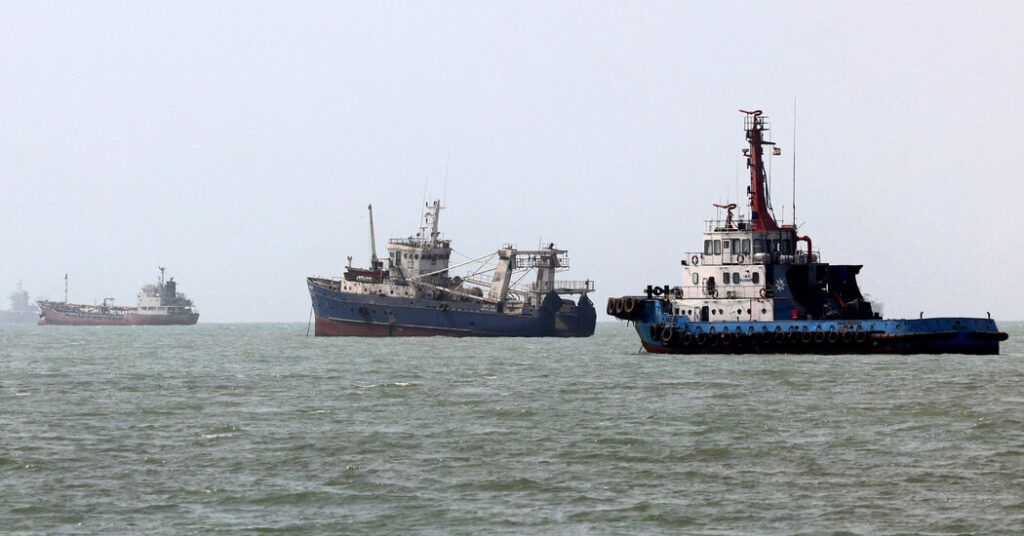
The price of oil continued to climb on Tuesday, reaching $90 a barrel for the first time in two weeks as the stalemate over the Iran war hardens and commercial shipping in the Strait of Hormuz dwindles.
President Trump said on social media on Monday that he had told his aides to demand compensation from Iran “for all of the people that they have killed and gravely wounded with their roadside bombs and many conflicts.”
The statement seemed to be a response to a set of demands that Iran made on Monday, claiming the strait would remain closed until the United States lifted its naval blockade in the region.
Brent crude, the global benchmark, jumped 1.6 percent on Tuesday, touching $90 a barrel before for receding to about $88. West Texas Intermediate, the U.S. benchmark, was up 1.8 percent to a little over $83 a barrel.
As the war has dragged on into a sixth month, shipping in the strait, a narrow path between Iran and Oman that once carried as much as one-fifth of the world’s oil supply, has been brought to a near standstill.
Only a handful of oil tankers have navigated the Strait of Hormuz since the weekend, according to data from the maritime firm Kpler. And many ships are cloaking their identity to avoid being detected, a practice that has been common since the war began. Before the war, about 130 ships sailed through the waterway every day.
At the same time, an alternate route for exports using the Red Sea, deployed by Saudi Arabia since the start of the war, has gotten more dangerous. The Houthis, an Iranian-backed militia in Yemen, have threatened to block Saudi ships in the region. Traffic through the Bab al-Mandab Strait, on the Red Sea’s southern end, has been stable, despite the uncertainty. There were 36 confirmed crossings of the strait on Monday, one more than the day before, Kpler said.
Activity in that part of the sea downshifted to its current pace in 2023, when the Houthis launched attacks on shipping in response to Israel’s war in Gaza.
In the United States, the disruption to energy flows from the Middle East has translated into elevated gasoline costs. The average price of gasoline stayed flat on Tuesday at $4.11 a gallon, a 38 percent increase since the war started.