

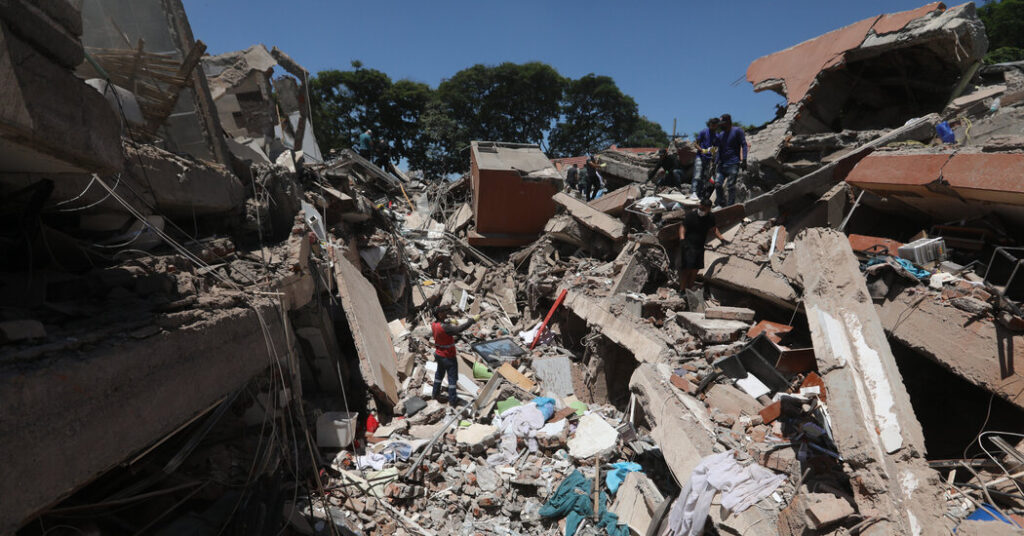
A powerful earthquake rocked western Colombia on Monday morning, rattling much of the country and setting off a desperate search for survivors in the rubble of collapsed buildings in several major cities.
At least 111 people were killed and 87 others were injured, according to Colombia’s president, Abelardo De La Espriella, who said that at least 1,575 homes, 18 health centers and 52 schools had been damaged. The death toll was likely to rise as rescue crews and residents continued to dig through flattened buildings.
The 7.4-magnitude earthquake, which struck at 7:34 a.m. local time, was the strongest recorded in Colombia in the last decade, according to the Colombian Geological Survey. The agency said that two aftershocks with magnitudes of 2.8 and 4.8 had been recorded and that the quake was felt in neighboring countries, including Panama, Ecuador and Venezuela, which is still recovering from devastating twin quakes just weeks ago that killed more than 6,000 people.
The epicenter, according to the U.S. Geological Survey, was about 3 miles east of San José del Palmar, a town of about 5,000 people in the Chocó region, one of the poorest parts of Colombia.
Videos showed partially collapsed buildings in Cali, Colombia’s third largest city, with about two million residents, as well as in Pereira and Manizales, two cities that are hubs of Colombia’s coffee-growing region.
In the town of Calima El Darién, three children were killed when a wall collapsed, according to the region’s governor, Dilian Francisca Toro. Ms. Toro said that one hospital had also collapsed, another had been overwhelmed with victims and that patients had been evacuated from a third hospital.
The city of Pereira, which is home to about 500,000 people and lies just 35 miles from the epicenter, was also hard hit. The mayor, Mauricio Salazar, told a national radio station that at least 18 people had been killed there.
In Cali, Francisco González, 34, said he was riding on his motorbike when he saw a motel called the Molino Rojo crash to the ground in a cloud of dust. He immediately became part of a volunteer rescue effort involving 20 to 30 people clawing through the rubble to find survivors.
“A young woman, she had fractures in her legs, and she was the first one we got out,” he said. “Her husband came out from under her. He was in worse shape. He had passed out.”
Four survivors were pulled from the rubble, but Mr. González was worried that others might still be buried underneath. By midmorning, rescue workers were clambering over the rubble, calling down into holes, “Is there anyone there?”
At least 26 buildings in Cali had collapsed, according to its mayor, Alejandro Eder. He said that officials had dispatched rescue teams and were asking for donations of helmets, work gloves, water and safety goggles.
At the scene of one collapsed apartment building in Cali, residents used wooden poles and their bare hands to move slabs of broken concrete.
“Everyone went running to help,” said Eder Figueroa, 48, who said he lived in the building next door. “The lady who sells ice cream, the lady who sells juices.”
He added, “We think there are three people alive inside, because we can’t find them, including two children.”
In Cali, searches at several collapsed buildings were punctuated by calls for silence as rescue workers and civilians strained to hear the cries of survivors.
The quake presented an immediate challenge for the president, Mr. De La Espriella, a right-wing lawyer with no previous political experience, who took office on Friday. He had campaigned on a promise to shrink government and crack down on resurgent armed groups and rampant crime and earned the endorsement of President Trump, who had repeatedly clashed with Mr. De La Espriella’s leftist predecessor, Gustavo Petro.
Mr. De La Espriella said on social media on Monday that he had “personally assumed leadership” of the emergency response to the quake. “You are not alone,” he wrote. “The state is present and taking action.” He later briefed the public at a news conference and promised to provide updates every few hours.
Secretary of State Marco Rubio said on social media that the Trump administration “stands ready to support the people of Colombia” and the De La Espriella administration.
In the capital, Bogotá, about 150 miles from the epicenter, Mayor Carlos Fernando Galán said preliminary inspections had found no structural damage from the earthquake. He added that Bogotá was preparing to send 100 rescuers and rubble-removal equipment to harder-hit cities. “Now is a moment for solidarity,” he said in a video on social media. “Bogotá is ready to help however it can.”
Reporting was contributed by Jaír F. Coll, Annie Correal, Anushka Patil and Richard Pérez-Peña.