

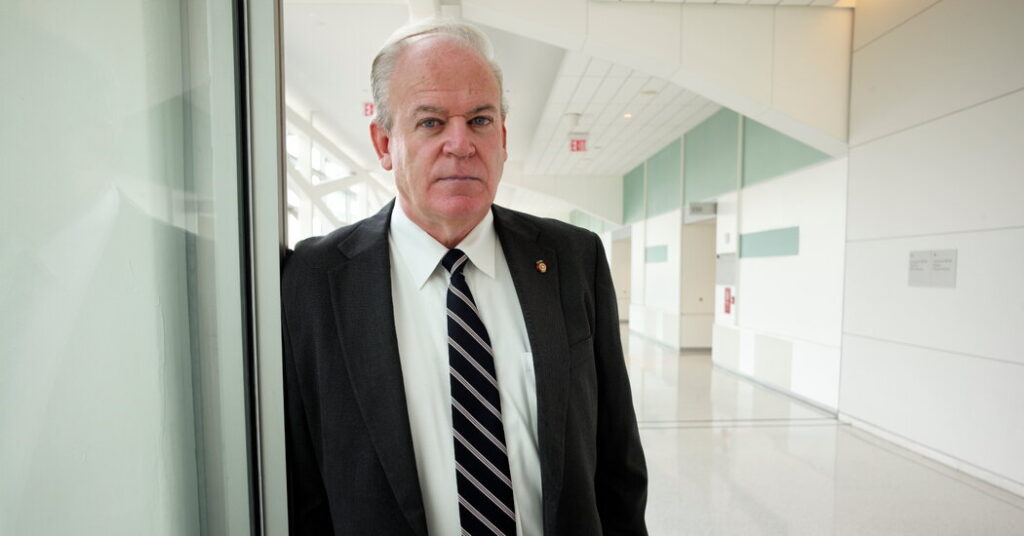
John O’Malley, a federal investigator in Manhattan who used years-old confessions to exonerate five people convicted of murdering a Bronx livery-cab driver, died on July 16 at his home in Pearl River, N.Y., in Rockland County. He was 73.
His wife, Annie O’Malley, said the cause was leukemia, which she attributed to his exposure to toxins at ground zero when he was part of the investigation into the Sept. 11 terrorist attacks.
By 1995, when Mr. O’Malley joined the office of the U.S. attorney for the Southern District of New York, he had already worked with federal prosecutors as a Bronx homicide detective, helping to pioneer the use of racketeering and other federal laws to convict members of murderous, drug-dealing gangs who couldn’t be taken down by state law.
“No one was more responsible for cleaning up the streets of New York, or at least the Bronx — more than you can possibly imagine — than John O’Malley,” Peter Forcelli, who worked with Mr. O’Malley as a fellow detective in the Bronx and as an agent of the federal Bureau of Alcohol, Tobacco, Firearms and Explosives, said in an interview.
In May 2012, Mr. O’Malley, the lead investigator in the violent crimes unit of the U.S. attorney’s office, was handed a letter sent by Eric Glisson from Sing Sing prison in Ossining, N.Y. Mr. Glisson was seeking help in overturning his 1997 conviction for the murder of Baithe Diop, a Senegalese immigrant who drove a livery cab, in the Soundview neighborhoodof the Bronx, where Mr. O’Malley grew up.
Mr. Glisson and Cathy Watkins, a woman Mr. Glisson did not know, had been convicted of second-degree murder in one trial; three others had been found guilty of the Diop murder and another killing in a separate trial.
But Mr. Glisson, who had maintained his innocence, suspected that Mr. Diop had been killed by someone from the violent Sex Money Murder gang that operated in his neighborhood.
His description of the crime reminded Mr. O’Malley of something he had been told during an investigation in 2003. Gilbert Vega, a cooperating witness who had been part of the gang, said that he and Jose Rodriguez, a fellow gang member, had robbed and shot a driver in late 1994 or early 1995 but were not sure if they had killed him.
Mr. Rodriguez corroborated the account, telling Mr. O’Malley and a prosecutor that he had assumed no one would ever find out about the robbery because only he and Mr. Vega knew about it, Mr. O’Malley wrote in his 2012 affidavit arguing for a new trial for Mr. Glisson and Ms. Watkins.
“John had a deep sense of what’s right and what’s wrong,” Judge Margaret Garnett of the U.S. District Court and a former chief of the U.S. attorney’s violent crimes unit, said in an interview. “If an innocent person is in prison, that undermines what we do.”
Jonathan Green, the author of “Sex Money Murder: A Story of Crack, Blood and Betrayal” (2018), said that Mr. O’Malley had a talent for flipping felons.
“He was raised in the Bronx, and he was able to get these guys to talk to him, which was very difficult,” Mr. Green said in an interview. “But he was from Soundview, where Sex Money Murder was from; they trusted him.”
In late 2012, the Bronx district attorney’s office vacated all five convictions. It was one of several exonerations that Mr. O’Malley was involved in during his career. The five received a combined $40 million from the city to settle civil rights suits claiming that they had been wrongfully convicted.
John Patrick O’Malley was born on Oct. 20, 1952, in the Bronx. His father, John B., was an insurance agent, and his mother, Marion (Hastings) O’Malley, managed the home.
Three of his uncles and two of his cousins served in the Police Department, so his career path seemed inevitable. When his uncle Jack visited the O’Malley home, John would admire his detective shield and bullets.
“When I look back at my yearbooks, it’s ‘Good luck on the N.Y.P.D. Good luck on the F.B.I.,’” he told Peter Moskos for “Back from the Brink: Inside the N.Y.P.D. and New York City’s Extraordinary 1990s Crime Drop” (2025). “When I turned old enough, it seemed like I was taking a test at least once a month for some kind of police department.”
He joined the police department in the Bronx in 1974, but was among more than 5,000 officers laid off the next year, as the city’s finances cratered. After two years of driving a cab — during that time he met his future wife — he was rehired in 1977. He was promoted to detective 10 years later.
One of his cases involved a gang called the Cowboys: white mobsters who disguised themselves as police officers and “arrested” Black drug dealers, holding them for ransom. In 1993 — after seven gang members had been convicted on federal racketeering and murder charges — Mr. O’Malley told The Daily News that whenever ransom had not been demanded, the victims had simply been handed over to the gang’s enforcers to be killed.
The case was the first major violent crime investigated entirely by the New York Police Department that was brought to the Southern District for prosecution.
“It kicked off a whole series of cases that we made on that model,” said Elizabeth Glazer, a former chief of the office’s organized crime unit. “John was the linchpin of the whole enterprise, between homicide detectives throughout the city, cooperators, prosecutors, district attorneys’ offices and federal agents.”
Although Mr. O’Malley flipped a few of the Cowboys, his efforts failed to persuade one in particular to cooperate in exchange for a reduced sentence; the man didn’t want to be labeled a snitch.
But after his release, he asked to meet Mr. O’Malley. “The guy was very grateful that John had tried to get him out,” Ms. Glazer said, “and stayed in touch throughout the years.”
Two weeks before Mr. O’Malley’s death, his wife said, he received a text from the man: “I want to tell you how important you’ve been to me.”
One or two of the men that Mr. O’Malley had flipped would call him every year to wish him a happy Father’s Day, Ms. O’Malley said, adding that her husband retired from the U.S. attorney’s office in 2015 to be a “full-time grandpa.”
In addition to his wife, Mr. O’Malley is survived by two sons, Daniel, a detective with the Greenburgh Police Department in Westchester County, and John, a TV sports producer; five grandchildren; and two sisters, Susan Gorassi and Kathleen Kelleher.
Soon after Mr. Glisson was freed, he met with Mr. O’Malley and Ms. Garnett to thank them.
“I feel weird when he’s thanking me for doing the job I was supposed to do, because it was something that shouldn’t have happened — and it did happen,” Mr. O’Malley said on “Doing Justice,” a podcast hosted by Preet Bharara, the former U.S. attorney for the Southern District of New York who wrote a book in 2019 of the same name. “And I just felt bad for him.”
At the repast after Mr. O’Malley’s funeral, Mr. Glisson recounted the story of his exoneration — and Mr. O’Malley’s role in it.
“He got a standing ovation,” Ms. O’Malley said in a text. “It was for him, brave enough to stand up and tell his story, and for my husband, who was the one who got him out of jail.”