

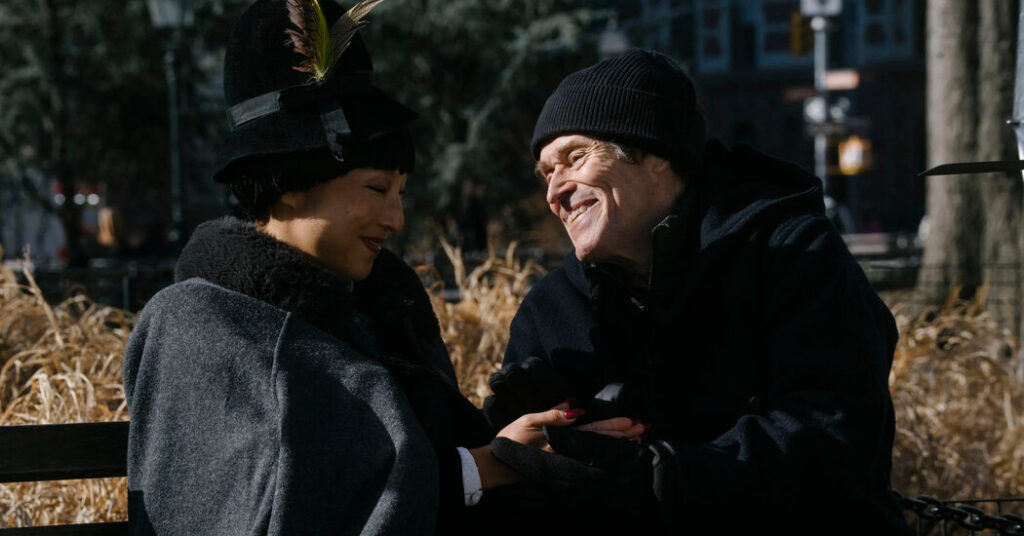
For a young person longing for the artist’s life, there’s nowhere like Greenwich Village, haunted by the ghosts of painters and beat poets who seem to have lived in a more magical time. When I first moved to New York City, only vaguely interested in writing but definitely coveting the trappings of a literary existence, I bought my first pocket Moleskine. I’d scribble down observations about the world on my lunch break, imagining it made me more interesting than the average corporate drone.
Ed Saxberger (Willem Dafoe) passed that stage of his life many decades ago. In 1979, when he was a recent Manhattan arrival and not yet out of his teens, he wrote and published a book of poetry titled “Way Past Go,” and it earned him a brief moment of modest fame. He knew some celebrity poets, a little. There was even an article about him in the Village Voice.
But to borrow a line from Tony Soprano, Ed feels a little like he came in at the end of something, and the best was over almost before he got there. His poetry days have long subsided, and he’s been working at the post office for almost 40 years, living in a small apartment with his books and recordings of poetry. After work, he eats a tuna fish sandwich, or he heads to his local dive bar to shoot pool with his friends, who have no idea that he was ever a poet.
Here’s who does know: Wilson Meyers (Edmund Donovan), a very earnest young man who recently finished his master’s degree at New York University (in the self-designed Virtues of Style, Rhetoric and Voice) and happened upon “Way Past Go” in a bookstore. Having learned Ed lives near him, he hunts him down and tries to get him to come meet his friends, a group of aspirationally literary young men (played with charming authenticity by Clay Singer, Arthur Langlie, Graham Campbell and Luca Padovan). Meyers — the group all call each other by their last names — has named the crew “The Enthusiasm Society,” and they are devoted to “standing against negativity, vulgarization, the monetization of everything, the coarsening of culture.” They drink sloe gin fizzes and espresso at a cafe on LaGuardia Place. Some of them wear suspenders and hats.
Ed is charmed by them, but especially taken with Gloria (Greta Lee), an actress and singer who hangs around with “her boys” and affects the kind of airs you’d expect from a bohemian muse in years gone by. So he keeps showing up, and agrees to write a new poem for a reading the group wants to put on to counteract the delusional trappings of late-stage capitalism and the degrading effects of “sociopath media.”
Still waters run deep with Ed, whom Dafoe — no stranger to downtown New York art scenes — plays almost without seeming to act. He is amused and a little flattered and also reminded of his own youth, when the world felt enchanted, and Dafoe lets this all roll across his extraordinary face. You’re meant to feel it along with him when Gloria remarks that he must have been so beautiful when he was young.
“Late Fame” is directed by Kent Jones from a screenplay by Samy Burch, who previously earned an Oscar nomination for writing “May December” (and also wrote the script for the upcoming Looney Tunes comedy “Coyote vs. Acme”). It’s based on Arthur Schnitzler’s 19th-century, Vienna-set novella, first published in the United States in 2017. (This is too good not to mention: Schnitzler also wrote the novella upon which “Eyes Wide Shut” is based.) The story seems right at home in 21st-century New York, perhaps because the sort of young person who valorizes Ed, a relatively unknown poet, will always exist wherever there are eager youths.
Jones handles the setting with a light and confident touch; having previously worked as a critic and, from 2013 to 2019, as the director of programming for the New York Film Festival, it’s clear he knows the milieu. There’s an appealingly naturalistic style to Jones’s direction, despite the posturing of most of its characters: the Enthusiasm Society guys, who rail against influencers while spending their own parents’ money, are dying to seem more cultured than they actually are, and Gloria attacks every moment with the put-on flourishes of a cabaret star. In their company, Ed seems like an alien floated in from another world, free of all airs.
Jones and his cinematographer Wyatt Garfield shoot in many familiar places on the streets of the Village (you can spot an out-of-focus Film Forum in the background across from Ed’s house), often with a hand-held camera, imbuing “Late Fame” with the feeling of art-house New York films shot on the fly in years past. The style matches the story; you can imagine a youthful Ed, and his young friends two generations later, crowding into a small theater to watch movies just like this one.
“Late Fame” is a story of a certain sort of wistful foolishness, affectionately told. It would have been simple to just satirize the poseur leanings of the young, to laugh at the ways they are building their brand as much as any social media star they despise. It might have been equally tempting to make Ed’s fascination with them feel tragic. But a loving and lovely sensibility runs through “Late Fame,” a fond and wise understanding of why some people want to become artists without making much art and why other people quit making it altogether. Still, they seem to keep coming back to New York, generation after generation.
Late Fame Not rated. Running time: 1 hour 36 minutes. In theaters.
The post ‘Late Fame’ Review: Lost Poet, Found Again appeared first on New York Times.