

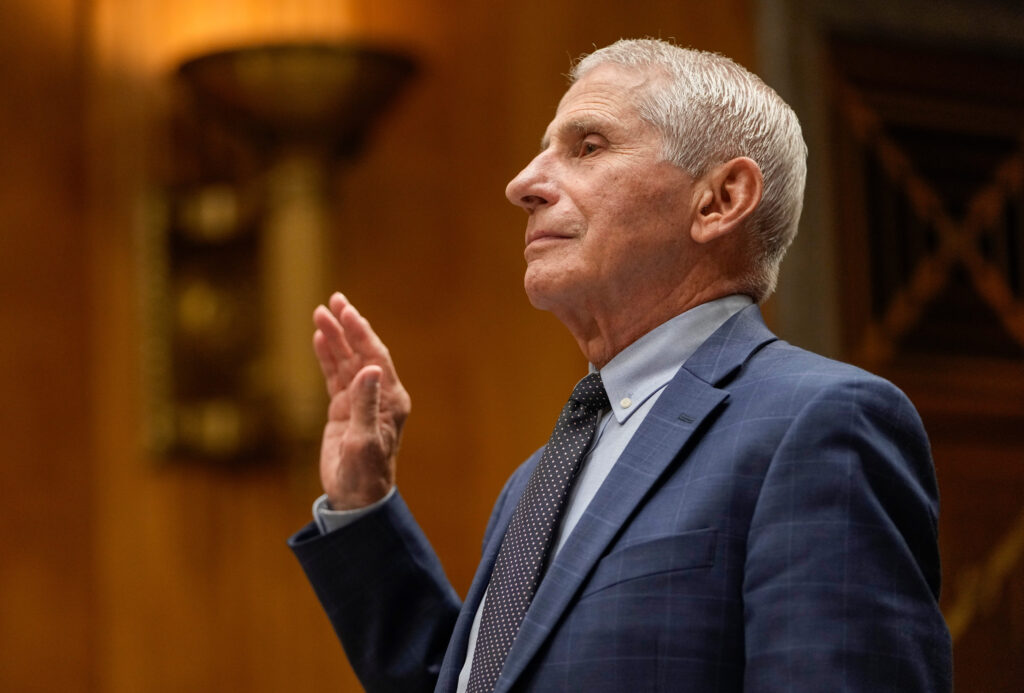
Anthony S. Fauci should have been forthright during his Senate appearance last week, offering a full explanation of his past misstatements and reflecting on lessons learned during the pandemic. But he had legitimate reasons — and constitutional protections — for staying tight-lipped.
A Senate committee voted Thursday along party lines to approve a resolution holding Fauci in contempt of Congress for invoking his Fifth Amendment right against self-incrimination 111 times. It would be an abuse of prosecutorial power if the Trump administration uses this stunt to pursue criminal charges against the 85-year-old.
Fauci explained that he would not cooperate with the committee because its chair, Sen. Rand Paul (R-Kentucky), had an “obvious obsession” with trying to engineer his prosecution.
Paul has argued that Fauci’s refusal to testify amounted to an obstruction of Congress’s investigative authorities. “A subpoena with no consequence is not a subpoena,” Paul said on Thursday. “It’s a suggestion.”
But Fauci did comply with the subpoena. Unlike Peter Navarro and Stephen K. Bannon, who were convicted of contempt of Congress after refusing to appear before the House’s special committee to investigate the Jan. 6, 2021, riot at the Capitol, Fauci endured hours of public humiliation from Republican lawmakers as he repeatedly claimed the Fifth.
The more complicated legal question is whether Fauci had a right to invoke that right after President Joe Biden granted him a preemptive pardon before leaving office. But that does not stop prosecution at the state level. Three Republican state attorneys general have opened a probe against him.
Given the repeated statements by Paul and other leading Republicans that Fauci deserves to be behind bars, the former director of the National Institute of Allergy and Infectious Diseases had reasonable fears that anything he said would be used against him.
It’s still unclear whether the contempt resolution will lead to criminal charges. The resolution has no chance of passing the full Senate, which would require 60 votes. Nevertheless, Paul has indicated he will refer the matter to the Justice Department. But prosecutors would have a difficult time convincing a jury, especially in D.C., that Fauci should be imprisoned for contempt when the Senate didn’t pass such a resolution.
In any case, this will do nothing to help the public understand the origins of the coronavirus or what went wrong in the government’s response. That’s a shame, because Fauci has a lot to answer for: He was slow to accept the airborne transmission of the coronavirus, and his guidance kept millions of kids out of school for far longer than was necessary. There are also questions about whether the agency he led at the National Institutes of Health supported research that altered coronaviruses in Wuhan, China, where the pandemic began.
Covid was hugely disruptive for society, and it is fair game for Congress to exercise oversight. Indeed, lawmakers should have done so years ago in a bipartisan way. But this contempt vote was clearly less about illuminating what happened than exacting revenge.