

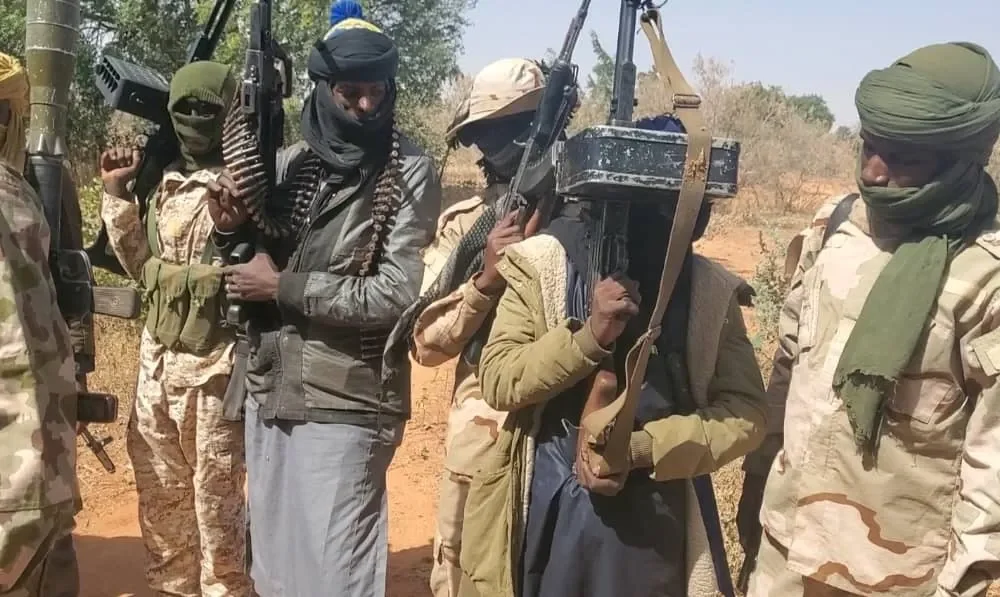
Nigeria’s security crisis is widening as insurgents, criminal networks and politically linked armed groups continue to exploit weaknesses in state security across several regions, SBM Intelligence has warned.
The warning was contained in the latest security analysis by the research organisation, which reviewed recent incidents involving Boko Haram and the Islamic State West Africa Province (ISWAP) in the North-East, Lakurawa in the North-West, armed groups in the South-East and criminal networks across the South-South and South-West.
SBM said although recent military operations had weakened some insurgent and criminal networks, the groups remained capable of adapting, regrouping and exploiting poorly protected communities.
According to the report, recent incidents point to a security environment in which non-state armed groups are taking advantage of weak local intelligence, difficult terrain and gaps in government presence.
“The common thread connecting the VIP ambush in Abia State and the political abduction in Ebonyi State is the dangerous proliferation of non-state armed groups operating with high mobility across rural community boundaries, exploiting weak local intelligence systems,” SBM said.
The organisation noted that Boko Haram factions operating around the Sambisa Forest were increasingly carrying out opportunistic raids on communities on the forest’s fringes to obtain food, medical supplies and cash as military operations disrupted their established supply lines.
READ ALSO; Lakurawa terrorists allegedly take over Mosque, exposes rural security gaps
SBM also examined the escape of an inmate from the Maiduguri Maximum Security Custodial Centre, suggesting that the incident was more likely linked to insider compromise or institutional laxity than an externally coordinated jailbreak.
The report further raised concerns over Lakurawa’s growing activities in Zamfara and Sokoto, saying the group was exploiting communities already weakened by banditry to establish influence, raise resources and compete for territorial control.
The assessment followed the reported neutralisation of 38 Lakurawa fighters in Gummi, Zamfara State. SBM said the operation could temporarily limit the group’s capacity to launch attacks as surviving members regroup, but warned that the militants could respond by targeting softer and less-protected communities.
According to the report, Lakurawa’s activities in Gummi and surrounding communities have included cattle rustling, looting and attempts to build influence through religious preaching.
In Sokoto, SBM linked the killing of civilians in Tambuwal to the group’s ability to sustain its operations through cattle theft and attacks on commercial establishments.
The organisation expects tensions to remain elevated in parts of Sokoto and Zamfara as security forces intensify operations against Lakurawa.
In the South-South, SBM said criminal networks were increasingly relying on kidnapping, extortion and oil theft rather than large-scale militancy, creating a persistent but less visible security threat.
The report urged security agencies to sustain pressure on insurgent and criminal groups while strengthening intelligence gathering and government presence in vulnerable communities.
The latest assessment comes amid a series of violent incidents across the country.
Among the most high-profile was the mass abduction at St. Mary’s Catholic School in Papiri, Niger State, where armed gunmen reportedly abducted more than 300 students and 12 teachers in late November. Security forces subsequently secured the release of some of the victims, while others remained in captivity.
In Kebbi State, gunmen attacked the Government Girls Comprehensive Secondary School in Maga, killing the vice principal and abducting about 25 schoolgirls.
The United Nations also reported that at least 1,932 people were killed across Borno, Adamawa and Yobe states between April and June 2026, amid continuing insecurity and attacks on humanitarian personnel.
On May 15, armed men reportedly attacked three schools in Ahoro Esiele/Esiele and Yawota communities in Oriire Local Government Area, abducting several students and teachers.
The impact on education has remained severe. Save the Children International has estimated that at least 1,683 learners were abducted across Nigeria between 2014 and 2022, while UNICEF said insecurity forced the closure of 11,536 schools during the 2020/2021 academic session, disrupting the education of about 1.3 million children.
In July, SBM Intelligence warned that armed groups were shifting their operations to new locations as military pressure intensified, contributing to rising kidnapping, mob justice and illegal oil-refining activities.
The latest figures cited by SBM showed that Nigeria recorded 106 violent conflict incidents, resulting in 445 casualties and 256 kidnapping victims between July 26 and August 8, 2026.
The figures, according to the assessment, underline the increasingly fluid nature of Nigeria’s security threats and the need for stronger intelligence-led operations, community engagement and sustained state presence in vulnerable areas.