

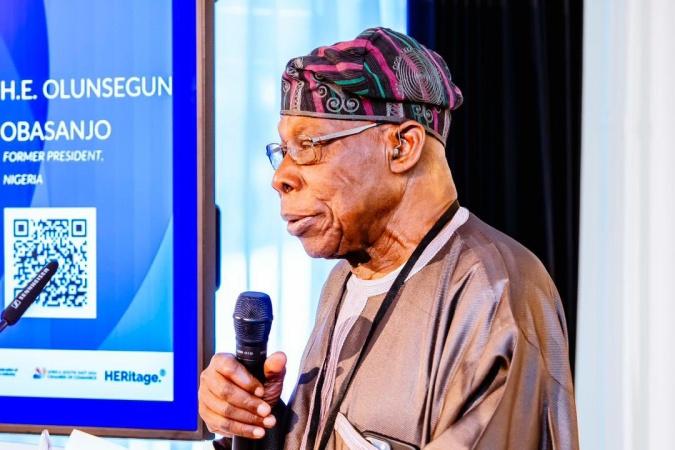
Former President Olusegun Obasanjo has described his decision to choose former Vice President Atiku Abubakar as his running mate in the 1999 presidential election as the greatest mistake of his time in office.
Obasanjo made the remark during a fireside conversation with veteran entertainer and activist Charles Oputa, popularly known as Charly Boy, at the launch of Charly Boy’s foundation and memoir, 999: A Memoir in Tribute to Late Justice Chukwudifu Oputa, held in Lagos.
Responding to a question about the biggest mistake of his presidency, the former Nigerian leader reflected on his years in office and said that while every administration makes difficult decisions, selecting his deputy remains the one he regrets most.
According to Obasanjo, he would never have made the same choice if he had known then what he later came to know about Atiku.
“The man I picked as my running mate, my number two. If I had known him as I came to know him later, I would not have picked him,” he said.
When Charly Boy sought clarification on whether he was referring to Atiku Abubakar, Obasanjo confirmed that he was speaking about his former vice president.
Despite his criticism, the former president maintained that he bears no personal grudge against Atiku, saying each of them acted according to their convictions while in government.
“There’s no bitterness because he did what he believed he should do, and God did what God had to do,” Obasanjo stated.
The comments revive one of Nigeria’s longest-running political rivalries, which has shaped the country’s democratic landscape since the return to civilian rule in 1999.
Obasanjo and Atiku were elected on the platform of the Peoples Democratic Party (PDP) and served together from 1999 to 2007. Their administration initially projected a united front, with Atiku playing prominent roles in economic reforms, privatisation programmes and the National Economic Council.
However, the relationship deteriorated significantly during Obasanjo’s second term after Atiku opposed efforts by allies of the president to amend the Constitution to allow a third presidential term.
The disagreement eventually escalated into a fierce political battle that included court cases over the powers of the vice president after Atiku defected from the PDP to the then Action Congress ahead of the 2007 elections.
The Supreme Court later ruled that an elected vice president could not be removed by the president, allowing Atiku to complete his tenure.
Since leaving office, both leaders have repeatedly exchanged accusations over corruption, loyalty and governance.
Although they briefly reunited ahead of the 2019 presidential election when Obasanjo endorsed Atiku’s presidential bid, the alliance did not last, and both politicians have since resumed separate political paths.
Obasanjo’s latest remarks are expected to reignite political debate as preparations for the 2027 general election continue.