

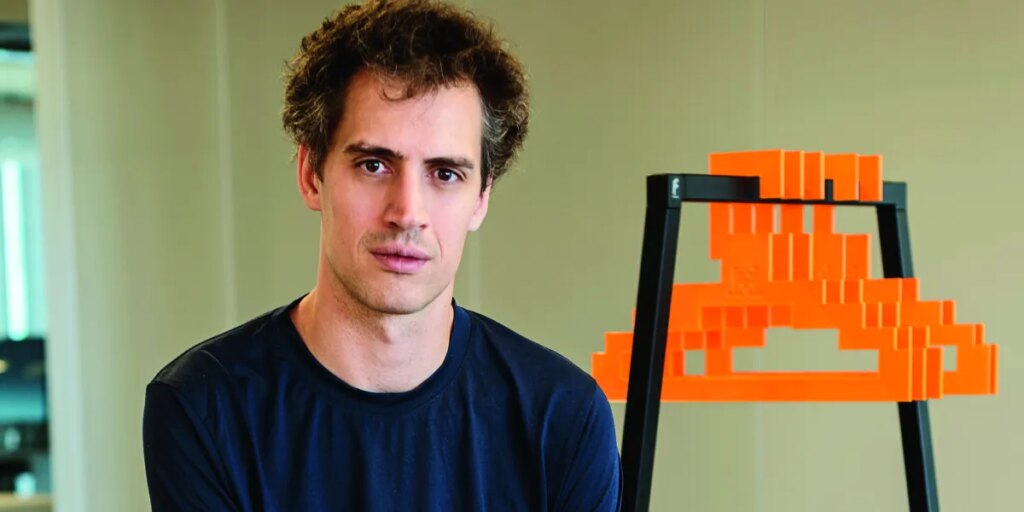
In May, Arthur Mensch walked into a largely empty hearing room to deliver an urgent warning to the French National Assembly. For 90 minutes, the CEO of Paris-based AI company Mistral laid out his case to a small, scattered audience of lawmakers: Europe had roughly two years to build its own AI infrastructure or risk becoming a “vassal state,” permanently dependent on American technology. France could not allow foreign AI models to become enmeshed in the country’s armed forces. That kind of dependency, he warned, would be “irreparable.”
Just one month later, a snap decision in Washington, D.C., proved Mensch’s point for him.
In June, the U.S. Commerce Department temporarily cut off foreign access to Mythos, a powerful AI model developed by Mistral’s San Francisco–based rival Anthropic. European firms and governments had been scrambling for access to the Anthropic model because of its advanced cyber capabilities: Tests showed the model could not only find software vulnerabilities but also exploit them autonomously, running full attacks end-to-end.
Those same capabilities let defenders spot flaws and build patches before adversaries gained access to AI as advanced as Mythos. Given the national security stakes, the prospect of foreign governments being able to suspend access to critical models at a whim started to feel like an unacceptable risk. Suddenly Mistral—the front-runner among Europe’s handful of frontier AI builders—looked like Europe’s most viable alternative.
“It’s been a validation of what we’ve been warning our customers about,” says Mensch, a tall 34-year-old with slightly ruffled brown hair who is dressed in a simple white T-shirt when he appears via video link. “Make sure that you can actually own that technology … so you know that you’re not going to be turned off from one day to another.” The big question is whether Mistral is actually ready to take up the mantle of European AI champion that so many desperately want it to seize.
Despite its sovereign AI rhetoric, Mistral remains somewhat dependent on U.S. technology for chips and cloud-computing infrastructure. It recently announced an expanded strategic partnership with Microsoft. Perhaps more critically, Mistral’s AI models also aren’t currently competitive with the bleeding-edge American AI systems from Anthropic, OpenAI, or Google DeepMind, or even models from some Chinese AI powers.
There are even questions over whether Mistral wants to be cast as Europe’s sovereign AI savior. Despite raising the alarm about the continent’s need for sovereign AI, Mensch is careful not to define Mistral as merely a regional champion, instead positioning the company as a global AI player. Around 40% of Mistral’s revenue comes from the U.S. and other non-European clients.
Skepticism about Mistral’s ability to compete on the global stage has dogged it for years. Now, a new era of politics and a shift in large enterprises’ approach to purchasing AI models may have given Mistral the perfect opportunity to prove its doubters wrong.
Mensch grew up near Paris and is the son of a teacher and a software engineer. From an early age, it was clear he’d inherited his father’s aptitude for math and science. “I guess the apple doesn’t fall too far from the tree,” Mensch says.
He went on to attend the elite French engineering schools École Polytechnique and Télécom Paris before he was hired by Google DeepMind in his late twenties. Not for the last time in his career, Mensch’s timing was impeccable. At 30, he quit his lucrative job to start Mistral with old college friend Timothée Lacroix and Meta alum Guillaume Lample. Mistral was formally founded in April 2023, just five months after ChatGPT’s launch sparked the AI frenzy.
At the time, Mistral was filling what many in the sector saw as a gap in the European AI ecosystem: the absence of a homegrown research lab capable of competing with the U.S. front-runners racing to build large language models. The three founders describe their motivations for founding the company similarly: a desire to “open up” and democratize the same closed-source technology they had been building for American labs.
Mistral appeared off to a promising start. In 2023, a month after it was founded, it closed a €105 million ($120 million) seed round with backers including U.S. VC firm Lightspeed Venture Partners and former Google chief Eric Schmidt. Three months later, it released its debut model, Mistral 7B—a freely downloadable model that beat Meta’s Llama 2 13B on benchmark tests despite being about half the size. In December, Mistral capitalized on its early successes, closing a €385 million ($440 million) round that pushed its valuation past €2 billion ($2.3 billion).
To date, Mistral has raised roughly $4 billion, according to PitchBook data, and is now worth roughly $23 billion. Anthropic, which is currently the world’s most valuable AI startup, was recently valued at $965 billion, more than 40 times Mistral’s size, while OpenAI sits at $852 billion, roughly 37 times.
That funding chasm may partly explain why, by late 2025, Mistral seemed to have hit a slump. Notably, it didn’t release a reasoning model—a type of AI that works through a problem step by step before answering, and the year’s biggest differentiator—until June of that year. Even then, the model trailed one from China’s DeepSeek.
In December, Mistral pushed back with its Mistral 3 range of models. These include a flagship model, Large 3, and a set of smaller Ministral 3 models that are efficient enough to run on a single GPU. Mistral hopes that this efficiency can be a key differentiator with its bigger, costlier rivals. However, on some benchmarks, Large 3 performs close to levels OpenAI’s models achieved a year and a half ago. Mistral argues that most real-world enterprise work doesn’t require bleeding-edge capabilities and that raw benchmark scores undersell its models—but on the hardest tasks, the gap with U.S. frontier models remains.
Recently, Mistral has been sharpening its pitch to business customers, investing in specialized models that excel at practical enterprise tasks, such as processing audio and reading text from scanned documents and images.
This better reflects how AI is used inside real companies, argues CTO Lacroix. Dressed in cargo shorts and a black T-shirt, he speaks from Mistral’s offices in Paris’s trendy Canal St.-Martin neighborhood during a record heat wave. The company’s meeting rooms, named after video game characters, are buzzing with employees eager to enjoy the air-conditioning—a rare luxury in Paris. “Everyone’s dream is to build the best models… but we have a bit of a more breadth-first approach than depth first, which is typically what you see with the Chinese [companies].”
Mistral is aiming to provide a service where enterprise workloads can run on smaller, specialized systems, while larger, more general models step in when tasks demand heavier reasoning or broader capabilities. That approach can reduce AI bills, making it easier for companies to predict and cap their AI spending rather than watching usage spiral. Over the past year, Mistral has grown its number of large enterprise customers to more than 100.
It’s certainly timely. Horror stories—including one Claude enterprise client that racked up a $500 million bill—have made executives skittish about allowing unlimited employee access to frontier AI. Meanwhile, the Anthropic saga has accelerated a shift toward model-agnostic workflows—where companies can swap different models in and out as the “brain” of the system. Building vital workflows on a single model feels riskier when that model can be pulled offline.
Analysts are generally optimistic about Mistral’s prospects, but say catching the leading American and Chinese labs on model quality alone will be hard. “The leading AI labs have been accumulating these tricks—even if the hardware was staying constant, they’re doubling or tripling the speed at which they can train models just by algorithmic tweaks,” says Stuart Russell, professor of computer science at UC Berkeley. While labs like Mistral are capable of catching up, he says, the real frontier advantage lies in the ability to move fast and test new ideas repeatedly, which requires access to a lot of computing power.
Mistral also appears to be following Palantir’s playbook—winning through deep, hands-on delivery with key customers rather than the mass adoption Anthropic and OpenAI have pursued. London-based hiring tracker Zeki Data found a third of Mistral’s 168 open roles are in enterprise go-to-market, a sign, it says, of Mistral leaning toward deeper integration with technical staff embedded in customer systems.
Most customers are already on “very large strategic” multiyear deals, says Marjorie Janiewicz, chief revenue officer at Mistral. She argues that these contracts, which pair efficient models with long-term transformation projects, give the company healthier unit economics than labs chasing short-lived pilots.
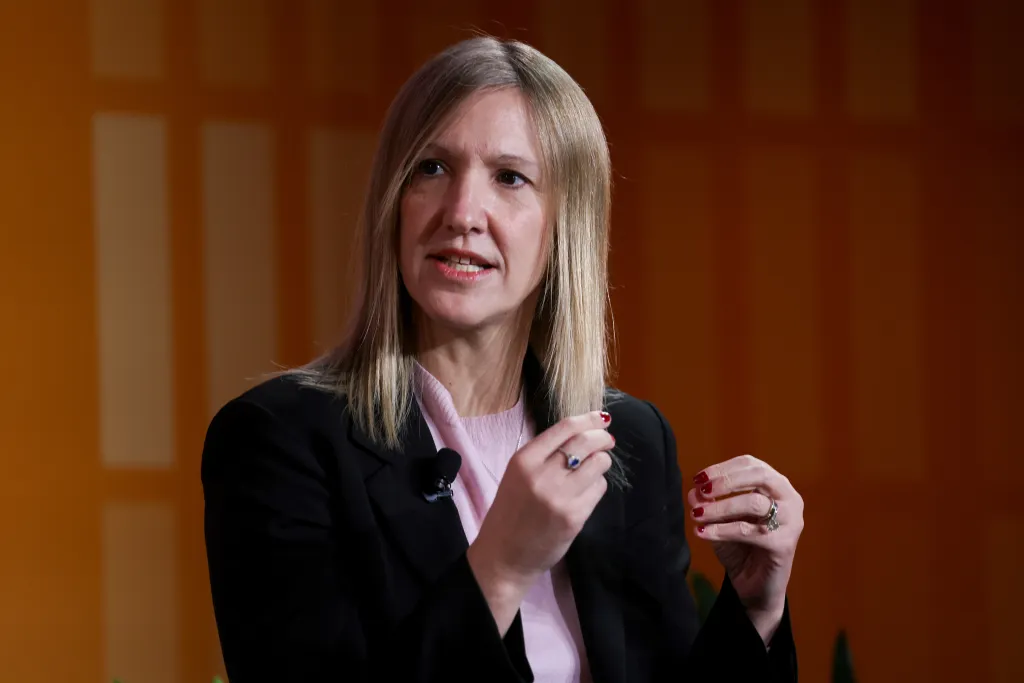
Mistral’s revenue growth shows that strategy may be paying off. Its annualized revenue run rate exceeded $400 million in 2025, and, as of early 2026, was on track to surpass more than $1 billion in revenue by the end of the year. (Despite that traction, Mistral’s sales pale in comparison to the $47 billion that is estimated to be Anthropic’s current annual revenue run rate.)
The company is also pushing into manufacturing. In May, it acquired Emmi AI, an Austrian startup specializing in physics-based AI for industrial engineering, which was previously valued at a reported €330 million ($377 million). The acquisition underpins deals with Airbus and BMW. Internally, the founders talk about a big bet on industrial engineering—using AI agents and physics-aware models to redesign and simulate physical systems, from factory floors to turbines and aircraft wings.
Mistral’s expanding verticals also include defense, a contentious territory as critics, including the pope, warn that the use of AI in battlefield decisions presents unacceptable risks and blurs accountability. “Inherently, this is a dual-use technology, because it’s a technology that allows us to process information, and warfare is all about processing information and taking the right decisions,” Mensch says in response to the controversy. “We would love for the world to follow the pope’s advice and be fully at peace, but it seems to not be the case.”
After Washington’s two-week shutdown of foreign access to Anthropic’s Mythos model, global governments have never been more receptive to Mistral’s arguments for AI independence.
Jordan Bardella, president of France’s National Rally and a member of the European Parliament, called the Mythos shutdown a reminder that AI is “a major issue of national sovereignty” and pushed for France to fast-track support for Mistral. Other European politicians fretted about national infrastructure and defense, with one comparing the loss of Mythos to Iran’s blockade of the Strait of Hormuz.
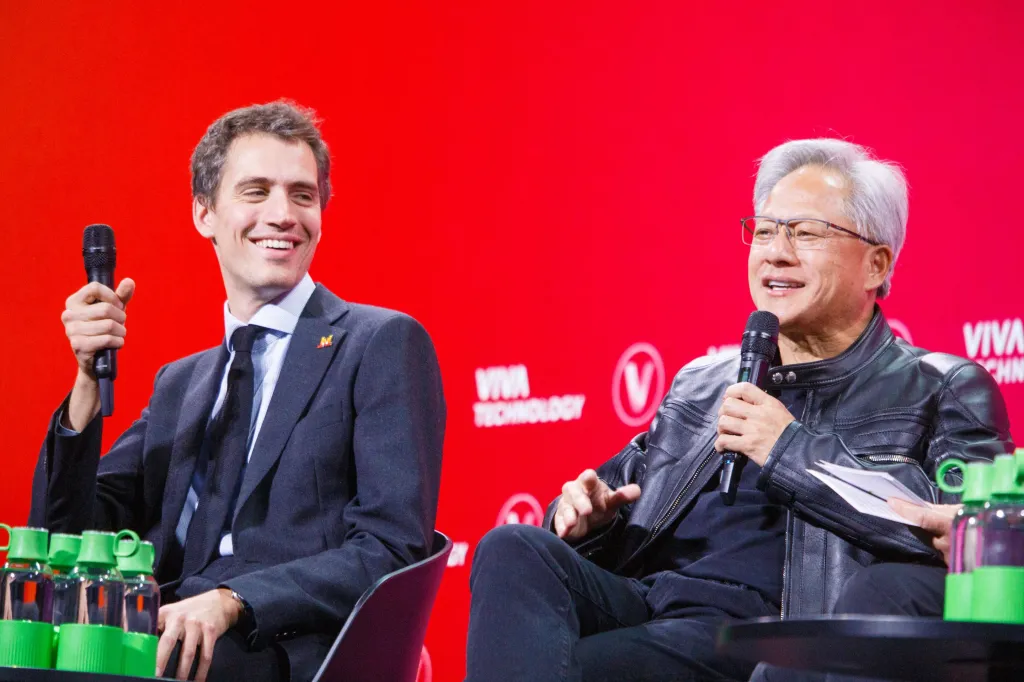
To bolster this pitch, Mistral has spent hundreds of millions building physical infrastructure. A data center south of Paris and a second site in Sweden are currently in the works. The company also plans to rent out that capacity as a cloud provider in its own right. In June 2025, it unveiled Mistral Compute, an Nvidia-powered European cloud platform—a deal French President Emmanuel Macron called “historic” when he announced it alongside Mensch and Nvidia CEO Jensen Huang at Paris-based tech conference VivaTech.
“We wanted to diversify our supply chain—we didn’t want all our compute to come from one provider,” Lacroix says. All of the new compute he describes still runs on Nvidia hardware, and building its own silicon isn’t on the table anytime soon. “Today, Nvidia is a great option,” he says. “But we’re looking for other chipmakers that know the work.”
For now, Mistral is in the same position shared by nearly every AI lab outside of China—controlling its models and data centers, but still forced to rent the underlying hardware from an American company. This is perhaps why Mistral is wary of the term “sovereignty,” which, in its current form, Mensch says, is based on a “misunderstanding.”
“Sovereignty is not about being isolated, it’s about having some decent weight on the value chain, and it’s about being able to have compounding effects—reinvesting [in] R&D, making sure that we grow on the technological level,” he says.
One odd side effect of the buzz is that Mistral has spent the past few weeks plagued by rumors about a giant cat. In mid-June, a fake Mistral model called “Le Chaton Fat”—French for “fat kitten” and a joking reference to Mistral’s former chatbot, Le Chat—began circulating on social media, complete with an invented benchmark chart claiming it beat Anthropic’s Fable 5.
While the model itself was fake, the memes pointed to a wider public hope that Mistral could provide a real alternative to the American labs. “It tells their expectations,” Mensch says of the fictional bot, “and we’re working to meet those expectations very soon.” Chief science officer Lample adds that Mistral has “a couple of new models” slated for release this summer.
However, other Mistral executives are trying to tamp down Le Chaton Fat–level expectations. “There cannot be truth to the claim, because they are as fat as the cat,” Lacroix says. “But we are building better large models, and we’re very excited about what we’re building.”
Over the past few years, every major AI lab’s chief executive has had to become something of a geopolitical actor—summoned to parliaments, G7 summits, and political debates, far removed from the product road maps that are the typical preoccupations of startup CEOs. If Mensch has joined their ranks, he’s done so reluctantly, often pulled along by President Macron.
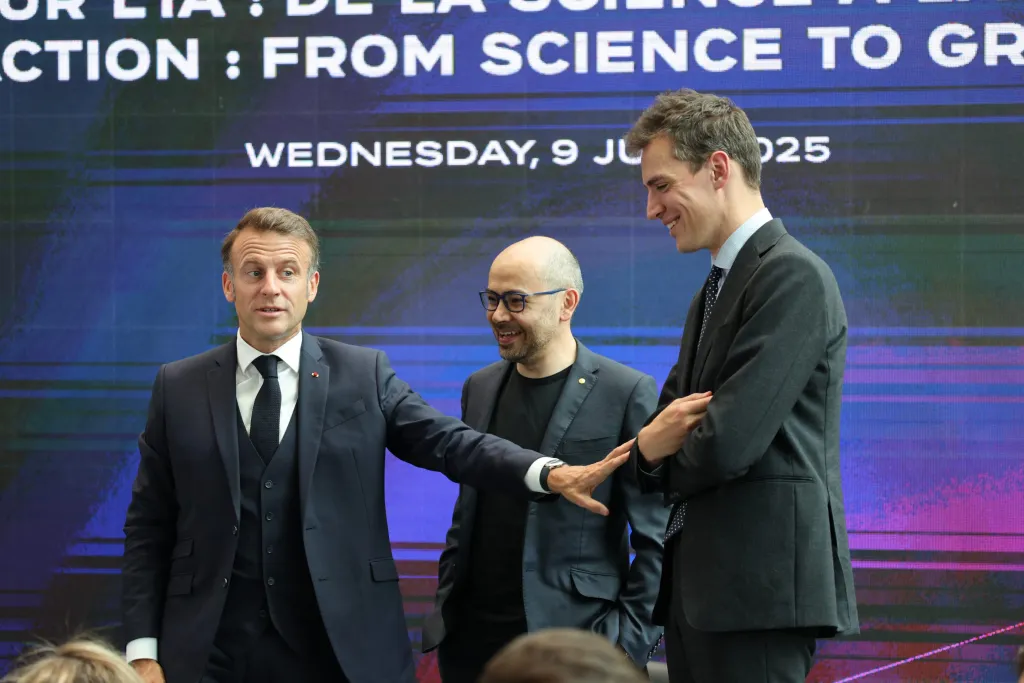
In June, at the G7 summit in Évian-les-Bains, Mensch appeared seated next to then–U.K. Prime Minister Keir Starmer. Also in attendance were U.S. President Donald Trump and the CEOs of OpenAI, Anthropic, and Google DeepMind. When asked if he’s political, Mensch says, “I see myself as a businessman.” However, he understands the influence AI holds. “AI is really about power: Your power as a country, your power as a company, depends on your AI strategy, so we get drawn into discussions that involve power, and in that respect we do a little bit of politics.”
Mensch has a certain Gallic candor that is uncommon among many tech CEOs. Beyond the debate over AI sovereignty, he has waded into other politically charged arenas. He has lobbied to loosen EU AI Act compliance thresholds, which, he says, fall disproportionately on smaller companies and nonprofits; warned lawmakers that AI-driven job losses “could not be dismissed”; pointed out how excessive dependence on AI could erode human expertise; and, perhaps most controversially, proposed a revenue levy on AI companies to compensate Europe’s creative industries. Some have criticized this plan as a way for AI companies to buy their way out of copyright liability for a fraction of what licensing would cost. Mistral itself has been accused by French publisher Nouveau Monde Éditions of training its models on pirated copies of its books. Mistral denies the allegations.
“There’s some tension between the AI space and the cultural space,” Mensch says. “We’re proposing a way to give some revenue to the cultural world, because inherently training models are about compressing knowledge, and they contribute to the world’s knowledge.”
Mistral has also faced political pressure from EU lawmakers who criticized the company over its strategic partnership with Microsoft in 2024. The deal drew an EU antitrust review over fears a foreign tech giant had gained outsized sway over Europe’s homegrown AI champion.
In the company’s early years, an advisory cofounder, Cédric O, a former Secretary of State in Macron’s government, also handled much of Mistral’s public affairs. His role drew scrutiny after he switched from supporting stricter tech regulation to lobbying against tougher EU AI Act provisions on Mistral’s behalf. French transparency authority, HATVP, ultimately found no issue with O’s transition from the public to private sphere. O has since stepped away from his formal advisory role, according to Mensch. “I see [Cédric] regularly. He’s a good friend,” he says.
For Mensch, much of the anxiety around AI comes down to a single question: Who benefits?
He sees the growing backlash against AI as less of a moral panic than a warning about the concentration of power. If only a handful of U.S. giants capture the spoils, he argues, resentment and instability will follow. “You want people to become prosperous on top of artificial intelligence,” he says. “One of the contributions we’re trying to make is to diffuse the technology so that it becomes more egalitarian.”
That mission is likely to appeal to European politicians now scrambling to chart an independent path through the AI boom. Mensch, for his part, doesn’t seem especially rattled by the geopolitical weight suddenly resting on his shoulders. When asked what the chaotic week after the Mythos shutdown was like for him personally, he shrugs it off as “more hectic for our customers than for us.”
Whether Mensch will embrace his role as a European champion or successfully chase his American rivals to AI’s bleeding edge is still an open question. But Mistral, which takes its name from a strong wind that blows from southern France, certainly has the wind at its back.
This article appears in the August/September 2026: Europe issue of Fortune with the headline “Meet Europe’s AI upstart taking on the U.S. tech titans.”