

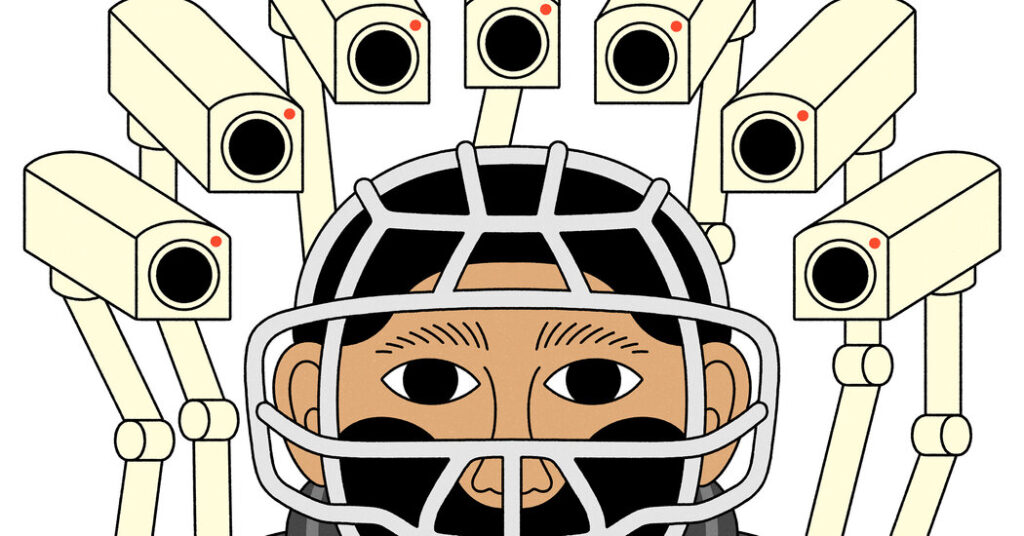
There are hundreds, maybe thousands, of things in the world today more pressing than the new robot umpire system installed by Major League Baseball, and yet I can’t help it: I find myself thinking a lot about those robots and how much I loathe them.
I feel something close to grief at the spectacle of humans behind home plate being usurped by the robots, and I can’t shake the suspicion that this needless tweak to our national game is somehow connected to all the darkness and dumbness we see around us.
A robot ump, of course, isn’t a robot. That’s just the simplest and most demeaning shorthand I can think of for what Major League Baseball calls A.B.S., the Automated Ball-Strike Challenge System, essentially 12 “Hawk-Eye” cameras snapping photos of every pitch in its flight to the batter. Artificial intelligence then analyzes those photos and predicts where the pitch landed, within a hundredth of an inch.
Right now the system only comes into play once or twice a game. Each team gets just two robot challenges per nine innings. (Sometimes a team winds up getting more, because challenges replenish when successful.) Still, everyone knows where this thing’s headed: Robot umps will soon decide every pitch of every ballgame, and human umps will be reduced to costumed extras, shambling around the periphery like Civil War re-enactors, only creepier and less relevant. It may not be the death of baseball, but it will be the death of a brand of baseball I’ve cherished my whole life, a loss I consider more than merely personal. I consider it ominous.
Baseball nerds love to make grandiose claims for the game’s galactic importance, so here comes one. Baseball, like the bumblebees, is a bio-indicator. When the game is good, the national life tends to be good. When the game is bad, watch out.
Artificial turf was invented in 1965, and in that same blighted year we had U.S. ground forces entering Vietnam, Selma’s Bloody Sunday, the Watts riots, the assassination of Malcolm X. …
Probably just a coincidence.
The one good thing to happen in 1965 was the Voting Rights Act, and it’s probably just another coincidence that the Supreme Court chose this Year of the Robot Umps to mutilate that milestone legislation.
“Don’t turn into George Will!” That’s how my friend Joe Rassenfoss replied when I texted him about my hatred of robot umps. Joe considers the Washington Post columnist and baseball connoisseur to be the exemplar of stick-in-the-mud Luddism. Later, Joe double-checked, and was stunned to discover that Mr. Will digs the robots. That gave Joe a moment’s pause, but he ultimately doubled down and maintained that robots are more accurate, more fair and thus better than the human alternative. He’s squarely in the majority, according to surveys, which only exacerbates my negativity.
It’s bad enough when dead-eyed oligarchs drag us kicking and screaming into their crypto-fascist dystopia, where robots numb our brains and nullify our humanity and launch all the nukes with a monotone whoopsie. But when we do it to ourselves? When we just willfully roll over and hand the robots our sacred pastime, that I don’t get. Why must we treat all technology as if it were foregone, irresistible, like the weather, rather than a choice we make with eyes wide open? Why can’t we see that blithely shrinking the domain and value of human work shrivels humanity itself?
Some will argue that baseball’s already lousy with A.I. — player development, game planning, nutrition, biometrics, scouting — but all that’s off the field. Until this season, robots hadn’t been permitted to breach the white lines.
Some will also insist that robot umps aren’t actually A.I., per se, because they’re not the generative A.I. that some experts lie awake worrying about, but that misses the point. Robot umps use algorithms and neural networks and computer vision and machine learning and make decisions that were once the exclusive purview of humans, and thus I feel fully justified in asking: Would it be so outrageous to keep one tiny corner of the planet — say, I don’t know, a baseball diamond — A.I.-free?
Maybe, on some level, all this was inevitable. We poisoned the oceans, fumbled the Republic, reduced genocide to a debate topic — maybe it was only a matter of time before we surrendered baseball with a subservient sigh to the nearest android: “Here, Hal, see what you can do with this.”
Truly, how pathetic it seems, and how excruciatingly Orwellian, that each time a player seeks aid from his robot overlords, he must, by rule, tap his head, the seat of human consciousness. Some executives at Major League Baseball must have a delicious sense of irony. Or, more likely, zero sense, which is why they greenlit this garbage.
Whether or not people like robot umps, my feeling is, so what? People like head cheese and Ted Cruz and “The Masked Singer.” People would like to sit naked in cedar hot tubs along the third-base line. Give the people what they want? That was the business model of vaudeville, and when’s the last time you met a vaudevillian?
Besides, since when does baseball, which ripped the Athletics away from hundreds of thousands of distraught Oaklanders, give a day-old Dodger Dog what people want?
As far as people go, baseball cares only about two discrete cohorts. First, Youngs. Baseball is more terrified of aging than your average Hollywood actor. The game will do anything to seem hip and cool to kids, which is doomed to fail because most kids can’t sit still for five minutes, and they think baseball is hella slow, bro.
The baseball commissioner, Rob Manfred, can’t accept this reality, however. Every morning he screams into his bathroom mirror: How in the Ford Frick can a three-hour ballgame compete with TikTok? That’s why he approved the pitch clock and other timesaving devices last year, all of which I applauded, by the way. I’m not reflexively anti-change. I don’t even mind video replay on the basepaths. Some bang-bang plays are too fast for the human eye, and that kind of video intervention can help the umps without showing them up.
My metric is simple. If it allows more “Field of Dreams” — good. But Field of Drones? Bad.
The second demographic baseball fixates on, sadly, is gamblers. And they’re the ones who’ve been bellyaching the loudest about human umps. Brad from St. Louis had a hundy riding on the Cards, and he was getting salty on his socials, claiming the umps literally hate the Cards. So baseball literally killed the umpires. For Brad.
Ask C.B. Bucknor if he didn’t feel like a dead man walking several weeks into the season, when the robots overruled him six times during a Reds-Red Sox game. Six times! Imagine the scene: fans laughing, jeering, as the humiliated ump once again sweeps off home plate and slumps back to his work station. Public shaming. This is what we’ve come to. Take your family to a ballgame and a performance of “The Crucible” breaks out.
Even the name of the robot ump system is a not-too-subtle shot at the men in blue. A.B.S.? Everyone knows that no ump in a century has had abs. Sick burn, Baseball.
I don’t enjoy defending umps. I’ve booed an ump or 10 in my time. But I never wanted to see them become endangered, like red pandas. Apologies to Joe and George Will, but umpiring doesn’t need to be modernized; it needs to be immunized. Baseball is a timeless metaphor wrapped in a parable stuffed inside a pita pocket of allegories, and the umpire represents one of its most important symbologies: authority. Questioning authority, navigating authority, accepting authority, all during the circular odyssey homeward — that’s the saga enacted in every game.
Which is not to say that I condone capricious authority, or incompetent authority. Boo to that, in baseball and in life. But human umps made the right call 93.5 percent of the time so far this season.
For whom is that not good enough?
This is really the crux. The pro-robot folks say they want baseball to be 100 percent accurate, and only technology can deliver such precision, which aligns with society’s overall exaltation of data. You’d never know it from the foods we eat and the people we elect and the money we no longer spend on science and research and schools, but we’re really quite obsessed with eliminating errors, and whenever we feel personally inconvenienced by an error, we go off. We’re a country forever demanding to speak to the manager.
That’s how it looks to me, anyway, when a player tap-tap-taps his head and complains. Insufferable. Entitled. Soft. In a game not long ago, the persnickety catcher challenged the call on the game’s very first pitch. It was like a guy sitting down to a meal at a burger stand … but first screwing in his gold monocle and checking the cutlery for water spots.
I might feel differently if perfecting balls and strikes were possible. But that would require the strike zone to be a definable physical space, like the end zone or Arkansas. It’s not. It’s liminal, and subliminal, a 430-square-inch(ish) terra incognita. Vaguely described by the rulebook, the strike zone has always been a matter of conjecture and opinion and heated, healthy argument. Researchers at Cornell, who studied the interface of A.I. and baseball, classified the strike zone as a “social construct.” Beautiful.
Also, baseball was never meant to be perfect. It’s the only game that tallies its errors and displays the number high above the action. That “E” on the scoreboard isn’t a black mark but a message: Life is rife, nay rich, with error. Conceived in its modern form roughly when Mark Twain was in diapers, when there were 26 states in the union, baseball is a weird, illogical, asymmetrical recreation, imperfect by design and by necessity, and therefore ideal as is.
When I played Little League in the Before Times, we had two umpires, identical twins. Strawberry blond, in their late teens and with a newly developed fondness for beer, they both found the muggy summer mornings of Long Island’s North Shore rough going. Depending on how much Schaefer the twins had consumed the night before, their strike zone would expand or contract in an effort to shorten the game.
One twin, however, had a slightly more efficient liver, so his hangovers were somewhat less severe and his strike zone tended to be more stable.
We kids needed to figure out, and fast, how our ump was feeling that day, which meant first of all figuring out which one he was. The twins were reluctant to identify themselves and we were afraid to ask.
Crazy situation, bewildering, not super wholesome, and yet I wouldn’t trade a single one of those memories. I loved those twins and, wherever they are today, I’d choose them in a heartbeat to work every Major League Baseball game this season, including the World Series, rather than these soul-crushing automatons.
I say that without a speck of hyperbole. More, I say it in the luxurious knowledge that I can’t be overruled by anything with an on-off switch.
Though I do expect a salty text from my friend Joe. And maybe George Will. And undoubtedly Brad in St. Louis.
J.R. Moehringer is a Pulitzer Prize-winning journalist who writes frequently about sports.
The Times is committed to publishing a diversity of letters to the editor. We’d like to hear what you think about this or any of our articles. Here are some tips. And here’s our email: [email protected].
Follow the New York Times Opinion section on Facebook, Instagram, TikTok, Bluesky, WhatsApp and Threads.