

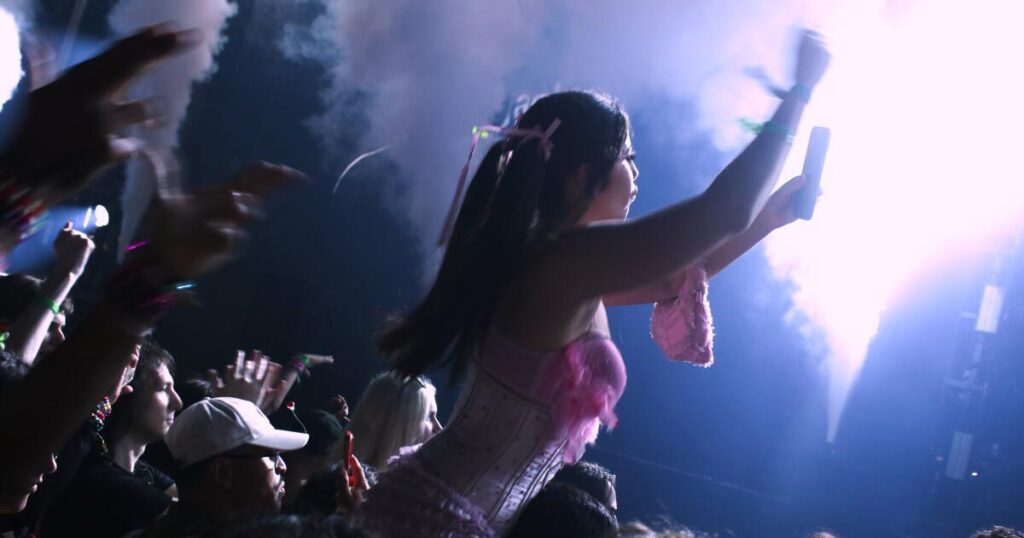
“I would choose to be Latina in every lifetime,” Kali Uchis said from her Saturday night closing set at L.A.’s EDM music festival Hard Summer. “Where are my Latinos at?”
The crowd responded with a resounding roar.
Throughout the day, fans crossed the grounds in bright Latin American soccer jerseys, the eye-catching complementary greens and reds of Mexico and the rich blue of El Salvador dotting the crowd. They held up flags, piñatas and tall signs pasted with images of Dr. Simi and “Dragonball Z” hero Goku — used to mark one’s place in the sea of people.
“Electronic music is for the beach and for Latinos,” said Dominican dembow artist and Hard Summer act Tokischa. “It’s for us. We love to dance, to feel sexy. And electronic music does that.”
Hard Summer first launched in downtown L.A. in 2007 — yet no Latin artists received top billing. Between Justice, Peaches and hip-hop group 2 Live Crew, the festival became a summit for English-language acts in the electronic and hip-hop genres. Yet last year’s lineup included Colombian reggaeton artist Feid as headliner, along with DJs Deorro, Funk Tribu and Sara Landry, who boosted the Latino community’s presence at the event.
This year at Hollywood Park in Inglewood, Colombian American crooner Kali Uchis headlined the main stage after a day of memorable sets by Argentine singer Six Sex, Mexican producer duo R∅z and Mexican American DJ Bolo.
“The underground DJ scene [in Southern California] is beautiful, but I will say: a few years ago, there was not a lot of Latino representation in the big festival lineups,” said Edgar Avalos, known as Bolo. “I feel like there are more opportunities for Latinos in these lineups. And I want to create an environment for Latino ravers to feel like they’re welcome in this space.”
The Mexican American DJ and L.A. native Deorro was an inspiration to Avalos, who describes him as “one of the first to break through on major lineups.” Following Deorro’s example, Avalos felt inspired to start his own record label Vibraza for Latino artists and to advocate for their inclusion in festivals — which includes not just onstage visibility, but career opportunities offstage too.
“I feel like there’s a huge bubble, a lot of dope emerging acts within the Latino dance community,” Avalos said. “It’s a blessing to be a part of the crew that’s putting [Latino DJs] on the map.”
According to Luminate’s 2026 data report, electronic dance music dominated the first half of 2026 as the largest growing genre in the U.S. Meanwhile, nearly 1 in 10 streams in the U.S. were songs in Spanish — and casual monthly listenership of Latin music in the States climbed to a peak of 54% of streams in the first quarter of this year.
“[Latino electronic] music makes you feel like … when you’re in the streets, you’re dancing, you feel proud, you let go of certain things or norms,” said Francisca Cuello, known as Six Sex. “Something about being Latino represents a cultural release and an understanding of fun that fits so well with electronic music at night.”
Cuello performed her new album, “Ultra,” as her pouting femme-bot persona who waxes poetic about eroticism over thumping techno beats. She said she was shocked by the number of people who sang the music back to her, despite the album having only been released earlier this summer.
“I never set out to make electronic music, but it’s what called to me,” Cuello said. “To be so far from my country and to connect with people in a country so different from mine, like the U.S., it’s such an honor.”
Festival attendee Azareal Hernandez-Moreno said she was most excited for the Hard Summer lineup this year because “it’s for us.”
“I feel like it’s a big moment for these artists to perform at such a big festival,” said Hernandez-Moreno. “[They] get to represent where they’re from. It means something to us as Latinos, as fans.”
Atop the Beatbox Art Car — a Hard Summer stage for emerging acts, which is approximately 20 feet tall and built to resemble a rainbow boombox — DJ Spiñorita mixed house, Latin dance and original funk for her audience. Donning a slicked-back hairstyle, Virgen de Guadalupe top and thick golden hoop earrings that reflected the penetrating rays of the sun, Spiñorita nodded and lifted her arms as ravers mouthed lyrics of “El Sonidito” back to her.
Spiñorita, who is Angela Ramirez by day, said that the L.A. rave scene is one of support and community among Latina artists, who run events for themselves year-round.
“We’re out here and brown and proud of it,” Ramirez said. “We’re putting in the work to make fundraisers for social issues and giving back to our community. Raving and DJing helps to heal trauma and helps us to open up.”
Earlier that day, R∅z sparked crowds of fans to run to their stage as they brought out música mexicana star Peso Pluma. The artist reached out to the crowd as he rapped in Spanish, fans jumping and raising their phones to take pictures and document the moment.
“Viva Mexico!” said R∅z’s Hugo Lara, as cheers rang and flags waved before him.
“I think that because the demographic here is very Latino, we’re all supporting each other,” said Frida Mitre, a Hard Summer attendee. “It was very heartwarming when [Kali Uchis] asked if we were out here, especially because we’ve been going through a lot.
Mitre said one of the sets she was most excited for was Tokischa — “for being so herself.”
“I was born and raised — lived my entire life — in the Dominican Republic,” said Tokischa, just after her high-octane performance. “Where my music plays, it reaches Dominicans there. In the crowd, I saw some Dominican flags. I raise that really high. I just want to see my community having fun.”
As the sun lowered on Sunday, and most Latino artists had finished for the day, local DJ Bianca Oblivion began spinning records jubilantly in her Mexican flag corset, grinning in the afterglow of a landmark weekend.
“It’s a really cool moment to be a Latino DJ,” she said. “Whatever people’s idea of what Latino music is … is not limited. We’re constantly crossing genres and cultures. We’re on the rise.”