

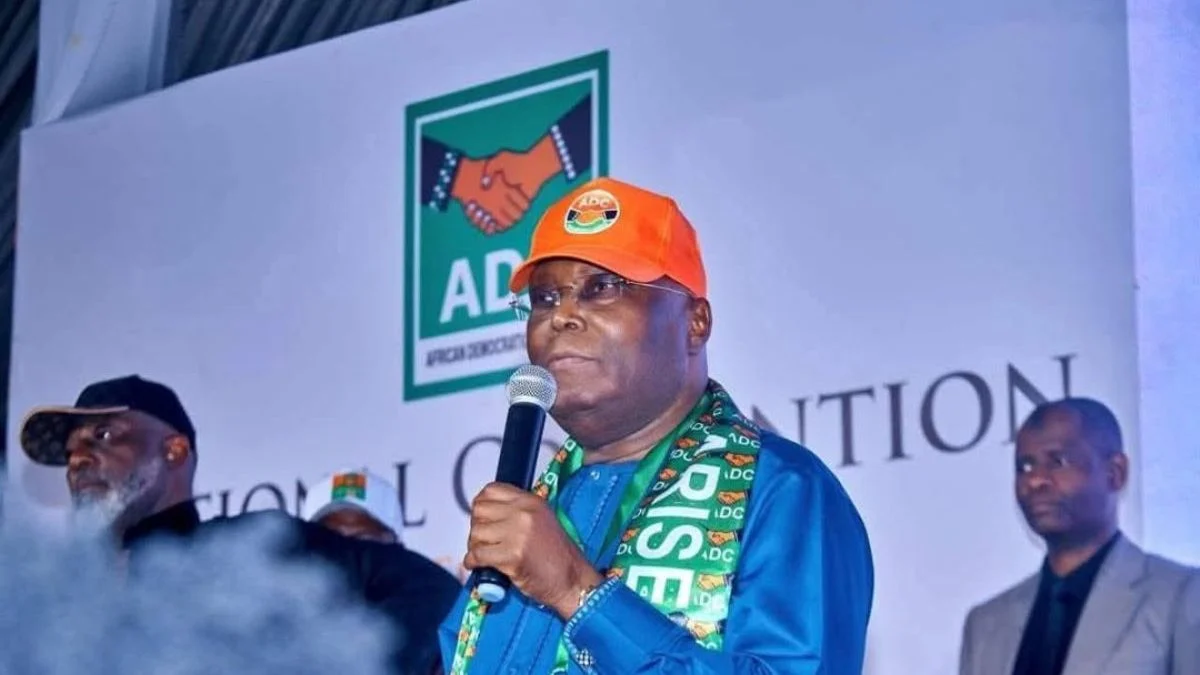
The presidential candidate of the African Democratic Congress (ADC), Atiku Abubakar, has disowned comments by one of his media aides, Paul Ibe, suggesting that his proposed restoration of petrol subsidy would be temporary.
Atiku insisted that his position on subsidy had remained unchanged, declaring that he would restore the intervention if elected president in 2027.
The former vice-president spoke on Tuesday in Abuja while receiving the Osun State leadership of the ADC, where he distanced himself from Ibe’s explanation of the proposed policy during an earlier interview on the African Independent Television (AIT).
“Earlier, one of my press aides contradicted me in a policy statement as far as subsidy is concerned.
“I want to repeat categorically that when I said I would return to subsidy, I will! Nigeria is rich enough to look after the welfare of its citizens. Let it be clearly stated that he was not speaking on my own authority,” Atiku said.
Ibe had, during his AIT interview, explained that Atiku would restore petrol subsidy if elected but gradually phase out the intervention once the economy recovered.
He said the proposed arrangement would differ from the former fuel import subsidy regime, as government support would be tied to crude oil production and domestic refining.
According to Ibe, crude oil would be supplied to local refiners at a discounted rate, allowing them to produce petrol and diesel at lower costs and consequently reduce pump prices for consumers.
“The crude oil will be sold at a discounted price, subsidised to refiners, and that will enable refiners to be able to produce fuel and diesel at a cheap cost. And when they produce cheaply, they will sell at the real pump price,” he said.
Ibe also proposed an independent mechanism for determining the appropriate price of crude supplied to refiners, taking prevailing market conditions into consideration.
He argued that although the downstream petroleum sector had been deregulated, government could still monitor prices to ensure that refiners and marketers operated within the framework of the policy.
He described the proposed intervention as temporary and intended to stimulate economic activity, increase productivity and provide relief to Nigerians and businesses.
However, Atiku’s subsequent clarification made it clear that the restoration of subsidy remained a firm component of his economic agenda.
In a statement posted on his X account, the ADC candidate said his administration would restore a targeted subsidy to strengthen purchasing power and reduce the pressure of rising fuel and transportation costs on households and businesses.
“I will restore targeted subsidy and put purchasing power back in the hands of Nigerians,” Atiku said.
He added that his administration would focus on supporting domestic production, reducing energy costs and improving the value of wages.
According to him, the objective would not be to revive the alleged corruption associated with the former petrol import subsidy regime, but to provide targeted relief while strengthening local refining.
“I will not restore the import racket; I will restore relief,” he said.
Atiku also linked the removal of petrol subsidy to the wider increase in transportation and food costs, arguing that rising fuel prices had contributed significantly to the hardship experienced by Nigerians under the current administration.
His Senior Special Assistant on Public Communication, Phrank Shaibu, subsequently clarified that Atiku’s proposal was not a return to the old subsidy system.
Shaibu said the former vice-president was proposing a “targeted, capped, transparently budgeted and independently audited subsidy” focused on domestic refining and production.
“For the avoidance of doubt, policy belongs to the candidate, not the spokesperson,” Shaibu said.
“Our responsibility as communicators is to explain Atiku’s position accurately, not create formulations capable of confusing Nigerians or handing opponents convenient talking points.”
According to Shaibu, the proposed intervention would not have an arbitrary withdrawal date. Rather, it would be gradually phased out when domestic refining capacity expands, fuel supply stabilises and competition becomes strong enough to deliver affordable prices without government support.
He likened the arrangement to temporary scaffolding used during construction, saying it should only be removed when the structure is strong enough to stand on its own.
The controversy has brought the petrol subsidy debate back into the centre of the 2027 presidential contest, with Atiku’s position now clearly framed as a commitment to restore targeted government support while avoiding a return to the former import-based subsidy system.
President Bola Tinubu removed petrol subsidy at his inauguration on May 29, 2023, triggering a sharp increase in petrol prices and contributing to widespread concerns over the rising cost of living.
The Federal Government has defended the subsidy removal, alongside foreign exchange reforms, as necessary measures to strengthen public finances, attract investment and reposition the Nigerian economy.
Atiku, however, has maintained that the economic burden on citizens must be prioritised, insisting that government intervention should be used to restore purchasing power and reduce the cost of living.