

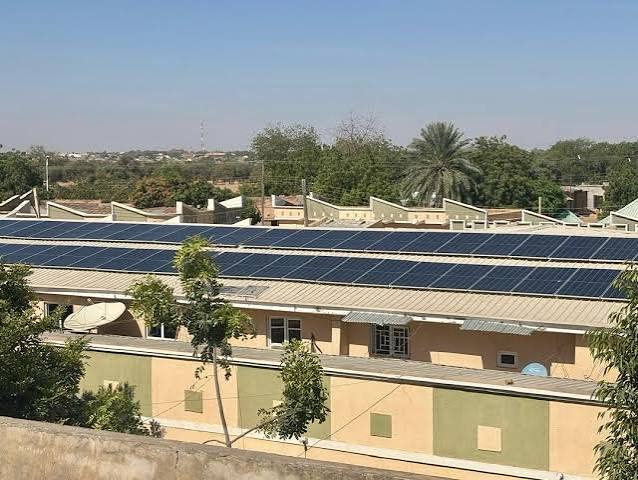
(Solar Power. Photo by Premuim Times)
Nigerian universities confronting chronic power shortages are poised to benefit from a proposed $500 million solar power investment announced at the launch of the Tinubu Light Initiative in Abuja on Thursday.
A renewable energy company has committed to providing up to $500 million in project financing covering as much as 90 per cent of the cost of university-based solar installations, subject to internationally bankable power purchase agreements and agreed project milestones.
The company noted that many Nigerian universities currently depend on costly diesel-powered generators, with electricity available for only a few hours daily, creating obstacles to institutional operations and limiting internet access.
Each university solar installation is anticipated to generate between 10 and 20 megawatts of electricity, sufficient to meet campus energy requirements whilst supplying excess capacity to neighbouring rural communities through prepaid metering systems.
The initiative would significantly reduce universities’ dependence on diesel fuel whilst lowering electricity costs and establishing sustainable, green energy infrastructure.
The company stressed that local enterprises would assume responsibility for operating and maintaining facilities, ensuring project sustainability beyond smaller standalone mini-grid systems.
The initiative prioritises local manufacturing and services provision to deliver broad economic benefits.
The renewable energy company emphasised that cheaper and more reliable electricity would enable universities to allocate resources toward their core academic functions.
The announcement addresses worsening electricity challenges confronting Nigeria’s tertiary institutions, many of which expend billions of naira annually on diesel fuel to maintain lecture halls, laboratories, residential facilities and research infrastructure.
Several federal universities have cautioned that escalating energy costs threaten academic activities, compelling some institutions to ration electricity supply and increase utility charges for students.
The proposed investment aligns with the Federal Government’s broader renewable energy expansion strategy through the recently launched Tinubu Light Initiative, which targets provision of clean energy to one million micro, small and medium enterprises, employment generation, production cost reduction and acceleration of Nigeria’s transition toward sustainable energy systems.