
2027 Elections: 74% of Nigerians Back Youth, 64% Open to Female Candidates—Invictus Africa Poll

By Omoyeni Ojeifo
Despite low current representation in public office, most Nigerians are open to electing women (64.4%), youth (74.3%), and persons with disabilities (38.7%) in 2027.
This is according to a nationwide Invictus Africa survey of 11,196 voters across all 36 states and the FCT.
The survey was conducted to gauge voters’ past behaviour, their willingness to vote for women, young people and persons with disabilities in the 2027 general elections, and the factors influencing those choices.
Presenting the findings on Tuesday, Invictus Africa Executive Director, Bukky Shonibare, said the survey examined voters’ past behaviour, voting intentions and factors influencing support for underrepresented candidates.
The report found 69.1% of Nigerians have never voted for a woman.
Among them, 51.1% said they never saw a female candidate on the ballot, while 55.1% cited track record as the deciding factor.
“One of the key findings from today’s data is that 64.4 per cent of Nigerians are willing to vote for women. The question is whether those women will actually make it to the ballot,” Persecondnews quotes from the report.
Support for women was strongest in legislative elections, with more than 70% willing to elect female House of Representatives members.
However, willingness declined for executive offices, while only 10.1% of successful 2023 candidates were women.
“Even when women have made it to the ballot, many Nigerians are unaware that women are on the ballot. The same applies to young people and persons with disabilities.”
Among young candidates, 79.9% of respondents who had never voted for one said they were unaware any appeared on previous ballots.
Support stood at 77.2% among middle-aged voters against 74.5% among younger respondents.
“People want women, young people and persons with disabilities to put their merit forward and not their identity. What works for voters is qualification, competence and track record.”
For persons with disabilities, 61.1% of respondents who had never voted for one said they did not know such candidates contested elections. Only 8.7% had previously voted for a candidate with a disability.
Support among respondents with disabilities reached 59.2%, compared with 37.7% among others. Also, 71.3% would support a PWD councillor, while 48.9% would support a presidential candidate with a disability.
The survey also found 87.9% prioritised qualification, honesty and track record over disability, while 74.9% of respondents said they intend to vote in the 2027 general elections.
“Intention is different from actual votes. That is why we will return after the election to compare what voters said they would do with what they eventually did.”
Also speaking, the Head of Data and Research at Invictus Africa, Gabriel Mobuogwu, said the survey was conceived to fill an evidence gap by focusing on voters rather than candidates seeking elective offices.
He said women constitute nearly half of Nigeria’s population and registered voters, youths are the largest voting bloc, while persons with disabilities are estimated at 35 million, yet remain politically underrepresented.
“The questions that have been asked before were about gatekeeping, godfatherism and party politics. Nobody asked voters what they think about women, young people and persons with disabilities as candidates.”
Mobogu said women accounted for only 10.1% of candidates in the 2023 elections, with just 72 of 1,533 elected officials being women, representing a 4.3% success rate.
He said youths recorded a 9.1% electoral success rate, while only four of 160 persons with disabilities who contested elections between 2019 and 2025 were elected, giving a 3.4% success rate.
“What we found is that structural barriers remain the biggest challenge. Nigerians are open to voting for women, young people and persons with disabilities. Political parties must give them the opportunity to emerge on the ballot.”
According to him, the survey employed 102 field enumerators, covering 102 senatorial districts, with face-to-face interviews conducted electronically and weighted against the 2023 INEC voters’ register to ensure national representation.
He said the report also used disaggregated analysis and predictive modelling to identify voter patterns and the factors influencing support for women, youths and persons with disabilities.
“Qualification, honesty and credibility ranked highest among the conditions that would make voters support women, young people and persons with disabilities.”
Invictus Africa said the Voters’ Preference Survey would continue after the 2027 general elections, when researchers will revisit a sample of respondents to compare their stated voting intentions with their actual voting behaviour and identify factors that influenced their choices.
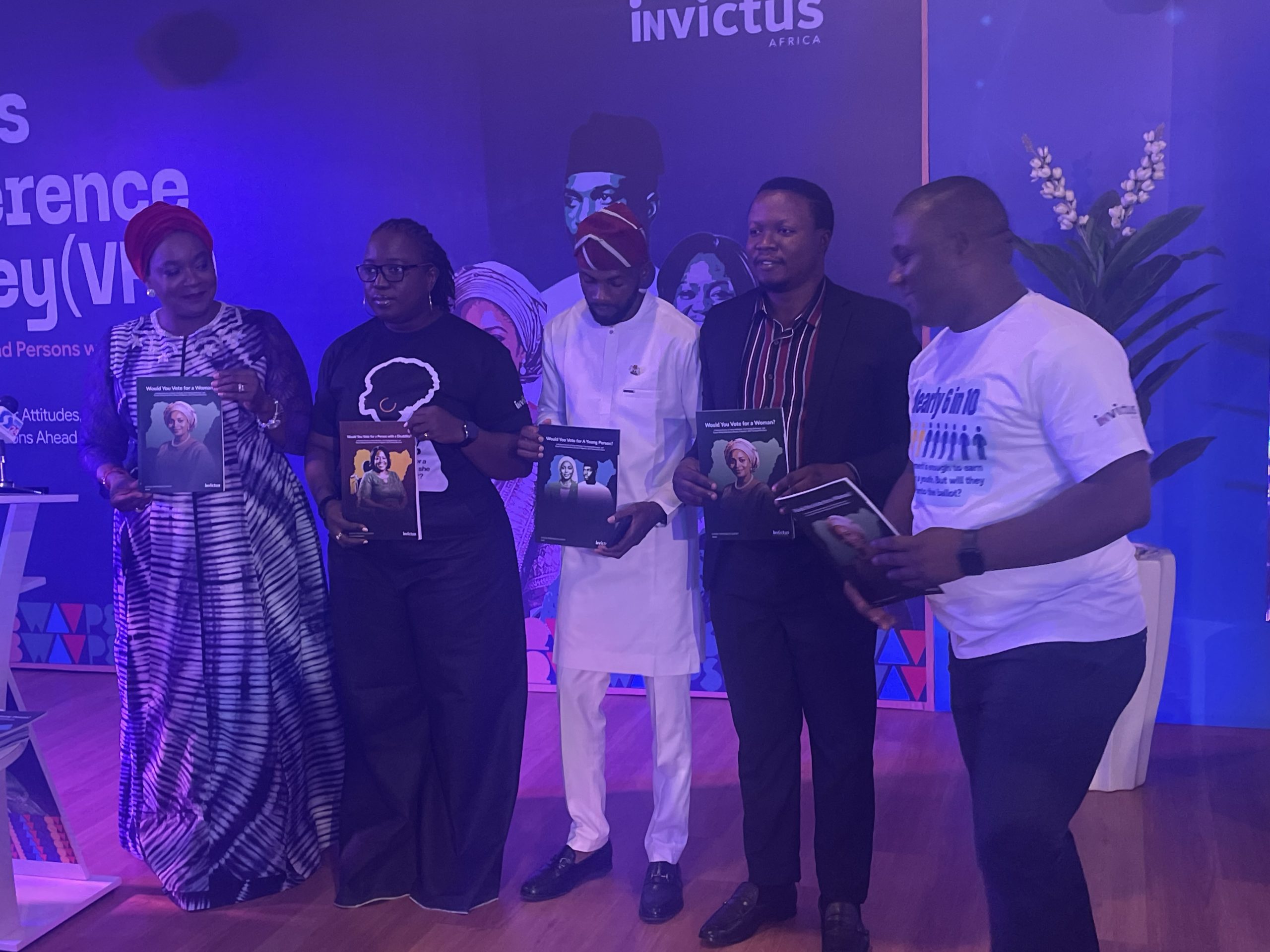
The event concluded with the unveiling of the three Voters’ Preference Survey Series reports on women, young people and persons with disabilities before election stakeholders, civil society organisations and members of the media.