

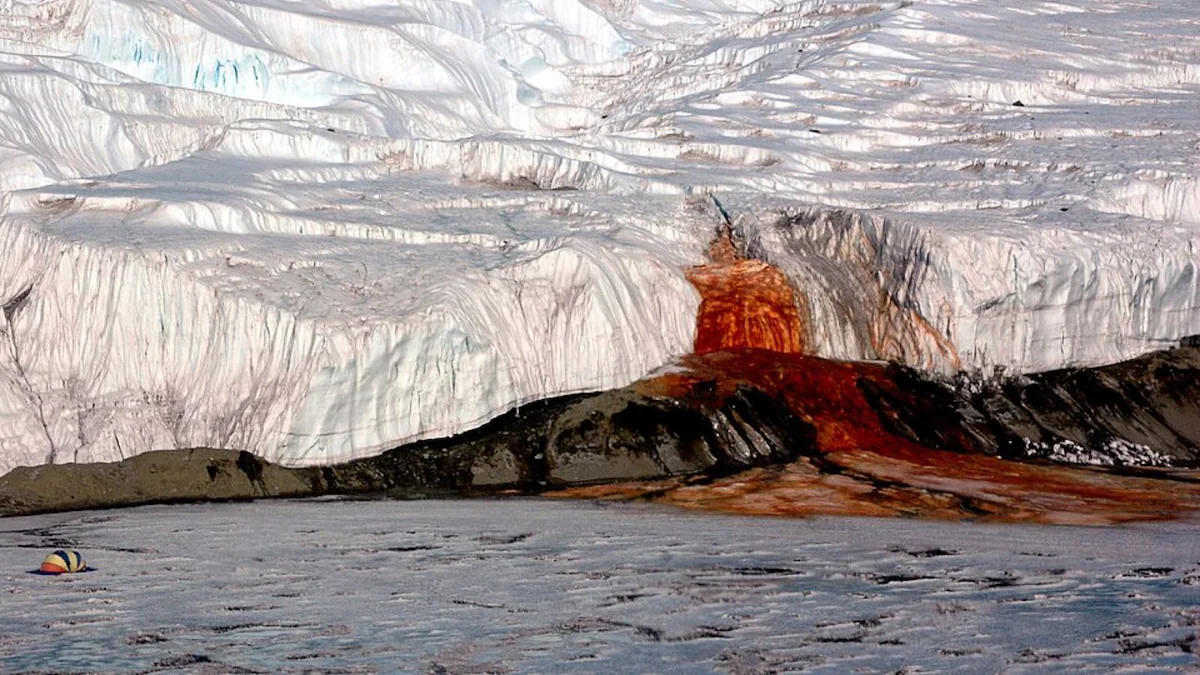
According to a new study published in the journal Antarctic Science, the periodic flow of Blood Falls is triggered by pressure changes beneath the glacier. Researchers found that as the overlying ice shifts, pressure briefly drops, allowing iron-rich, salty water trapped deep below the glacier to travel through hidden channels and fractures before reaching the surface.
What is Antarctica’s Blood Falls?
Blood Falls is located at the edge of Taylor Glacier in the McMurdo Dry Valleys of East Antarctica, one of the coldest and driest regions on Earth. The phenomenon was first documented in 1911 by Australian geologist Thomas Griffith Taylor during the British Terra Nova Expedition.
Early explorers believed the unusual red colour was caused by algae. However, decades of scientific research later showed that the waterfall’s colour comes from iron-rich brine flowing from beneath the glacier.
Why is Blood Falls red?
Scientists believe the water is an ancient hypersaline brine that became trapped beneath nearly 400 metres of ice after seawater was sealed under the advancing glacier around 1.5 million years ago. The high salt content prevents the brine from freezing even in extremely low temperatures.
When the iron-rich water reaches the surface, it reacts with oxygen in the air. This process, known as oxidation, turns the dissolved iron a deep reddish colour, giving Blood Falls its distinctive appearance.
What did the new study find?
The latest study provides what researchers describe as the missing piece of the puzzle. They matched a Blood Falls discharge recorded in 2018 with a measurable drop of about 15 millimetres in the glacier’s surface, along with a temporary slowdown in the glacier’s movement.
The findings suggest that these subtle shifts reduce pressure beneath the glacier, allowing the trapped brine to move upward through an underground network before emerging at the surface.
Why the discovery matters
Previous radar surveys had already identified pressurised channels carrying the brine beneath Taylor Glacier, helping explain how liquid water can exist and move inside one of the coldest glaciers on Earth. The new observations strengthen that model by directly linking the release of the brine to changes in glacier movement.
Researchers say the findings improve understanding of how water behaves beneath glaciers and help explain one of Antarctica’s most unusual natural phenomena.
(Edited by : priyanka deshpande)