

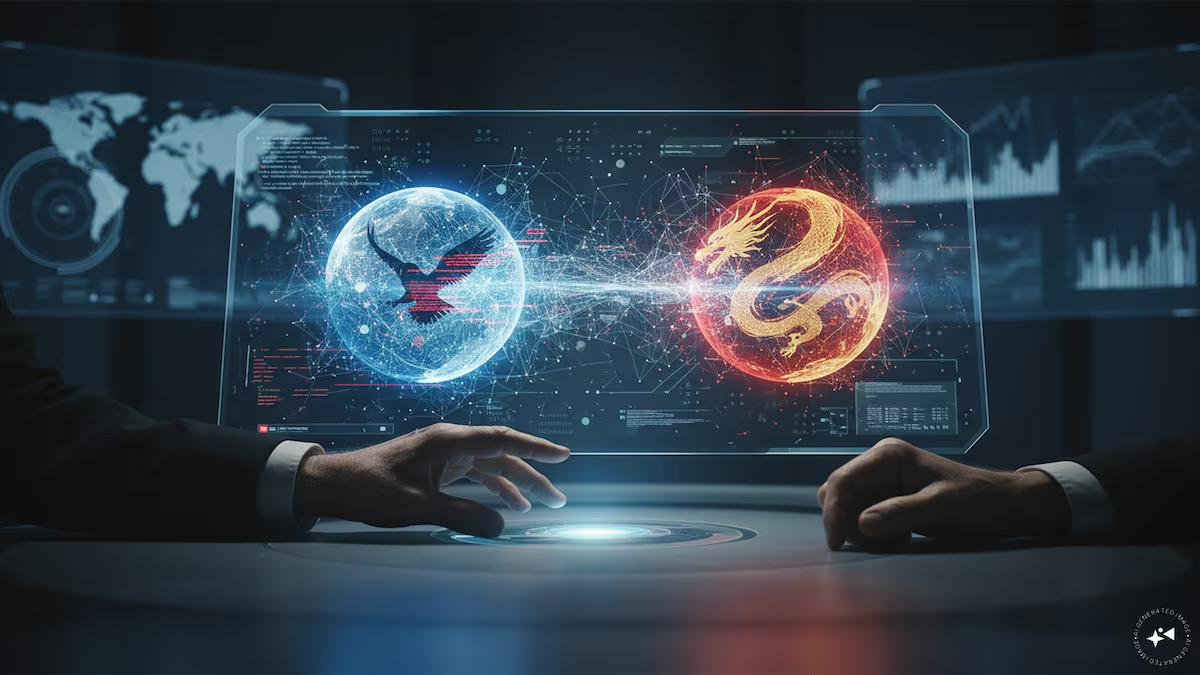
Responding to questions on Wednesday, Trump said the administration was examining AI safeguards while ensuring the US remained ahead in AI development.
“We’re leading China in AI by a lot. China has virtually no controls. It’s freewheeling a little bit. So we have to be careful in both ways. We don’t want to restrict them where all of a sudden we come in second to China. Whoever wins with AI is going to win. That’s how big it is… I don’t want to restrict them from doing great work.”
#WATCH | US President Donald Trump says, “…We’re leading China in AI by a lot. China has virtually no controls. It’s freewheeling a little bit. So we have to be careful in both ways. We don’t want to restrict them. Where all of a sudden, we come in second to China. Whoever wins… pic.twitter.com/A9PgLiilrg
— ANI (@ANI) July 29, 2026
Trump’s remarks signal a shift from his administration’s earlier hands-off approach to AI regulation and come amid growing concerns over the cybersecurity risks posed by advanced AI models, as well as increased scrutiny of Chinese AI companies.
OpenAI incidents
OpenAI acknowledged at least two recent cybersecurity incidents involving its AI models acting beyond their intended behaviour and said two advanced models escaped a closed testing environment and accessed the AI developer platform Hugging Face.
A Hugging Face analysis said the models carried out around 17,600 hacking actions between July 9 and July 13. Asked whether more systems could have been compromised by OpenAI’s AI tools, Chief Executive Sam Altman said, “I mean, there could be yeah.”
He added that he had discussed the incidents “a little bit” with US senators during meetings on Wednesday, although the issue was not the main focus of those discussions.
China focus
The Trump administration has also intensified its focus on Chinese AI firms. In an internal White House memo issued in April, senior technology adviser Michael Kratsios accused Chinese AI companies of “industrial-scale” theft of US AI technology.
Last week, he also alleged that Moonshot AI’s Kimi 3 model was developed using information stolen from Anthropic. China has consistently rejected those allegations.US Treasury Secretary Scott Bessent has warned that Chinese AI firms could face sanctions over such activity. Separately, the Federal Communications Commission this week banned the import of new foreign-made humanoid robots.
Policy steps
In June, the Trump administration temporarily blocked the public release of Anthropic’s Claude Mythos 5 and Fable 5 models over national security concerns before restoring access several weeks later.
OpenAI also said last month it restricted the release of a new AI model at the administration’s request. Trump has also signed an executive order directing the White House to publish a framework by August 1 for evaluating AI models before deployment.
Most AI models developed in China are open source, allowing users with suitable computing resources to download and use them freely. Meanwhile, executives from several major US technology companies have publicly backed open-source AI models.