

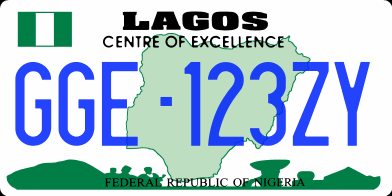
The persistent scarcity of vehicle number plates across Nigeria has been blamed on hoarding by touts, overwhelming demand for Abuja registration plates and the failure of state governments to establish production plants, a road traffic expert, Abimbola Ige, has said.
Reacting to an earlier analysis on the lingering shortage, Ige argued that the crisis had been oversimplified, insisting that the problem extends beyond administrative lapses to include illegal hoarding, production limitations and the growing preference for Federal Capital Territory number plates.
He explained that vehicle number plates are designed and produced by the Federal Road Safety Corps before being supplied to state Vehicle Inspection Offices and the FCT Directorate of Road Traffic Services for distribution to motorists.
According to him, Lagos remains the only state with its own production plant, while all other states and the FCT rely on supplies from the FRSC.
Ige said the overwhelming demand for Abuja number plates by motorists from across the country had fuelled shortages and created an opportunity for touts to exploit the system.
He alleged that some touts, working with “bad eggs” within the system, corner available number plates through online processing before genuine applicants can access them, only to resell them at exorbitant prices.
He noted that where about 15,000 number plates are supplied to the FCT, demand could exceed 30,000, making shortages inevitable.
The road traffic expert also faulted the failure of state governments and the FCT Administration to establish number plate production facilities, despite the growing demand.
He disclosed that land had already been allocated in Dutse, Bwari Area Council of Abuja, for a production plant, urging the FCT Minister to facilitate its development to meet increasing demand.
Ige further claimed that intelligence reports had repeatedly identified locations close to the FCT Directorate of Road Traffic Services headquarters where large quantities of number plates were allegedly being hoarded.
He maintained that while both the Federal and state governments often complain of inadequate funding, they were overlooking significant revenue opportunities that could be generated through efficient production and distribution of number plates.
According to him, the FRSC already generates revenue from producing the plates, while state traffic agencies pay for the quantities supplied to them.
He argued that motorists also contributed to the crisis by insisting on Abuja number plates instead of registering vehicles in their respective states.
“Number plates are not fashion,” he said, urging Nigerians to abandon the culture of seeking FCT registration numbers for prestige.
Ige added that the existing partnership involving the FRSC, Vehicle Inspection Offices and the FCT Directorate of Road Traffic Services had largely worked as intended, but the failure of governors and the FCT Administration to invest in local production had continued to undermine the system.
He called for collective action rather than blame, urging governments to establish production plants and curb the activities of touts to eliminate artificial scarcity and boost internally generated revenue.