

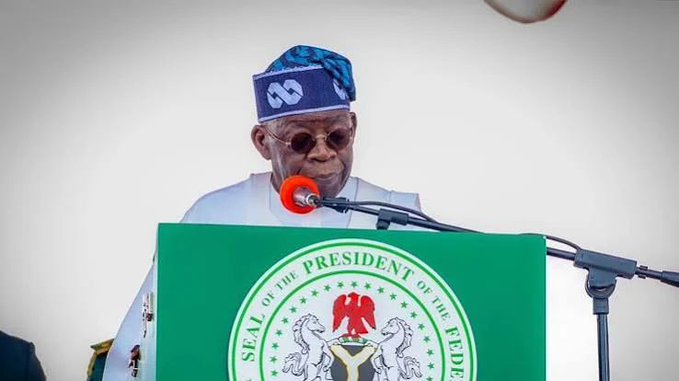
(President Bola Tinubu. Photo by Punch News)
In Abuja on Tuesday, President Bola Tinubu cautioned political rivals hoping to unseat him in 2027 that he would not give up easily, claiming that a democratic election is fair.
At the Presidential Villa in Abuja, Tinubu made the statements while hosting the Catholic Bishops Conference of Nigeria.
The President stated that those seeking to unseat him were free to try, insisting that all is fair in politics and that opportunity is equal for everyone, adding that he would neither offer them a red carpet nor allow himself to be tied down at home, but would rather wrestle it out to the finish, describing that as the true nature of political competition.
He also dismissed concerns about the electoral process, defending the Independent National Electoral Commission against accusations of bias, insisting that INEC remains neutral and has never intimidated anyone, and suggesting that political opponents crying foul were merely afraid of their own shadows and the uncertainty within their own ranks.
At the meeting, which lasted barely an hour, Tinubu told the clerics that three years of difficult reforms were yielding visible dividends, pointing to the uninterrupted academic calendar as a measure ordinary Nigerians could feel, describing the calm within the Academic Staff Union of Universities as an answer to his prayers and those of many Nigerians.
He noted that none of the children of the clerics present, whom he described as belonging to all of them by virtue of their calling as Reverend Fathers, could complain that a four-year course was no longer running its normal duration, stressing that ASUU was not on strike and was therefore not bringing hardship to their homes, which he considered an answer to prayer.
On the broader economic picture, Tinubu acknowledged inheriting both the assets and liabilities of the previous administration but insisted that stabilisation had been achieved and that better days lay ahead, stating that government had stabilised the economy and that prosperity was on the horizon, with quality of life improving.
He added that he had not shirked the burden of difficult decisions, noting that he had inherited the situation, did not run from it, and had in fact sought the job he now occupies.
The President also addressed the long-running matter of returning mission schools to their original proprietors, a point of contention between the Catholic Church and several state governments. He recalled having returned mission schools to the Church during his tenure as governor of Lagos State, citing Cardinal Anthony Okogie as a living witness to that decision taken between 1999 and 2007.
However, he argued that the power to act on the matter rested with state governors rather than the Federal Government, urging the bishops to engage the states directly, noting that since the schools fall under state jurisdiction, governors are the ones to act, and that no constitutional amendment was required, describing it simply as a matter of democratic choice.
On national unity and security, he described Nigeria’s challenges as a generational issue that could not be escaped, stating that the security situation remains what it is, and that Nigeria is the only nation available to its citizens, drawing on the national anthem’s reference to complexity and diversity as a source of hope that the country would thrive, rejoice and remain good to all.
He noted that the nation’s founding fathers had done their best in leaving behind a country, and that it remains the duty of the present generation to build one defined by unity, stability and prosperity for generations yet unborn.
The Catholic bishops, led by Archbishop Matthew Man-Oso Ndagoso, concluded their visit to the Presidential Villa a few minutes past 5:00 p.m. local time and were conveyed out of the premises in a Toyota Coaster bus.