

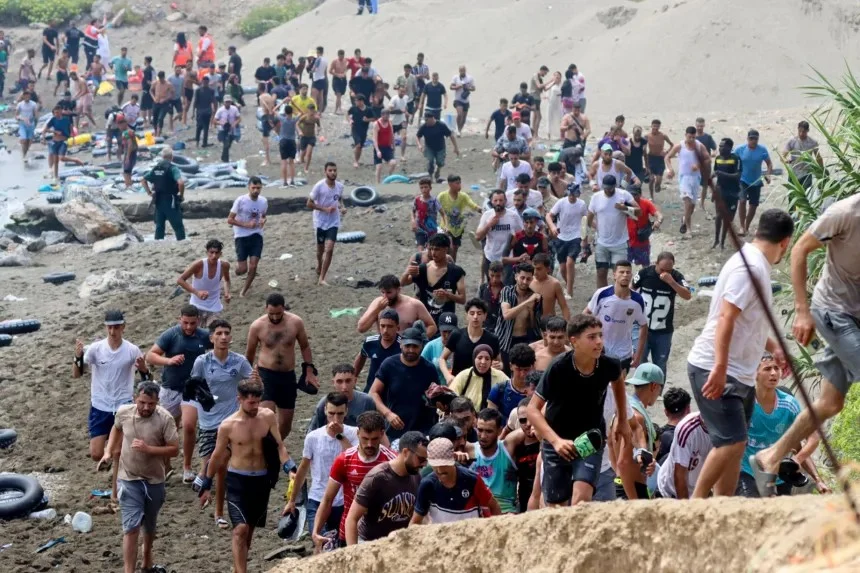
Spain and Morocco tightened security around the Spanish enclave of Ceuta after a mass migrant crossing that saw tens of thousands arrive by land and sea in a single day, leaving at least 19 people dead.
Spain’s Department of National Security said more than 49,000 people crossed illegally into Ceuta within 24 hours, citing figures from the Interior Ministry.
The unprecedented influx into the tiny Spanish territory on Morocco’s Mediterranean coast stunned Europe and reignited debate over migration.
Ceuta and Melilla, Spain’s two autonomous cities in North Africa, are the European Union’s only land borders with the continent. Although both cities, each with a population of about 85,000, periodically experience migrant surges, Thursday’s crossings were on an unprecedented scale.
At Ceuta’s border, Moroccan authorities deployed water cannon and pushed back migrants. The charred remains of a bus and seven vehicles were left behind following clashes with the crowds.
Spanish authorities said they would swiftly deport those who entered illegally, despite a court ruling limiting the use of special “border rejection” procedures that allow immediate expulsions from the enclave.
Territorial Policy Minister Angel Victor Torres said Friday’s surge may have been influenced by a recent Spanish Supreme Court ruling barring the summary return of migrants intercepted at sea while trying to reach Ceuta or Melilla.
Torres said the government responded immediately and would return migrants in line with court rulings and international obligations.
Meanwhile, Spain’s Guardia Civil police association (AUGC) said there were too few officers on duty to secure the border fence during Thursday’s influx, leaving security personnel overwhelmed.
On the Moroccan side, thousands of migrants gathered in the border town of Fnideq despite heightened security that thwarted most crossing attempts. While the main crossing remained blocked, groups moved along the coastline searching for alternative routes, with some preparing to swim.
The developments have renewed concerns over migration across Europe, where the issue has remained politically divisive since more than one million migrants and refugees entered the continent during the 2015 migration crisis.
French Interior Minister Laurent Nunez said he had ordered an immediate tightening of checks along France’s border with Spain, although he did not specify what additional measures would be introduced.
While border checks are generally abolished within the EU’s Schengen Area, member states may temporarily reintroduce them under exceptional circumstances.
Italy’s Prime Minister Giorgia Meloni said her government was prepared to take extraordinary measures to protect its borders, including suspending Schengen arrangements with Spain. Finland’s interior minister backed the proposal, urging the European Union to follow Italy’s lead.
Spain’s Socialist government, while maintaining a firm stance against illegal migration, argues that immigration strengthens the country’s economy. It also recently introduced a mass regularisation programme that enabled hundreds of thousands of undocumented migrants to apply for legal status.
Italy’s Foreign Minister Antonio Tajani criticised the policy, arguing that granting citizenship to more than 500,000 undocumented migrants would encourage human trafficking.
Spanish Foreign Minister Jose Manuel Albares dismissed the remarks as “inappropriate,” saying Spain expected solidarity rather than partisan rhetoric from its European partners. He added that the Italian ambassador would be summoned to register Spain’s protest.
French far-right leader Marine Le Pen also called for tighter border controls, saying France should immediately strengthen checks along its border with Spain and, if elected president next year, restrict Schengen free movement to European nationals.