

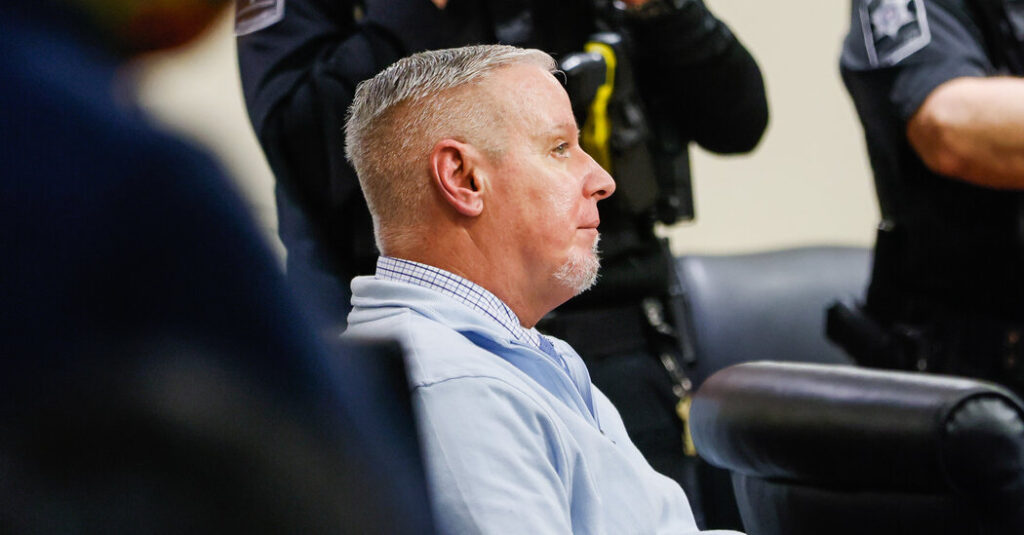
The father of a teenager who fatally shot four people at his Georgia high school was sentenced onThursday to 15 years in prison after a jury found he bore criminal responsibility for his son’s deadly attack in 2024.
The father, Colin Gray, had been convicted in March of murder and involuntary manslaughter, among other charges. Prosecutors argued that he shouldered significant blame for the shooting in Winder, Ga., because he had given his son, Colt, then 14, the rifle used in the attack and failed to heed signs of his son’s deteriorating mental health and growing obsession with violence.
Prosecuting the parents of juveniles who carry out mass shootings has become one of the latest fronts in the search for accountability in a country frustrated by recurring gun violence. The case against Mr. Gray has stood out for the severity of the charges. His potential sentence ranged from 10 years of probation to 243 years in prison; prosecutors had asked for an 80-year sentence.
“You were convicted because the warning lights were flashing brighter and brighter and you didn’t get him help and you didn’t remove his access to the guns,” Judge Nicholas Primm of State Superior Court in Barrow County said as he handed down the sentence.
“It became more and more obvious that something bad was going to happen,” the judge said, adding that Mr. Gray was “tethered” to his son’s crimes by his negligence. If he had acted differently, the judge added, “you wouldn’t be here today.”
The son, who is now 16, pleaded guilty to 55 charges related to the shooting, and he was sentenced by Judge Primm on Tuesday to life in prison without the possibility of parole. The judge, in that sentencing, said that the younger Mr. Gray “understood the horror of what you were going to do,” but he also acknowledged that Colt Gray had been failed by the adults in his life, his father chief among them.
During his trial, the elder Mr. Gray, 55, had tried to convince jurors that his son’s intentions seemed clear only now with the benefit of hindsight.
Testifying in his own defense, he portrayed himself as ill-equipped to handle his son’s cascading behavioral problems. Giving him an AR-15-style rifle as a Christmas gift was, in his telling, a misguided attempt to connect with his son and pull him away from the internet and video games. “There’s this whole other side of Colt I didn’t know existed,” he told the court.
But prosecutors said the shooting, at Apalachee High School on Sept. 4, 2024, had followed a litany of warnings in a childhood punctuated by upheaval, including repeatedly moving homes and changing schools, his mother’s addiction struggles and conflict between his parents.
In his bedroom, Colt Gray had created a “shrine” to the teenager convicted of killing 17 people in Parkland, Fla., in 2018, with photographs and news clippings. Sheriff’s deputies visited the Gray family home to investigate an online threat of a school shooting traced to their address. And the boy’s behavior worsened, with violent outbursts and anxiety-driven meltdowns, and statements to relatives about voices in his head.
His parents discussed and researched possible treatment options, but never followed through, prosecutors said. Instead, they gave him antidepressants prescribed to his mother.
Breanna Schermerhorn, the mother of Mason Schermerhorn, a 14-year-old killed in the shooting, acknowledged the challenges of parenting, the inevitable situations one feels unprepared for.
But this was not the situation with the elder Mr. Gray.
“He wasn’t left guessing,” Ms. Schermerhorn said in court on Thursday, as she gave a victim impact statement. “He knew his son was in crisis,” she added, pausing as her voice broke. “Instead of acting, he chose to look away. Instead of intervening, he chose inaction. Instead of protecting his son from himself and protecting the community from the danger he posed, he armed him.”
The case arose as gun violence prevention advocates and others have contended that blame for such shootings does not always end with the perpetrator.
Yet the pursuit of broader accountability has often ended in frustration.
Vast federal protections shield gun companies from most litigation. Efforts to prosecute law enforcement officers for flawed responses, like after school shootings in Parkland and Uvalde, Texas, were unsuccessful. The activism of victims’ families and survivors has yielded little in the way of restrictions on gun access.
In recent years, the parents of juvenile perpetrators of these shootings have emerged as another avenue for accountability, by way of criminal charges and through litigation.
James and Jennifer Crumbley, the parents of a 15-year-old boy who fatally shot four people at his Michigan high school, were convicted of involuntary manslaughter and sentenced to at least 10 years in prison.
After a 21-year-old opened fire on a crowd gathered for a Fourth of July parade outside Chicago in 2022, the gunman’s father pleaded guilty to misdemeanor charges and was sentenced to 60 days in jail for helping his son obtain a gun license despite being aware of his son’s mental health issues.
Last year, prosecutors in Wisconsin charged the father of a 15-year-old girl who shot and killed a student and teacher at her private Christian school before killing herself.
After the shooting at Apalachee, investigators quickly zeroed in on the elder Mr. Gray, and he was charged with second-degree murder a day after the attack.
In his trial, prosecutors pointed to the father’s actions as soon as word began to spread of a shooting at Apalachee. During the trial, they showed a portion of a text message exchange between Mr. Gray and his daughter, in which he asked if she had been in touch with her brother. “I think we’re thinking the same thing,” she replied. They also noted that he had asked his boss to leave work, saying his son had broken his arm.
And when the police arrived at the family home after the shooting, before officers could explain why they were there, Mr. Gray told them, “I knew it.”