

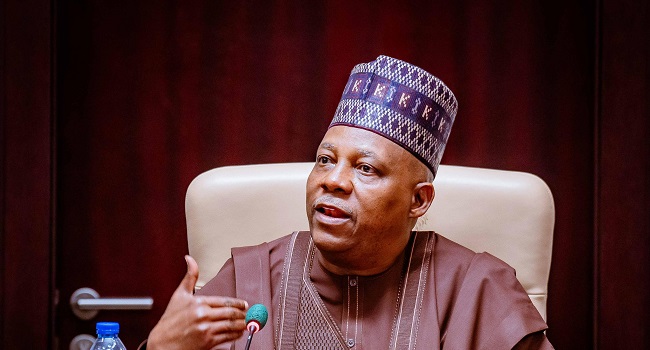
Vice President Kashim Shettima has called on state governments to unlock their economic potential to drive Nigeria’s growth, stressing that the country’s prosperity depends on the success of its constituent states rather than the Federal Government alone.
Speaking at the Jigawa State Economic and Investment Summit (J-INVEST 2026) in Dutse on Wednesday, Shettima said the strength of Nigeria’s federation lies in the economic progress of every state.
“The strength of our federation is measured not by the wealth of the centre alone, but by the awakening of its constituent parts,” he said.
He urged states to leverage their natural resources, human capital and comparative advantages to stimulate sustainable development.
“A federation truly flourishes because every state discovers what it can become through the full realisation of its own economic potential,” he stated.
The vice president conveyed President Bola Tinubu’s goodwill to participants and said the administration’s economic reforms, though difficult, were beginning to yield positive results.
“We are taking difficult but necessary decisions to place our economy on the path of sustainable growth. Those choices have required sacrifice, but they are the right choices,” he said.
According to Shettima, reforms including the Business Facilitation Act and the liberalisation of the foreign exchange market have strengthened transparency and boosted investor confidence.
He also described the Electricity Act 2023 as a major milestone, noting that it gives states greater control over electricity generation and distribution.
“It empowers states to license, generate, transmit, and distribute electricity,” he said.
On agriculture, Shettima commended Jigawa State for contributing nearly 40 percent of Nigeria’s wheat production during the last farming season.
However, he noted that Nigeria must improve agricultural productivity, pointing out that the country’s average wheat yield of 1.5 metric tonnes per hectare remains below that of countries such as Ethiopia and South Africa.