


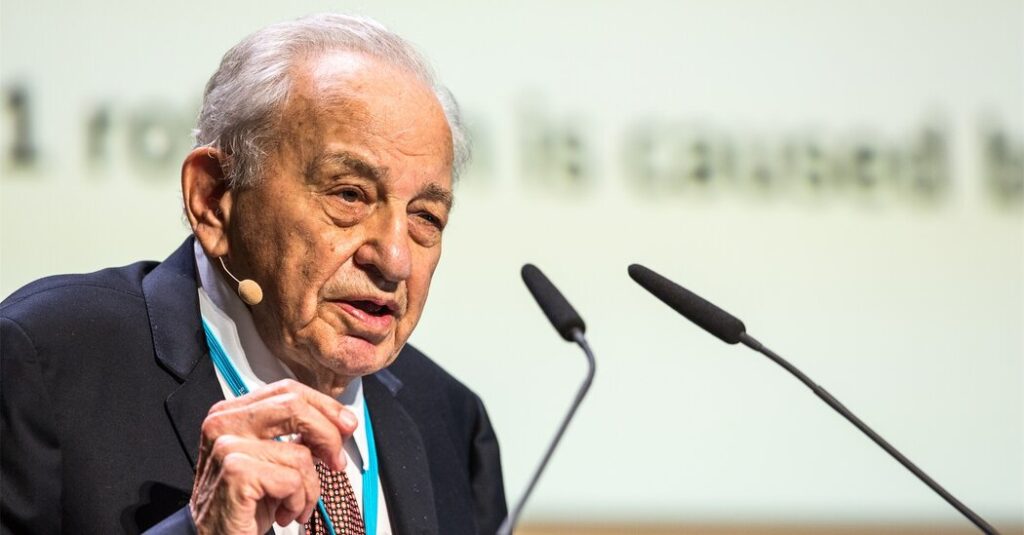
Rudolph Marcus, a Canadian-born American chemist who received the Nobel Prize in Chemistry for developing a theory that helped explain the electrochemical processes behind photosynthesis, respiration, oxidation and even how fireflies produce light, died on Thursday at his home in Pasadena, Calif. He was 102.
His death was announced by the California Institute of Technology in Pasadena, where he had taught since 1978.
Sarah Reisman, the chair of the chemistry and chemical engineering division at Caltech, said that it was almost impossible to overstate the importance of Dr. Marcus’s work.
“It provides a simple theory for one of the most fundamental processes in chemistry and has been applied to understand reactions ranging from small-molecule catalysts to proteins involved in photosynthesis,” she wrote in an email.
Dr. Marcus was a theoretical chemist and not an experimentalist. He discovered early in his career that he did not like performing experiments, preferring to conceive explanations for mysterious phenomena, he explained in a 2016 podcast interview for The Electrochemical Society.
“It all comes back to the puzzles, I think, and the enjoyment of puzzles as a child,” he said, adding, “Only now the puzzles are scientific puzzles.”
The puzzle Dr. Marcus solved that led to his winning the Nobel in 1992 concerned electron transfer reactions — “the simplest” of all chemical reactions, he said, because “there are no bonds that are broken or formed, just simply an electron is transferred from one reactant to another.”
He stumbled upon the subject in 1955 while teaching at the Polytechnic Institute of Brooklyn (which, after a merger, is now New York University’s Tandon School of Engineering). While leafing through magazines in the library, he read an article by the future Nobel laureate Willard Libby that explained why some electron transfers occurred at faster speeds than others (and, to some degree, why they occurred at all).
Dr. Libby’s ideas were based on a phenomenon first observed in the 1920s, in which shining a light on atoms would give them enough energy to spontaneously emit electrons, a process so fast that the nuclei would not change positions. Dr. Libby suggested that the same thing happened in electron transfers.
Dr. Marcus thought that Dr. Libby’s idea of how electrons can be emitted without disturbing the nuclei was promising, except for one glaring problem: Where did the energy come from to support the emission?
In the 1920s experiment, the source of that energy was light, in the form of photons. But what about reactions that happened in the dark? Almost immediately, Dr. Marcus thought of a way to solve the problem.
Electron transfers can occur between atoms that do not have the same number of electrons — for example, two different isotopes of iron. Dr. Libby had noted that immediately after an electron transfer, the new isotopes are in the “wrong environment” (as opposed to the one in which they started) and electrically disturb, or polarize, other atoms in the material around them. That gives the atoms potential energy.
Dr. Marcus thought that — if the potential energy of the isotopes and other atoms surrounding them was considered as a whole — as the potential energy increased because of the disturbances, a critical point would be reached at which potential energy would be converted to kinetic energy, making electron transfers possible. And the process could start again, feeding the cycle.
He worked out a formula with all the elements of the reaction, and the equation showed that the energy remains the same before, after and during the transfer, so energy is conserved, following physical laws.
Over the next several years, he published papers that outlined the results of experiments that might be expected if his theory was correct. Others did that work, and most of his predictions were quickly validated.
One prediction — the most unusual of all — was that, as the electron transfers occurred, they would create more perturbations, and so they would happen faster and faster until, paradoxically, there would come a point at which the reactions would slow down. When plotted, the shape of the curve of these reactions was an inverted parabola, and Dr. Marcus called the area under the curve the “inverted region.”
In the 2016 Electrochemical Society interview, Dr. Marcus said the result was “unexpected, like falling down a cliff and you make it too steep and it’s harder to fall.”
Demonstrating that phenomenon proved to be difficult; it was not until 1984 that an experiment by John R. Miller, Lidia T. Calcaterra and Gerhard L. Closs confirmed it, thus validating Dr. Marcus’s entire theory.
In the years since, the theory has been extended to other, more complicated transfers — like those across membranes in photosynthesis, in organic semiconductors and in chemiluminescence (“cold light”), which is the chemical form of bioluminescence found in fireflies — and proved to be just as applicable.
Rudolph Arthur Marcus was born in Montreal on July 21, 1923. He was the only child of Myer Marcus, who worked in a grocery store, and Esther (Cohen) Marcus.
Throughout grade and high school, he excelled in math and science. At McGill University in Montreal, he received a bachelor’s degree in chemistry in 1943 and a doctorate in 1946. Afterward, he obtained a postdoctoral position at the National Research Council of Canada and later at the University of North Carolina at Chapel Hill, working under the renowned chemist Oscar Knefler Rice.
A week after he started at North Carolina, Dr. Marcus met Laura Hearne, a graduate student in sociology. They were married six months later. She died in 2003. Dr. Marcus is survived by their three sons, Alan, Kenneth and Raymond; and four grandchildren.
After more than a decade teaching at the Polytechnic Institute of Brooklyn, he moved to the University of Illinois at Urbana-Champaign in 1964 before joining Caltech. He continued to work until he fell ill earlier this year. His last jointly published paper appeared in the January issue of the Journal of Physical Chemistry.
Dr. Marcus received dozens of awards, among them the Wolf Prize, considered to be the second most prestigious award in chemistry after the Nobel, in 1985 and the National Medal of Science in 1989.
As a postdoctoral student in Chapel Hill, Dr. Marcus began working on a theory that had been developed in the 1920s by Dr. Rice, Herman Carl Ramsperger and Louis Stevenson Kassel about reactions involving single molecules.
Dr. Marcus was able to extend the RRK Theory, as it was known, to predict and interpret the rates of some types of important chemical reactions, publishing four papers on the topic in 1952.
The reworked theory, which is widely used today in mass spectrometry to measure compounds and materials and in simulating combustion dynamics, is now called the RRKM Theory, honoring Dr. Marcus with an initial.