

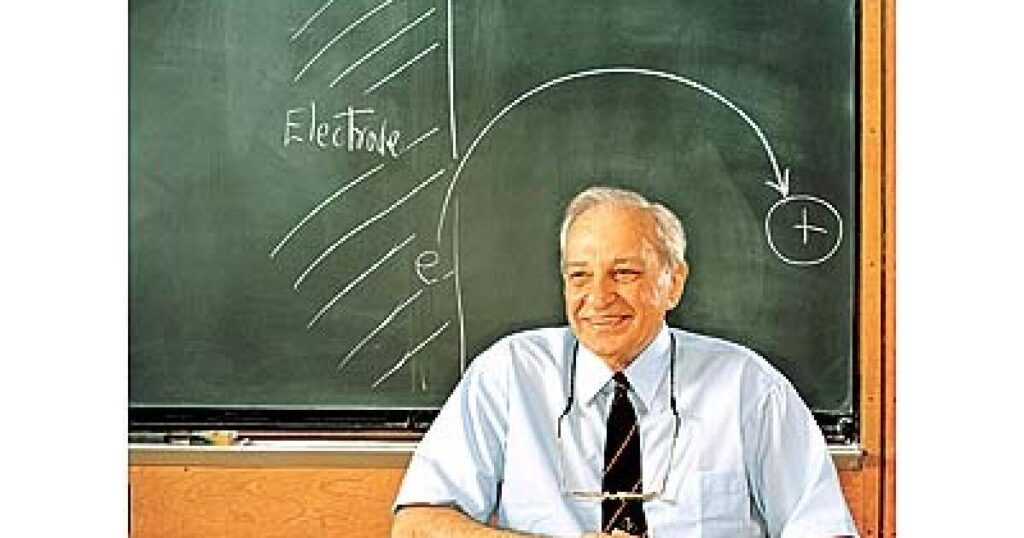
Rudolph Marcus was perplexed. It was 1955 and Marcus, a 31-year-old associate professor of chemistry still in the early stages of his career, had found an elementary mistake in the work of an esteemed scientist.
“Something doesn’t add up,” Marcus thought..
Marcus had discovered a calculation that violated the law of conservation of energy, a bedrock scientific principle, tucked inside a new theory on electron behavior. This frustrated Marcus because he otherwise liked the innovative theory that had been proposed by Willard Libby, a physicist who had helped develop the atom bomb.
Marcus set out to fix the problem, but ended up doing much more. Within a month, he had developed an elegant formula that would upend scientific understanding of how molecules use energy and eventually win him the Nobel Prize.
“When I got the result it was the most exciting moment that I’d ever had in science in my life,” he recalled in a Caltech oral history interview in 1993. “There was just such exhilaration. … It came out in such a simple form. It really was a thing of beauty — to me, anyway.”
Marcus, a Caltech professor for more than 40 years and a longtime Pasadena resident, died Thursday in his home, Caltech said. He was 102.
Marcus first published his conclusions on “electron transfer reactions” in 1956 and continued to refine them over the next nine years. His ideas were controversial until they were confirmed by experiments over three decades. In 1992, he was awarded the Nobel for chemistry.
“His theories had an enormous impact,” said Harry Gray, a fellow Caltech chemistry professor, in 1992.
The “Marcus Theory,” as it came to be known, provides a mathematical way to determine how fast or slow, or in what direction, electrons jump between molecules without breaking chemical bonds. It expanded scientists’ knowledge of a wide spectrum of processes, such as how plants gain energy from sunlight, how animals use oxygen and food as fuel, and how batteries use chemicals to create electricity.
He was also known for his part in what was called the RRKM theory, named for the four scientists, including Marcus, who developed it. It describes how energy is released from the chemical reactions of molecules in the gas phase.
“The RRKM theory is one of the outstanding theories of chemical physics,” said Harold Johnson, a physics professor at UC Berkeley, in 1985. “Marcus took a good theory developed in the 1920s and ‘30s, brought it up to date in 1951 and made it complete. All kinds of people in chemistry use it.”
Rudolph Arthur Marcus was born July 21, 1923, in Montreal, the only child of American-born Myer Marcus and English-born Esther Marcus, both of Jewish-Lithuanian descent. His father had various jobs, selling picture frames at one point, later managing a fruit store. When he was 3, his family moved to Detroit, then returned to Montreal when he was 9.
While his father had little interest in education, Marcus found academic.inspiration in two uncles who were doctors, a great uncle who could speak nine languages and, mostly, his mother.
“She liked school so much that she went to the last grade twice, because she couldn’t afford to go on,” Marcus recalled in a 1991 interview with the Chemical Heritage Foundation.
In high school, he developed a love for mathematics. “If the teacher said do every alternate problem, I’d do every problem, just simply for the fun of doing it.”
At Montreal’s McGill University, he majored in chemistry, partly because an advisor said that as a Jew he would have a harder time finding a job in mathematics. He received his bachelor’s degree in 1943 and a Ph.D. in 1946, both in chemistry and both from McGill.
Marcus did his first postdoctoral research in Ottawa, but in 1949 he jumped at the chance to study theory — instead of hands-on, experimental chemistry — at the University of North Carolina. Within his first few days there, Marcus met Laura Hearne, a graduate student in sociology, and they married six months later. They would have three sons together and remain married until her death in 2003.
In 1951, Marcus landed at the Polytechnic Institute of Brooklyn as an assistant professor. It was there, four years later, that he had his Nobel-winning insight.
“We’ve heard of ‘eureka’ and, yes, there was this eureka moment,” he recalled. “I’ve never solved a problem so quickly, before or after.”
In 1958, he was naturalized as an American citizen.
In 1964, Marcus left Brooklyn’s Polytechnic to be a chemistry professor at the University of Illinois. He spent 14 years there — even turning down a professorship at England’s Oxford University because he didn’t want to uproot his family — before coming to Pasadena and the California Institute of Technology in 1978. Caltech was his home for the rest of his career.
The Nobel and its $1.2 million prize did little to change Marcus. A 1994 Los Angeles Times profile noted that he continued to walk to work most days from his home just off the Pasadena campus, and still drove a 16-year-old car. He said, proudly, that when Laura met Sweden’s King Carl Gustav XVI, she was wearing a homemade dress.
Around the Caltech campus, Marcus remained so unaffected and so focused on his research that one colleague quipped that he “must have spent his million dollars on a new sweater.”
Said Marcus: “It’s best if one doesn’t think too much about prizes and things. That puts the focus in the wrong place, which should be on your work . . . on a particular problem and how you should solve it.”
Marcus is survived by his three sons, Alan, Kenneth and Raymond and four grandchildren. Laura Marcus died in 2003.
Times Staff Writer Corinne Purtill contributed to this report.