

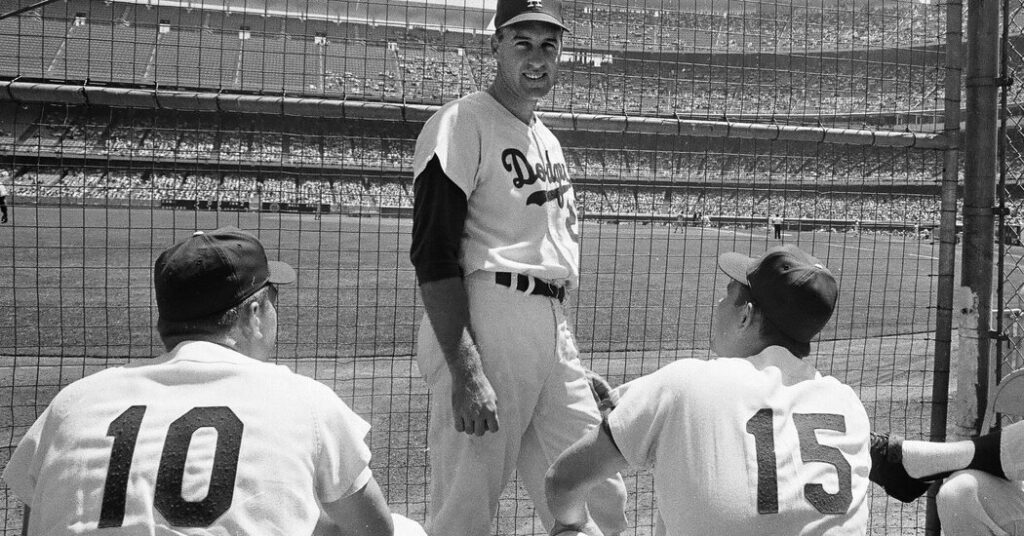
In the summer of 1966, Sandy Koufax gave Phil Regan, his Los Angeles Dodgers teammate, one of baseball’s most descriptive nicknames: the Vulture.
Regan was in his first season as a reliever, Koufax in the last of a Hall of Fame pitching career. Regan quickly developed into an elite closer, picking up an unusual number of wins on a team where the starters — Koufax, Don Drysdale, Claude Osteen and Don Sutton — completed 52 games, a remarkable 27 of them by Koufax.
On July 27, Koufax left a 1-1 game after striking out 16 Philadelphia Phillies over 11 innings. Regan pitched the 12th inning and got the win when the Dodgers scored a run in the bottom of the inning.
Four days later, after Regan won another game in relief, Koufax struck out nine Pirates in seven innings. Regan entered and pitched two scoreless innings and got the win — his 12th of the year — when the Dodgers rallied for three runs in the ninth.
“You’re getting to be a real scavenger,” Koufax told him after the game in Pittsburgh. “A vulture, that’s what you are.”
In the visitor clubhouse at Forbes Field, other pitchers joined in.
“Caw, caw, caw,” Joe Moeller said.
“The vulture strikes again!” Drysdale shouted.
“He hovers over the starters,” Osteen said, “and picks up the win.”
Koufax himself offered another version of the vulture tale. Terry Collins, a former manager of the Mets, recalled in an interview that Koufax told him that Regan’s physical appearance — he stood about 6-foot-4 — had inspired the nickname.
Collins said that Koufax had told him, “One day, I’m on the mound, and he’s in the bullpen. His arms were stretched out over the fence of the bullpen. He looked like a vulture.”
Regan died on July 8 in Port St. Lucie, Fla. He was 89. His death was confirmed by Matthew Blit, his lawyer.
Philip Raymond Regan was born on April 6, 1937, in Otsego, Mich., to James Regan, who worked in a milk condensery, and Gladys (Lewis) Regan.
He enrolled at Western Michigan College (now University) in Kalamazoo, but left in 1956, after his first year, to sign with the Detroit Tigers and played in its minor league system until being called up to the majors in 1960.
Pitching mostly as a starter, Regan won a combined 26 games in 1962 and 1963, but he faltered in the next two seasons and was traded to the Dodgers after the 1965 season.
Regan finished the 1966 season with a 14-1 record, an earned run average of 1.62 and a National League-leading 21 saves. (ElRoy Face’s 18 wins in 1960 for the Pittsburgh Pirates remains the most by a reliever in a single season.) In 1968, Regan won 12 more games in a season when the Dodgers traded him to the Chicago Cubs.
He pitched for the Cubs through the 1971 season; he was released by the Chicago White Sox during the 1972 season. In all, he had a 96-81 career record with a 3.84 E.R.A.
Over the next half-century, Regan epitomized the baseball lifer. He was a major league pitching coach, a scout and, in 1995, the manager of the Baltimore Orioles. But he found his managing niche during winter ball in Latin America.
Over a quarter of a century, he won two championships in the Dominican League, two in the Venezuelan League and one in the Caribbean Series. He kept returning — especially to Venezuela, where he managed five teams — to try out new strategies to use in the major leagues.
In 2009, he joined the Mets organization, where he influenced the development of Jacob deGrom, Noah Syndergaard, Steven Matz and others as the pitching coach of the Class A St. Lucie team and the minor league assistant pitching coordinator. In June 2019, when he was 82, Regan was named interim pitching coach of the Mets.
“He has a great feel for pitching and what it takes to improve pitchers,” Collins, the former Mets manager, said. “I’m sure this summer Steven Matz and Jake deGrom reached out to him, sending him videos of their last outings. It’s always a mechanics thing.”
In 2023, four years after filling the role of interim pitching coach for the Mets, Regan filed an age discrimination and harassment lawsuit against the team and its former general manager, Brodie Van Wagenen. He accused them of refusing to retain him full time in order to hire a younger man, despite his success with the staff.
The case was dropped a few months after it was filed, but Mr. Blit would not say if it had been settled.
Regan is survived by his wife, Lissette Regan; two daughters, Susan VanderWood and Lisa Regan, and a son, Tom, from his marriage to Carol Jurrians, which ended in her death in 2004; a sister, Rita; 18 grandchildren; and 11 great-grandchildren. His son Phil Jr. died in 2025.
Regan didn’t mind being called the Vulture. Late in the 1966 season, a fan told him that a friend who raised vultures wanted to give him one on opening day in 1967.
“I don’t know the guy’s name, and I haven’t heard from him since,” he told The New York Times in early 1967, “but I hope he goes through with the idea because I’m looking forward to it. I even have a name picked out — Koufax. It’s my one way of getting back at him. I can see the headlines now: ‘Koufax returns to the Dodgers.’”