
NOG 2026: Industry leaders say policy, technology, local content, finance must work together for equitable energy transition

Oil & Gas
By Anthony Isibor
THE Oil and gas industry leaders have said that Nigeria can strengthen energy security while reducing emissions if government, operators, technology providers and financiers work together to implement practical decarbonisation strategies.
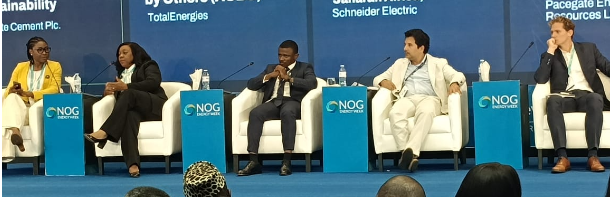
The position was made during a strategic panel session on “Achieving Equitable Energy Ambition – Strengthening Energy Security while Accelerating Decarbonisation” at the 2026 Nigeria Oil and Gas (NOG) Energy Week.
Moderating the session, Igazeuma Adikema Okoroba, Group Head, Sustainability, Dangote Cement Plc, said Africa’s challenge was balancing climate commitments with the need to expand access to affordable energy and industrial development.
Speaking from the policy perspective, Ogogome Epecham said that Nigeria’s energy transition should be tailored to the country’s realities rather than copied from other jurisdictions.
Drawing from more than two decades of industry experience, she argued that any transition strategy must simultaneously address energy access, affordability and industrialisation.
She dismissed the notion that countries must choose between development and decarbonisation, saying that both objectives could be achieved together.
According to her, TotalEnergies has demonstrated this through projects that incorporate emissions reduction measures from the design stage while increasing gas supply.
She cited the company’s Ubeta gas project, expected to deliver first gas in 2027, as an example of integrating zero routine flaring, solar-powered systems and electrified drilling operations into project development.
She also described the Petroleum Industry Act as an important policy framework for supporting Nigeria’s energy transition.
Elijah Daniel, Country Sales Director for Process Automation, Sub-Saharan Africa at Schneider Electric, said that digital technologies had removed many of the traditional barriers to decarbonisation.
He noted that artificial intelligence, infrared methane detection cameras, predictive maintenance systems and automation now allow operators to continuously monitor facilities, reduce emissions and prevent equipment failures.
Daniel said that the falling cost of cloud computing and AI has made these technologies accessible even to indigenous operators.
Unlike international oil companies, he added, local operators have shorter decision-making processes and can implement innovations more quickly.
He argued that Africa’s infrastructure gap presents an opportunity to leapfrog directly into digitally enabled energy systems, much like the continent did with mobile telecommunications and financial technology.
To achieve that, he called for stable government policies, greater investment in digital infrastructure such as data centres and stronger development of digital skills among young professionals.
Speaking on local manufacturing, Umesh Amarnani of Pacegate Energy & Resources Limited said that producing oilfield chemicals in Nigeria has strengthened supply chains while reducing dependence on imports.
He explained that production of chemicals are essential to maintaining oil and gas operations by preventing corrosion and scale formation.
According to him, local manufacturing has enhanced energy security by ensuring products are readily available while promoting technology transfer and creating employment.
Amarnani, however, urged stricter enforcement of Nigeria’s local content law, arguing that contracts should be awarded based on technical capability and product performance rather than other interests.
He also highlighted his company’s investment in staff development, profit-sharing and education programmes, including the adoption of 50 government schools to help develop future talent.
Paul Boeffard, Methane Finance Advisor at the Environmental Defense Fund, said Nigeria has emerged as a leader in regulatory innovation through the Nigerian Gas Flare Commercialisation Programme.
He explained that the programme separates flare gas from operators’ balance sheets, enabling independent developers to recover gas that would otherwise be flared and convert it into commercial products such as compressed natural gas, liquefied petroleum gas and liquefied natural gas.
According to him, this structure allows climate-focused investors to finance projects that reduce emissions while creating new commercial opportunities.
Although 28 flare gas recovery licences have already been issued, he said many developers still face challenges moving from permits to final investment decisions.
The Environmental Defense Fund, he added, is supporting developers through technical advisory services and feasibility studies.
Returning to methane reduction, Epecham said effective methane management depends on accurate detection, monitoring and measurement rather than expensive technology.
She disclosed that TotalEnergies has deployed drone-based methane detection systems alongside permanent monitoring sensors across its facilities and recently renewed collaboration with NNPC on the technology.
She added that the company eliminated routine flaring across all its operated assets in Nigeria in 2023, describing the achievement as a major milestone in its decarbonisation strategy.
The panellists agreed that decarbonisation should not be viewed as an obstacle to energy security but as an opportunity to improve operational efficiency, attract investment and support sustainable economic growth.
A.I
July 8, 2026
Tags: Elijah Daniel Igazeuma Adikema Okoroba Paul Boeffard TotalEnergies Umesh Amarnani