

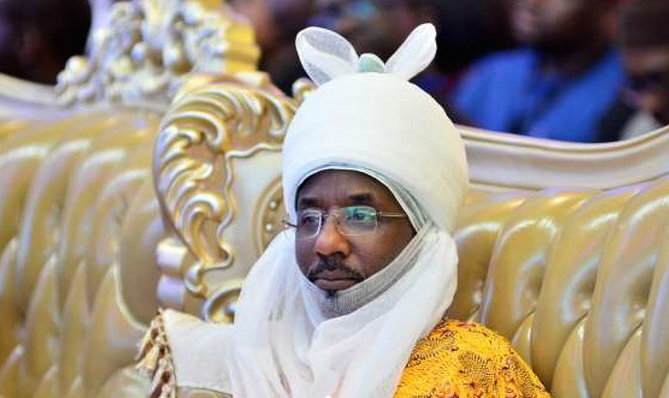
The Emir of Kano, Muhammadu Sanusi II, has declared that Nigeria’s failure to provide reliable, affordable, and sustainable energy remains the greatest impediment to the nation’s industrialisation.
Speaking on Friday at a symposium honouring former Power Minister and Geometric Power Group Chairman, Prof. Barth Nnaji, in Enugu, the Emir underscored that energy security is intrinsically linked to national development. He described a stable electricity supply as the bedrock of economic growth, industrialisation, and poverty alleviation.
“Energy security and national development are inextricably linked,” Sanusi stated. “A reliable, affordable and sustainable energy supply is the foundational driver of economic growth, industrialisation and poverty reduction.”
Economic Productivity at Stake
Sanusi warned that countries without consistent electricity suffer from low productivity, high operational costs, and poor socio-economic development. He noted that affordable power enables businesses to boost productivity and plan effectively.
Citing data from the International Monetary Fund (IMF), he emphasised that energy security directly influences macroeconomic stability and industrial competitiveness. Even brief power disruptions, he added, can curtail economic growth and exacerbate inflation.
The Emir stressed that reliable electricity is equally vital for healthcare, education, ICT, and transportation. He cautioned that Nigeria risks falling further behind as the world transitions to electric vehicles unless policymakers take deliberate steps to bridge the energy gap.
Energy Crisis and Poverty
Describing the energy crisis as a major contributor to poverty, unemployment, and the rising cost of living, Sanusi noted that decades of inadequate supply have stunted industrial growth. He lamented that households and businesses are forced to rely on generators, exposing millions to harmful emissions.
He identified underinvestment, infrastructure vandalism, corruption, regulatory uncertainty, and the absence of cost-reflective tariffs as key constraints to sector investment. The Emir added that the transmission and distribution network lacks the capacity to deliver stable electricity, leading to frequent grid collapses and substantial technical and commercial losses.
Proposed Solutions and Structural Reforms
Advocating a dual approach, Sanusi called for an energy transition that harnesses Nigeria’s natural gas resources alongside greater investment in renewables like solar and wind. He stressed that addressing the country’s estimated $100 billion power infrastructure funding gap would require deep structural reforms.
Geometric Power’s Success Story
As a testament to the transformative power of reliable electricity, Sanusi cited Geometric Power in Abia State. “If you want to see the impact of electricity on an economy, just look at Geometric Power and Abia State. This is living evidence,” he said.
Reflecting on the power sector privatisation, he recalled that Prof. Nnaji had raised concerns about the financial viability of certain distribution companies. Sanusi noted that this highlighted the critical need for strong financial and regulatory institutions to build a sustainable electricity market.
The symposium drew political leaders, policymakers, academics, and industry stakeholders. Notable attendees included former President Olusegun Obasanjo, Enugu State Governor Peter Mbah, and Abia State Governor Alex Otti. The event also featured a presidential fireside chat moderated by Segun Adeniyi, an innovation challenge, and a book presentation.