

By Maryanne Awuya
Nigeria’s cashew industry is set for major reforms following the Federal Government’s validation of the Nigeria Cashew Industry Roadmap, a policy expected to transform the sector into a globally competitive, value-added industry that will drive industrialization, create jobs and boost non-oil exports.
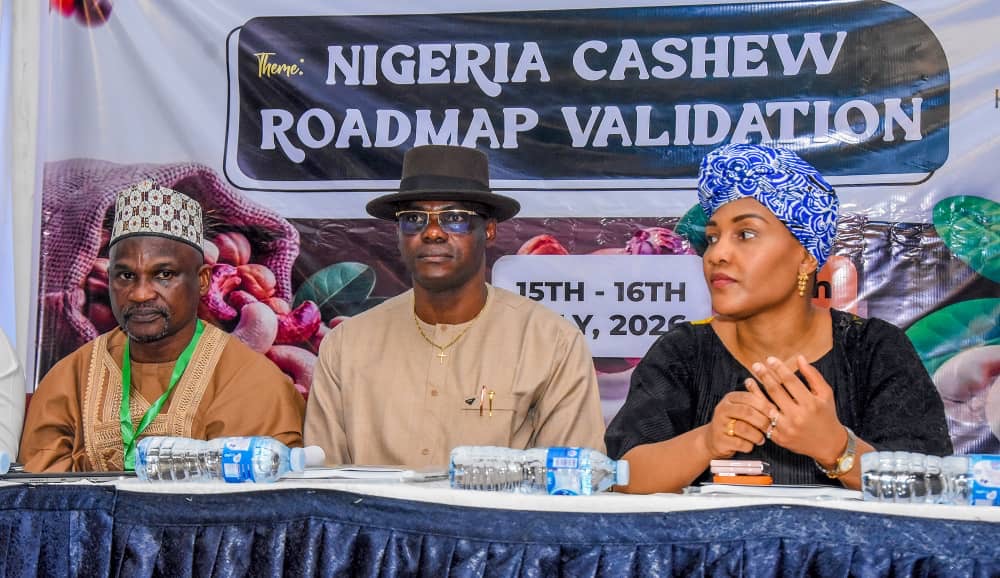
Persecondnews reports that the roadmap was validated at the Stakeholders’ Validation Workshop held on Wednesday in Abuja, where government officials, industry operators and development partners agreed on strategies to strengthen the cashew value chain and unlock its economic potential.
Speaking at the workshop, the Minister of State for Industry, Sen. John Owan Enoh, represented by the Permanent Secretary of the Federal Ministry of Industry, Trade and Investment, Dr. Chris Osa Isokpunwu, described the roadmap as a strategic intervention to reposition Nigeria’s cashew sector through increased processing, investment and value addition.
He said Nigeria’s annual production of between 300,000 and 350,000 metric tonnes of raw cashew nuts presents a huge economic opportunity, but the country continues to lose significant value because more than 85 per cent of the produce is exported without processing.
According to him, moving from raw exports to local processing will not only increase revenue but also create jobs, strengthen farmers’ earnings and enhance Nigeria’s competitiveness in the global cashew market.
Designed to align with President Bola Tinubu’s Renewed Hope Agenda and the 2026 Nigeria Industrial Policy, the roadmap target’s the sector’s biggest pain points.
Isokpunwu noted that the strategy directly addresses critical challenges such as aging crops, low yield, infrastructure and funding shortages, weak quality control, and idle processing plants.
To ensure the roadmap delivers on its objectives, he announced the establishment of a Nigerian Cashew Project Office, which will coordinate implementation alongside the Federal Ministry of Agriculture and Food Security, the National Cashew Association of Nigeria (NCAN), GIZ and other stakeholders.
He said progress would be measured through increased local processing facilities, higher export earnings, improved farmer incomes and stronger recognition of Nigerian cashew products in international markets.
Also speaking, the Minister of Agriculture and Food Security, Sen. Abubakar Kyari, represented by the Director of the Federal Department of Agriculture, Mr. Bukar Musa, described the validation as a major milestone towards creating a comprehensive framework for strengthening cashew production, processing and export competitiveness.
The Director of Industrial Development, Mr. Bala Mohammed, urged stakeholders to focus on effective implementation, stressing that the roadmap must remain practical and capable of delivering sustainable industrial growth.
The Director-General of the Presidential Enabling Business Environment Council (PEBEC), Princess Zahrah Mustapha Audu, said the initiative supports the Federal Government’s goal of building a one-trillion-dollar economy by promoting value addition, investment, non-oil exports and employment opportunities.
Osun State Commissioner for Agriculture, Kola Fashoro, said the roadmap would help unlock the potential of the cashew sector and strengthen Nigeria’s position as a leading producer and processor of cashew in Africa.
Persecondnews also reports that industry stakeholders, including the Cashew Processors and Allied Products Association of Nigeria (CAPPAN), the National Cashew Association of Nigeria (NCAN), the National Apex of Cashew Farmers, Processors and Marketing Cooperative, and the Nigeria Commodity Exchange (NCX), called for policy consistency, improved financing, stronger quality standards, structured markets and increased investment in local processing.
They agreed that successful implementation of the roadmap would transform the cashew industry into a major contributor to industrialisation, rural development, job creation, export growth and economic diversification.