

The Federal Government has issued a formal diplomatic protest to South Africa, demanding urgent action to halt the escalating violence against Nigerian nationals, with official records confirming 98 deaths since 2022.
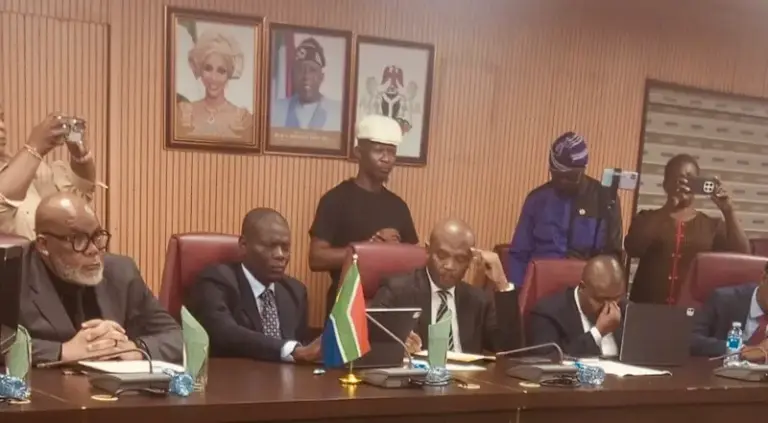
During a high-level meeting in Abuja on Monday, Nigeria’s Minister of State for Foreign Affairs, Ambassador Sola Enikanolaiye, confronted South Africa’s Minister of International Relations and Cooperation, Ronald Lamola, who arrived as Special Envoy of President Cyril Ramaphosa .
President Bola Tinubu directed the talks, emphasising the need for frank discussions regarding what Nigeria describes as persistent “Afrophobic attacks” targeting Nigerians and other African migrants in South Africa .
Enikanolaiye expressed deep concern over the recurring violence, noting that 98 Nigerians have lost their lives in mob and hate-related incidents since 2022 .
“We have seen a pattern that has become a concern to the Nigerian government,” the minister stated, tracing outbreaks of anti-migrant violence back to 1995 .
The minister stressed that while Nigeria does not condone criminality, allegations must be addressed through proper judicial processes rather than mob justice .
“Nigeria will not support drug traffickers or any criminal activity, but those accused of crimes must be treated in accordance with the rule of law, South Africa’s Constitution and international human rights standards,” he said .
Enikanolaiye recalled the recent evacuation of over 1,500 Nigerians from South Africa, describing the experience as deeply emotional. “I shed tears when I received the first batch of evacuees. I saw children, women and the elderly returning home with almost nothing after their properties had been looted and destroyed. That is not the Africa we want,” he said .
He questioned why South African security agencies had failed to prevent attacks on many victims who were legally resident in the country, raising concerns about state responsibility and the safety of foreign nationals .
Drawing on Nigeria’s historic contribution to South Africa’s liberation struggle and their collaboration in establishing the African Union and NEPAD, Enikanolaiye warned that continued attacks threaten decades of strategic partnership between Africa’s two largest economies .
In response, Lamola reaffirmed South Africa’s commitment to combating xenophobia, racism and all forms of violence. “President Ramaphosa has consistently spoken against xenophobia, racism, homophobia, violence and all forms of intolerance directed at anyone living within South Africa,” he said .
He acknowledged Nigeria’s pivotal role in the anti-apartheid struggle, stating: “We remain deeply indebted to the people of Nigeria for their sacrifice” .
However, Lamola maintained that South Africa retains the sovereign right to enforce its immigration laws and tackle crimes including drug trafficking and cybercrime . He called for greater collaboration under African Union protocols to promote safe, regular and orderly migration .
Both governments agreed on confidence-building measures, including strengthening cooperation on migration management and accelerating implementation of the Nigeria-South Africa Early Warning Mechanism .
The Federal Government also confirmed it is preparing compensation claims for Nigerian victims who lost property during the attacks, with claim forms being distributed to affected citizens .