
Nigeria commits to government led humanitarian coordination as minister opens transition workshop

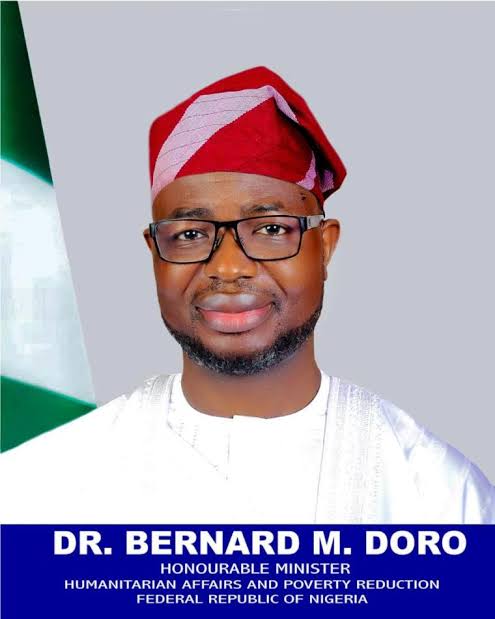
The federal government has reaffirmed its commitment to building a nationally owned, government led humanitarian coordination system as it formally commenced the transition of humanitarian coordination responsibilities under the One Humanitarian, One Poverty Response System (OHOPRS).
Speaking at the opening of the Humanitarian Transition Workshop on Tuesday in Abuja, the Minister of Humanitarian Affairs and Poverty Reduction, Dr. Bernard M. Doro, said the transition marks a strategic shift from dependence on international humanitarian financing to a sustainable system driven by Nigerian institutions, domestic resources and government leadership.
The Minister noted that the workshop comes at a defining moment for Nigeria’s humanitarian sector, as global humanitarian financing continues to decline and the international community increasingly encourages stronger national ownership and institutional sustainability.
He stressed that Nigeria is embracing this transition not merely as a response to shrinking donor support but as a deliberate effort to establish a resilient humanitarian architecture capable of addressing both current and emerging humanitarian challenges.
According to the Minister, the Federal Government established the One Humanitarian, One Poverty Response System (OHOPRS) as the country’s unified framework for humanitarian action, social protection and poverty reduction.
He explained that the initiative is designed to eliminate fragmentation, reduce duplication and ensure that all available resources, whether domestic or international are coordinated through a single, accountable national system.
He clarified that the transition should not be viewed as the withdrawal of international support or merely the transfer of coordination functions from the United Nations to government, but rather as the operationalisation of a Nigerian owned humanitarian coordination framework that will endure beyond fluctuating donor funding cycles.
The Minister assured stakeholders that the Federal Ministry of Humanitarian Affairs and Poverty Reduction is fully prepared to assume the coordination role on behalf of the Federal Government through the OHOPRS framework.
He said the Ministry would work closely with relevant Ministries, Departments and Agencies, state governments, humanitarian organisations, development partners and affected communities to coordinate preparedness, emergency response and recovery efforts nationwide.
He emphasised that the new coordination framework will be guided by accountability, inclusiveness, transparency, evidence based planning and effective collaboration while upholding internationally recognised humanitarian principles.
Acknowledging Nigeria’s persistent humanitarian challenges, including conflict induced displacement, food insecurity, flooding, climate related disasters, public health emergencies and other socio economic shocks, the Minister said government institutions and humanitarian partners must now adapt to operating within increasingly constrained financial realities.
He commended the United Nations Resident and Humanitarian Coordinator, the United Nations Office for the Coordination of Humanitarian Affairs (UNOCHA), the Humanitarian Country Team, development partners and civil society organisations for their sustained support to Nigeria’s humanitarian response. He particularly praised UNOCHA for strengthening coordination, information management, resource mobilisation and effective humanitarian response during some of the country’s most difficult emergencies.
The Minister identified domestic resource mobilisation as a critical pillar of the new humanitarian framework, urging federal and state governments to increase budgetary allocations for humanitarian response and social protection.
He also called for innovative financing through private sector investment, diaspora contributions, philanthropic support, the National Social Registry and the National Social Safety Nets Project (NASSP) Scale Up structures under OHOPRS.
He appealed to development partners to continue supporting Nigeria through technical assistance and capacity building aimed at strengthening sustainable domestic financing mechanisms rather than relying solely on external funding.