

By Omoyeni Ojeifo
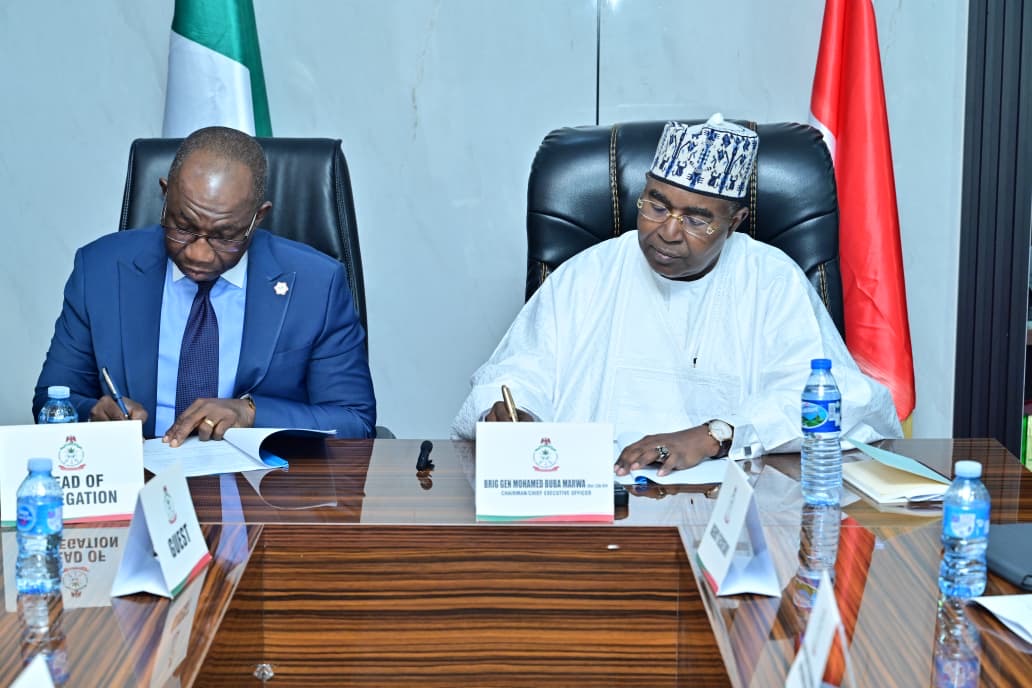
In a strategic shift against organised crime, the National Drug Law Enforcement Agency (NDLEA) and the Nigerian Copyright Commission (NCC) signed a landmark Memorandum of Understanding (MoU) on Friday.
The new partnership unites both agencies in a coordinated front to simultaneously dismantle drug trafficking networks and eradicate copyright piracy across Nigeria.
Persecondnews reports that the Memorandum of Understanding (MoU) was signed on Friday at the NDLEA headquarters in Abuja as part of efforts to strengthen collaboration against drug trafficking, copyright piracy and other forms of organised crime.
Speaking at the meeting, retired Brig.-Gen Mohamed Buba Marwa, the NDLEA Chairman/CEO, said the partnership reflects the shared responsibility of both agencies in tackling organised crime.
He said although the mandates of the NDLEA and NCC may appear different, criminal networks rarely confine themselves to a single illegal enterprise, making collaboration necessary.
Marwa said investigations had shown that drug traffickers often engage in copyright piracy, while proceeds from one crime are frequently used to finance another.
“The same criminal groups also target the works of musicians, filmmakers, writers and software developers, undermining Nigeria’s creative industry. This MoU helps us disrupt that criminal value chain together,” Marwa said.
He pointed that the agreement provides a framework for intelligence sharing, coordinated operations, capacity building and technical support between both agencies.
Marwa added that a Joint Working Committee would be established to meet regularly and ensure the partnership translates into tangible results.
“This partnership protects our people from illicit drugs while safeguarding Nigeria’s creative talents from piracy,” he added.
He said the collaboration goes beyond law enforcement, stressing that it would protect the health and social wellbeing of Nigerians while preserving the country’s creative economy.
The NDLEA Chief commended the NCC for recognising the connection between drug trafficking and piracy, describing the alliance as an example of government agencies working together instead of operating in isolation.
On his part, Dr John Asein , the Director-General of the NCC, described the alliance as a significant milestone in strengthening inter-agency collaboration to combat organised crime and protect national security, economic development and the rule of law.
Asein said copyright piracy is far more than a commercial offence, noting that it deprives creators and investors of legitimate income, destroys jobs, discourages investment, reduces government revenue and weakens Nigeria’s creative economy.
“Large-scale piracy is organised crime. It often shares the same networks used for narcotics trafficking, money laundering and smuggling,” he said.
He added that international experience has shown that organised copyright piracy is closely linked to transnational crimes, including narcotics trafficking, money laundering, smuggling and cyber-enabled offences.
“The same transportation routes, storage facilities, financial channels and distribution networks used for illicit drugs are often deployed to move pirated books, films, music, software and other copyright products.”
He stressed that proceeds from piracy could also be laundered or channelled into other criminal activities, underscoring the need for closer collaboration between both agencies.
“Combining the expertise and intelligence capabilities of the NDLEA and NCC would improve efforts to identify criminal networks, trace illicit financial flows, disrupt illegal supply chains and dismantle organised criminal enterprises.”
He emphasized that the partnership would also enable the NCC to leverage the NDLEA’s intelligence-led operations, strategic investigations, forensic capabilities, surveillance, financial intelligence, international cooperation and effective inter-agency coordination.
Asein commended the NDLEA under Marwa’s leadership for its professionalism, operational excellence and innovation, saying the agency had earned national and international recognition in the fight against organised crime.