

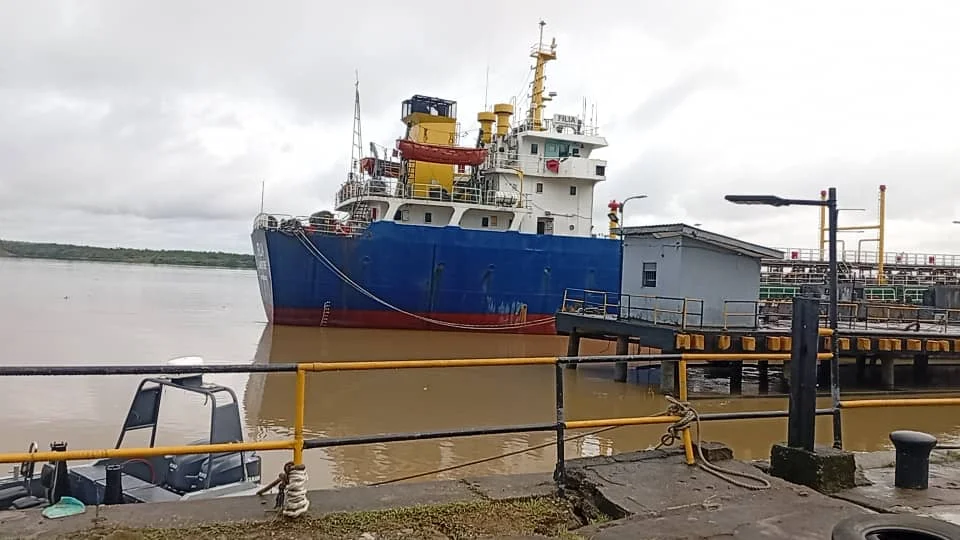
The Nigerian Navy has identified prolonged judicial processes as a major obstacle to the prosecution of crude oil theft cases, warning that lengthy court proceedings are slowing efforts to bring suspects to justice and sustain the fight against maritime crimes.
The delay, according to the Navy, has also created operational and financial challenges as vessels arrested over alleged involvement in illegal activities remain in custody for years while their cases are being determined by the courts.
The Flag Officer Commanding, Eastern Naval Command, Rear Admiral Chiedozie Okehie, disclosed this on Tuesday in Calabar, while speaking with journalists after the command presented MT Filia, a foreign-flagged vessel arrested for allegedly engaging in crude oil theft.
“Our major challenge is in the area of prosecution. We have a vessel that was arrested in 2022 and the matter is still in court. We have other vessels under similar circumstances. The prolonged judicial process places a huge administrative and financial burden on the Navy because we have to maintain these vessels while the cases drag on,” he said.
The naval commander called for reforms to facilitate faster prosecution of vessels and individuals arrested for maritime crimes, stressing that swift judicial action was necessary to complement ongoing security operations.
According to him, the Chief of Naval Staff had provided the strategic direction for Operation Delta Sentinel, while commanders and personnel at operational and tactical levels remained committed to tackling crude oil theft from the nation’s backwaters to the Exclusive Economic Zone.
“There is the strategic will, operational will and tactical will to ensure the success of Operation Delta Sentinel. Our officers and men have shown integrity, transparency and resilience in carrying out this responsibility despite the complex criminal networks involved in crude oil theft,” he said.
Okehie described crude oil theft as a highly organised criminal activity driven by financial interests, adding that the Navy would continue to deploy intelligence gathering, surveillance and enforcement measures to disrupt the networks behind the illegal trade.
He also clarified that Nigeria had successfully eliminated piracy within its maritime domain, explaining that criminal attacks recorded within the country’s territorial waters should be regarded as sea robbery.
“There is a difference between piracy and sea robbery. Piracy occurs outside territorial waters, while attacks within our territorial waters are sea robbery. Nigeria has not witnessed piracy for several years because of the efforts of the Nigerian Navy and other security agencies,” he said.
Speaking on the arrest of MT Filia, Okehie disclosed that the vessel’s 12 crew members were Nigerians, although the ship was registered under the flag of São Tomé and Príncipe.
“The vessel is foreign-flagged but crewed by Nigerians. This shows the international dimension of crude oil theft and the collaboration among criminal elements,” he said.
He assured Nigerians that the Navy would sustain its operations against crude oil theft and other maritime crimes, describing the fight as a long-term effort that requires continuous commitment and periodic review of strategies.
“We are determined to win this war and ensure a safe and secure maritime environment for the country,” Okehie added.