

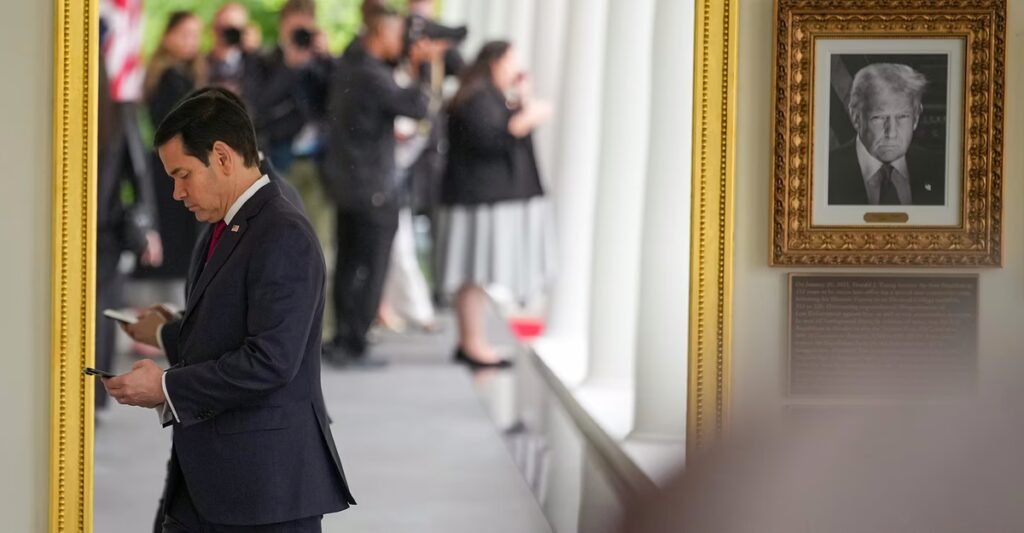
Secretary of State Marco Rubio, like most federal officials, is legally required to retain records that he creates as part of his job. So it was no surprise that his office ended up in court last year after The Atlantic revealed that he had participated in an auto-deleting Signal chat about war plans in Yemen with other top national-security officials. In a case involving a Freedom of Information Act request for the Signal records on Rubio’s phone, a federal judge wanted assurances that these documents had been preserved.
Rubio’s team told the court that his government phone was equipped on July 21, 2025, with software called LeapXpert that automatically preserved from Signal “all messages sent or received, regardless of whether the sender configures a message to ‘auto-delete.’” Seven weeks later, in another declaration to the court, the State Department went further. “Secretary Rubio does not use the auto-deletion functions in third party messaging applications when sending communications that may include federal records,” Susan Weetman, a senior adviser for the department’s Information Access Programs Directorate, told the court on September 9.
But that denial, written in the present tense, was less than it seemed. About two months later, Rubio changed the settings in a Signal chat about administration matters with other senior officials so that the messages would automatically delete after a set amount of time, a person familiar with the exchange told us, requesting anonymity because he was not authorized to share the information. When we reached out to the State Department for comment, the official who responded contested the idea that Rubio has made a practice of turning on disappearing messages but said he could not address the specific instance.
The State Department told us that Signal continues to be an approved communication application, that LeapXpert is installed on the government phones of some officials, and that the department remains committed to full compliance with record-keeping laws. “These measures support compliance even when users adjust application settings, including the Signal app’s ‘disappearing messages’ setting,” the department official told us, speaking on the condition of anonymity to address agency regulations.The department did not answer questions about why Rubio would decide to activate disappearing messages if his phone contained software that ensured those messages could not be fully deleted.
[Read: Hegseth, Rubio, and Caine had an auto-deleting Signal chat]
Jason R. Baron, a professor at the University of Maryland and the former director of litigation at the National Archives and Records Administration, told us that as long as a copy is archived, nothing in the law bars the deletion of messages from an official’s phone. Doing so may even provide security advantages if the phone is lost or hacked. “It can be said to be good practice to eliminate redundant records in multiple places,” Baron said.
The Foreign Affairs Manual, which governs the conduct of most State Department officials, states that “the use of ‘ephemeral’ or self-destructing/disappearing message features with the eMessaging application is strictly prohibited.” Such options should “be disabled or remain deactivated to maintain the integrity, availability, and retention of the official records,” the manual says. The State Department official said the agency has given additional guidance to officials who have LeapXpert installed, because the technology will ensure their messages are archived even if they use the auto-delete function and the messages disappear in Signal. The manual does not reflect this, because so few officials have been given access to LeapXpert.
Democracy Forward filed the litigation to obtain Signal chats from the first half of 2025 from the phones of Rubio and Mike Needham, who was then a senior State Department aide to Rubio. The advocacy group has reserved the right to file further motions in the case after the State Department produced documents last month that showed Rubio or Needham had participated in 13 previously unknown work-related Signal chats. Those heavily redacted documents include a three-person chat among Rubio, Defense Secretary Pete Hegseth, and Joint Chiefs of Staff Chairman General Dan Caine in which messages were set to auto-delete after eight hours. “Democracy Forward is looking closely at these latest developments in light of the State Department’s representations in litigation that Secretary Rubio does not use disappearing messages, and we are evaluating next steps,” Dan McGrath, the senior oversight counsel at Democracy Forward, told us in a statement.
Last year, Democracy Forward raised questions with the U.S. District Court for the District of Columbia about what Weetman meant when she said that Rubio “does not use” auto-deletion, an assertion made under penalty of perjury. “At best, the Declaration indicates that the Secretary does not presently use autodelete, but that representation sheds no light on the preservation of records created prior to the Secretary’s hypothetical change in practice,” the group’s lawyers wrote to the court.
Earlier this year, as part of a settlement with the watchdog group American Oversight, multiple government agencies filed court declarations on April 30 describing their record-keeping practices. What’s notable: The State Department did not repeat its claim from last year that Rubio did not use disappearing messages, instead stating that an application installed on his device collected messages “even if those messages otherwise have a deletion timeline setting enabled.”
In the same filing, the Office of the Director of National Intelligence offered a broader assurance, saying that Signal chats of senior staff “are not currently set for automatic deletion.” The Defense Department said that as of April 26, 2025, there were “no Signal chats containing federal records at risk of impending or automatic deletion” on Hegseth’s phone. The CIA told the court that as of this March 12, all messages on Signal were preserved and that the agency is not aware of any federal records that were “at risk of impending deletion.”
But the continued use of Signal by senior officials worries some on Capitol Hill. Representative Don Bacon of Nebraska, a Republican, has a personal reason for his concern that the platform may not be secure. “Russia hacked my Signal,” he recently announced, after an apparent phishing attempt by a foreign government. Bacon and Representative Chrissy Houlahan of Pennsylvania, a Democrat, recently wrote a letter, first reported by Politico, to the Pentagon and the Directorate of National Intelligence asking for a briefing about what information administration officials are relaying over Signal and the vulnerabilities of the platform. The members of Congress argued that even unclassified information, if intercepted in a nongovernmental chat app, could in the aggregate betray “significant insights” that could “inform adversary decision making.” Bacon told us in a statement that Cabinet secretaries should stop relying so heavily on Signal.
“The Russians and Chinese are definitely monitoring them, and they should act like it every day,” he said.