

As communities in parts of Lagos continue to grapple with the aftermath of persistent rainfall that has submerged homes, inundated roads and disrupted economic activities, Governor Babajide Sanwo-Olu has announced plans by the state government to review the master plans of flood-prone communities.
The governor said the review is aimed at identifying and correcting planning infractions and anomalies that may have emerged over the years due to rapid urban growth and development, with a view to reducing flooding, particularly during the rainy season.
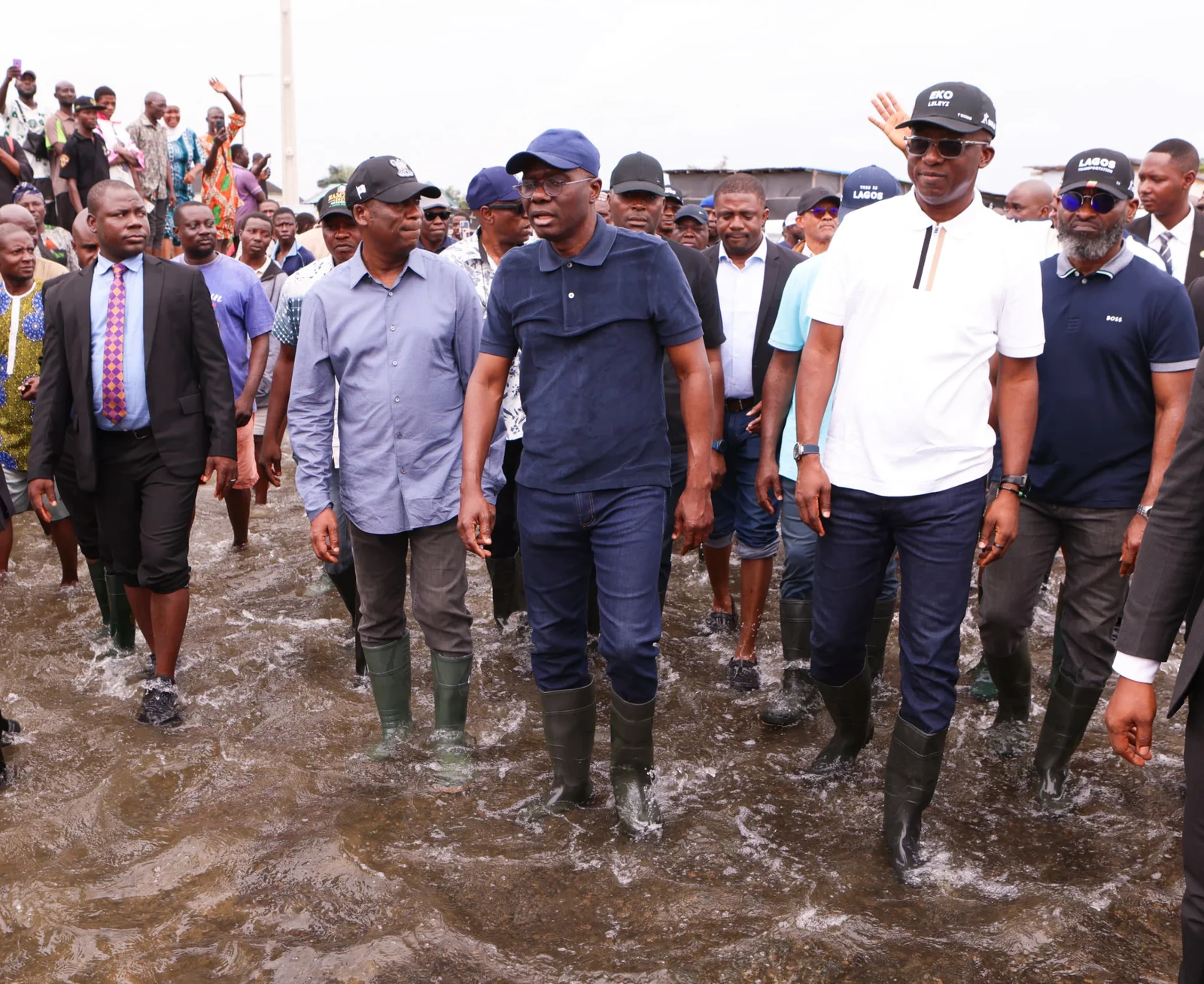
Sanwo-Olu made the disclosure on Wednesday during an inspection tour of flood-affected communities in Ibeju-Lekki and Eti-Osa Local Government Areas, where he assessed the impact of the recent heavy rains and ongoing efforts to improve water flow.
Explaining the rationale behind the planned review, the governor said Lagos has witnessed significant growth over the last four to five decades, with some developments obstructing natural drainage channels.
“If you go and look at the map of Lagos in the last 40 or 50 years, there’s been growth and development. And because of also how we live, some people also would have bastardised some of those natural flow. So we usually review some of these things.
“It’s not to change the master plan, but to identify areas where there have been blockages, where people have tampered with the natural course of drainage, and where we need to improve secondary and primary drainage channels so they can effectively connect to the tertiary drains, especially within the main city,” he said.
The governor, who was accompanied by Deputy Governor Obafemi Hamzat and other members of the State Executive Council, attributed the flooding witnessed in parts of the state to a combination of intense rainfall and human activities that have obstructed natural waterways.
According to him, many of the affected communities are located along Lagos’ natural drainage corridors, making it imperative to preserve and restore the free flow of water into the lagoons.
“What we are being very intentional about is ensuring that water flows through its natural channels because Lagos is surrounded by water and several tributaries,” he said.
Sanwo-Olu noted that while the recent flooding was largely triggered by unusually heavy rainfall, human activities had worsened the situation in several areas.
“In all of the journey we have seen today, there is a natural occurrence and there is also a human factor. Over the years, developments have come to meet natural bodies of water. In some places, people without approvals have restricted the flow of these waterways,” he said.
Using a household analogy, the governor explained how blocked drainage channels contribute to flooding.
“If your kitchen sink is blocked with waste, water will not flow freely. The same thing happens when our drainage channels are filled with refuse or other materials. It is our responsibility to remove those obstructions,” he said.
The governor also described the volume of rainfall recorded across Lagos in recent weeks as unusually high, attributing it largely to the effects of climate change.
“The volume of water recorded in the last three to four weeks is largely due to natural causes. Climate change is real, and we are seeing heavier rainfall across the world. We cannot stop the rain, but we can continue to improve our infrastructure to manage it,” he said.
Sanwo-Olu stressed that tackling flooding requires collective responsibility, urging residents, the media and relevant government agencies to work together to protect the environment.
“We all have a role to play. The media has a responsibility to educate the public, citizens must act responsibly, and government has the responsibility to provide the necessary infrastructure. It is only when we all play our part that we can achieve better results,” he added.
The governor sympathised with residents whose homes and properties were affected by the flooding, assuring them that the government would assess the damage and provide necessary relief.
“We want to commiserate with families that have suffered losses. We will visit other affected communities and see what kind of relief we can provide. Our relief centres are already receiving people, and we will continue to support those in need,” he said.
He also urged residents living in flood-prone areas to heed weather advisories and relocate to safer, higher ground where necessary, warning that the rainy season is not yet over.
Sanwo-Olu further disclosed that the state government would sustain the dredging, excavation and expansion of drainage channels to improve the free flow of stormwater and reduce the risk of flooding.
“We need to come regularly to excavate and clear these channels so there will be free flow of water. Once the waterways are maintained, the water will eventually find its way into the lagoon,” he said.
He added that the Ministry of the Environment and Water Resources, alongside other relevant agencies, would continue monitoring flood-prone communities and implementing measures to minimise the impact of flooding across the state.