

After years of being cast by Knicks fans as a villainous owner, James L. Dolan finally won a measure of redemption when his team won the N.B.A. championship last month.
Now Mr. Dolan has quietly won another protracted war, this one against the New York State Liquor Authority.
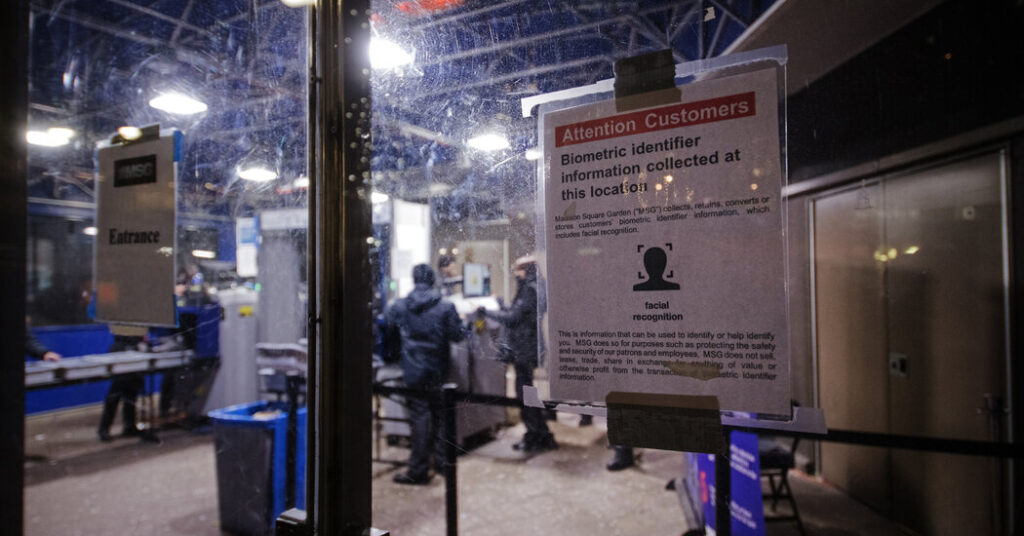
Three years ago, Mr. Dolan courted public condemnation by deploying facial recognition to bar scores of people he deemed enemies from Madison Square Garden. At that time, the liquor authority also took exception, saying that the Garden’s exclusionary biometric surveillance violated state beverage laws that require establishments to admit the general public.
Mr. Dolan was so offended that he took to morning television and urged his supporters to call the head of the liquor authority — whose phone number he helpfully supplied — to urge him to “stick to his knitting.”
Disciplinary actions by the authority, which is responsible for regulating the sale of alcohol, could have included fines or revocation of liquor licenses.
But in an unpublicized ruling last week, the authority quietly directed Mr. Dolan to pay a modest penalty to continue serving alcohol. Fines of $10,000 each were levied on the Garden and two other Manhattan venues that Mr. Dolan also controls — the Beacon Theater and Radio City Music Hall.
“No one wants to cross an organization that’s winning, and in particular one that just won the national championship,” said Brad Hoylman-Sigal, the Manhattan borough president who has tangled with the Garden. He added that he was “disappointed” that the liquor authority was not “more aggressive in interpreting its authority to ban facial recognition technology.”
“It’s unacceptable that fans visiting a venue can be profiled in such a manner that violates their personal privacy,” he said.
The liquor authority’s penalty did not address the biometric issue. Rather, the authority levied penalties for an unapproved change to MSG Entertainment’s corporate structure, an agency spokeswoman said.
The liquor authority said that it levied the maximum fine for the charges in question.
The authority’s decision was not announced but rather buried in the final minutes of a nearly eight-hour board meeting last week.
The charges contesting the venues’ barring of patrons were withdrawn as part of the resolution and not adjudicated, said Jade Kraft, a spokeswoman for the authority, adding that the withdrawal “should not be read as an endorsement of any exclusion policy, facial-recognition practice or admission practice.”
In 2018, the Garden quietly began using facial recognition technology, primarily framing it as a security measure.
The issue gained notoriety in 2022 after numerous lawyers reported that they had been escorted out of MSG Entertainment’s venues after being caught up in the company’s facial recognition dragnet.
It turned out that Mr. Dolan was using the scanners to detect and bar lawyers working for firms involved in litigation against MSG Entertainment, the family-controlled corporation of which Mr. Dolan is chief executive.
The story blew up after Kelly Conlon, a lawyer who worked for a firm that was suing MSG Entertainment, was flagged by facial recognition technology and kept out of Radio City Music Hall while trying to accompany her daughter’s Girl Scout troop to see the Rockettes.
Some of the law firms filed suits challenging the policy and lodged complaints with the liquor authority, which then opened an investigation that threatened the revocation of MSG’s liquor licenses.
If the idea was to use the company’s liquor licenses as a lever to force Mr. Dolan to change his ways, that strategy has fallen short.
“The S.L.A.’s fine pertains to an administrative error and has nothing to do with MSG’s biometric practices,” a Garden spokeswoman said in an email.
Samuel Davis, a partner at the firm where Ms. Conlon was then employed, blasted the authority’s decision as “a wrist slap” that was most likely linked to Mr. Dolan’s outsize political influence.
“If the state is giving him a pass, this will give permission for any bar in the state to exclude certain customers without limits or boundaries,” Mr. Davis said. “It just opens up a whole new spectrum of repression.”
When the liquor authority assigned an investigator to look into possible liquor law violations at MSG-affiliated properties, Mr. Dolan’s team hired a private investigator to tail the state investigator and monitor his Queens home, setting up an encounter worthy of a film noir.
Last week’s decision came as Mr. Dolan’s company remains embroiled in a separate public battle over a database it maintains of its prominent guests.
Earlier this month, Wired magazine published a report detailing a huge leak from a cyberattack of MSG Entertainment’s internal systems. It revealed that the Garden kept a “talent database” of nearly 40,000 entries, tracking high-profile figures in sports, business, politics and entertainment, from John Turturro and Tracy Morgan to Fat Joe and Edie Falco.
Many of the names were Celebrity Row staples who got free tickets to attend the Knicks’ championship run.
Notably, the list also included Lily M. Fan, the chair of the liquor authority, according to an analysis of the hacked material conducted for The Times by Data Breach, a website that helps individuals determine if their data has been exposed.
Ms. Kraft, the authority spokeswoman, said the authority could not speak to why Ms. Fan was on the list. She and a Garden spokeswoman said that Ms. Fan did not receive free tickets.
Last week, MSG Entertainment filed a defamation lawsuit against Wired, calling the article a false narrative composed of cherry-picked fragments of stolen data from the dark web. MSG said its database was a standard customer relations management platform, not a surveillance blacklist.
Wired has stood by its reporting and called the suit baseless.