

Colorado’s rural Fourth Congressional District is Republican territory. In the 2024 presidential election, Donald Trump carried it by 18 percentage points. Yet Eileen Laubacher, a former Navy rear admiral running as a Democrat there, has managed to raise nearly $10 million. The reason? The incumbent is Lauren Boebert, a publicity-hungry Republican despised by Democrats nationwide. In a show of solidarity with Laubacher (or, more accurately, antipathy toward Boebert), donors chipping in less than $200 have provided the bulk of the challenger’s funding, totaling at least $7.4 million.
Like the $55 million that small donors gave to Amy McGrath in 2020 for the privilege of seeing her badly lose to Mitch McConnell in a Senate race in Kentucky, or the $71 million they gave for Jaime Harrison’s quixotic run against Lindsey Graham in South Carolina, the millions now pouring into Laubacher’s campaign will probably look ill-considered in a year’s time.
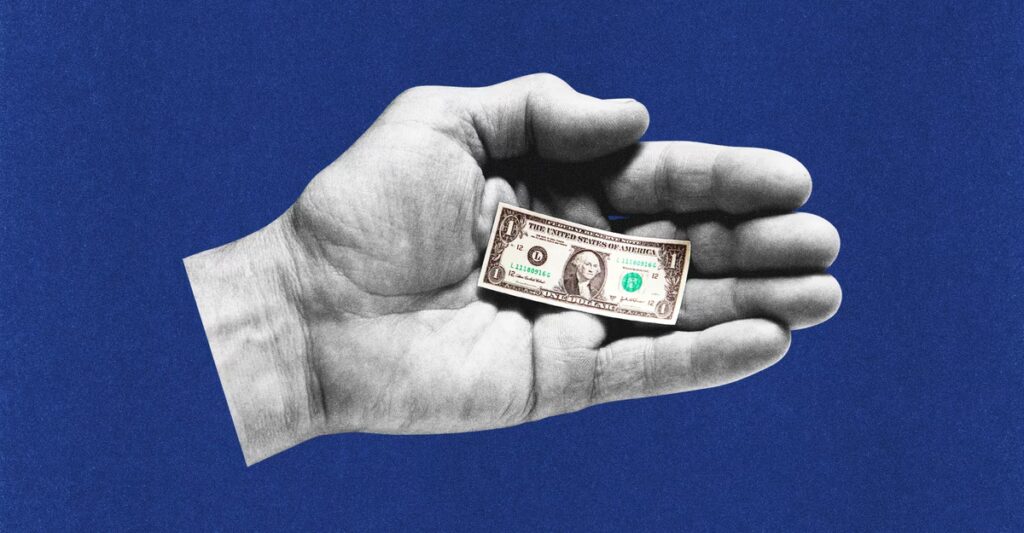
Even so, these costly interventions epitomize a political revolution. For years, most Americans on both sides of the spectrum have bemoaned the ostensibly corrupting influence of large campaign donors. Liberals deplore the Koch network and Elon Musk; conservatives substitute in George Soros and Michael Bloomberg. But over the past decade, the most notable shift in electoral politics has been the massive explosion of small donations, which now rival or exceed donations by the wealthiest campaign contributors. Far from cleaning up the system, as some commentators had hoped, the flood of grassroots money has made American politics both more polarized and more performative. Chasing dollars given by people in a fit of pique has forced politicians to become aspiring influencers.
Concerns about big donors grew after a string of Supreme Court rulings—including Citizens United v. Federal Election Commission in 2010 and McCutcheon v. FEC in 2014—defanged campaign-finance laws on First Amendment grounds. Some reformers who wanted to break megadonors’ grip looked to smaller donors to counterbalance the growing spending by plutocrats. One proposal would have increased the role of small money by having taxpayers match these contributions several times over. “Over the years, small donor public financing has emerged as the most powerful antidote to the outsize influence of megadonors in our elections,” the Brennan Center of Justice, one of the biggest boosters of this idea, claimed in 2023.
[Read: Hawaii vs. Citizens United]
I am familiar with this line of thinking, because I, like many people in the 2010s, once bought it wholeheartedly. I spent my early 20s fuming about Supreme Court decisions that would cement an American plutocracy. Only a constitutional amendment reversing Citizens United followed by new laws reinstating hard limits on political donations could keep rich donors from outbidding the popular will.
As often happens with strong convictions formed in college, a lot of my thinking turned out to be wrong. Money turns out to not be everything, either in life or in politics. Candidates who simply outspend others are not guaranteed victory—which is why we are not presently in the second term of the Bloomberg administration. Both parties have proven adept at raising money through super PACs (which can accept unlimited contributions but must disclose donors) or “dark-money groups” (whose donors are hidden). Democrats have outraised Republicans in every presidential and congressional election cycle from 2018 to 2024, but without achieving anything like permanent control of government. Corporate interests have actually lost their grip on the Republican Party—the Koch brothers, once seen as omnipotent, could not prevent the Trumpian takeover in 2016, and their network’s importance has receded since.
Up until now, I still had hope for the last myth standing—of the salvific power of small-dollar donors. The political scientists Zachary Albert, of Brandeis University, and Raymond La Raja, of the University of Massachusetts at Amherst, disabused me of that idea too. Their new book, Small Donors in US Politics, finds that most people who donate small amounts of money to political candidates are far from a moderating influence; indeed, they are extremely partisan in their beliefs (no less than large donors). Such donors, Albert and La Raja write, are “richer, older, whiter, and more educated” than the electorate as a whole. Their importance has only increased, supercharged by the rise of online donation platforms such as ActBlue and WinRed. Albert and La Raja calculate that from 2016 to 2020, the amount that small donors spent on congressional races quintupled to more than $2 billion. In 2024 congressional elections, small donors more than doubled what large donors spent on direct contributions to candidates. In the 2020 presidential election, La Raja and Albert calculate that small donors put up more than $1.3 billion—actually exceeding super-PAC spending.
The overall effect of their giving has been greater polarization. Many large donors, even hyper-ideological ones, frequently support boring incumbents and other candidates with temperate instincts. “If anything, there’s a sense that corporate donors and institutional donors—big donors—are actually more moderate, or at least more strategic” than small donors, Anthony Fowler, a University of Chicago political scientist, told me. Albert and La Raja show that small donors are disproportionately drawn to ideologically extreme candidates, and pay little attention to how their money might have a greater impact in their home community. They are hugely nationalized in their giving, sending considerable sums out of state to attention-grabbing political figures such as Alexandria Ocasio-Cortez and Marjorie Taylor Greene. Their money tends to be allocated especially inefficiently because of what La Raja summarized to me as the “Darth Vader effect”: Challengers to particularly despised politicians—figures such as Boebert, McConnell, and Greene, in Democrats’ eyes—can crowdsource huge amounts of money even when their odds of winning are impossibly slim. (In a contest between ActBlue and the Death Star, the Death Star usually wins.)
Two presidential candidates who benefited immensely from small-dollar donations were Donald Trump and Bernie Sanders—insurgents who attempted hostile takeovers of America’s two major parties. In 2016, 65 percent of Trump’s individual donations came from small donors; for Sanders, the share was 58 percent. In Congress, some of the prime beneficiaries of small donations are members of ideologically rigid groups: the Freedom Caucus on the right, and the Squad on the left. The most prolific small-dollar fundraiser in the House of Representatives is Ocasio-Cortez, who, despite facing no electoral threat, has raised at least $20.7 million from such donors in the past 18 months—almost triple the comparable sum for Hakeem Jeffries, the Democratic minority leader. La Raja and Albert find that the state legislator who grossed the most from small donors in recent years was Wendy Rogers, an Arizona state senator who is a member of the Oath Keepers and led efforts to overturn the 2020 presidential election in her state.
Anti-establishment figures continue to rely on small donors. In his improbably successful New York City mayoral campaign, the democratic socialist Zohran Mamdani was disproportionately powered by donors who gave less than the $250 (as well as by New York City’s generous match rate of eight to one for contributions by city residents). Small donors have also showered money on Graham Platner, the scandal-plagued Democratic Senate nominee in Maine. Whether ultra-MAGA or ultraprogressive, grassroots donors show far less interest in state legislative races (average cost: $68,000), where their money could go much further than in marquee federal races.
[Read: The AI super PACs trying to influence the midterms]
The right way to categorize small donors is not as all-American everymen, but instead as what the political scientist Eitan Hersh has called “political hobbyists”—people who are intensely interested in politics, but not to the point of running for office or volunteering in a campaign. Hobbyists vent their feelings by giving money, usually from the comfort of their smartphones, in response to viral speeches or events such as the death of Supreme Court Justice Ruth Bader Ginsburg (which led to $91 million in donations on ActBlue). “It’s an emotive type of giving,” La Raja said. “It’s a bit irrational and inefficient in many ways.”
Perhaps smalligarchy, for all of its flaws, is better than oligarchy. The argument goes that it is still less corrupting to the souls of politicians to raise money from the masses instead of cultivating major donors. Liberated from intimate dinners with plutocrats, legislators should have more time on their hands to do honest work. But the pursuit of small donations shapes candidates’ behavior too. To earn these dollars, politicians must attract attention and attain some degree of virality through extreme social-media posts or catchy performances in committee hearings or cable news. Because giving is an emotional response, maximizing donations requires appeals to anger, fear, and disgust (thus explaining the hysterical register in which most political fundraising emails are written). Getting likes on TikTok and Instagram may not be as morally suspect as backroom dealing, but it can be just as time-consuming—and is likely more divisive.
The best thing that can be said of the rise of small donors is that they have almost completely counterbalanced the rise of super PACs. Yet they are further weakening the Democratic and Republican parties. Each major party finds that the candle has been burned at both ends: ultrarich donors are able to set up independent committees to boost whichever candidates they like, while rank-and-file donors can sustain candidates who are hostile to the party apparatus and seek to expropriate it for their own faction. Parties have seldom exercised less control over candidates, and thus over policy. (The Supreme Court recently decided a case, National Republican Senatorial Commission v. FEC, striking down hard limits on expenditures made by political parties on behalf of their candidates, which will helpfully bolster the parties even if the further loosening of spending rules offends reformer types.)
Amplifying the role of small donors could destabilize politics further. A six-to-one matching scheme for small donors, such as the one that Democrats proposed when they previously ran the House of Representatives, would benefit immoderate and spotlight-seeking candidates of both parties. The parties have previously experimented with requiring a certain number of small donors in order to qualify for televised debates. On the Democratic side in the 2020 presidential campaign, this criterion aided the campaigns of Andrew Yang, Tulsi Gabbard, and Marianne Williamson (each of whose politics can be politely summarized only as “heterodox”) while impeding moderates such as Senator Michael Bennet of Colorado and former Montana Governor Steve Bullock. On the Republican side in 2024, it led to the spectacle of Doug Burgum, a self-funding, ultra-wealthy candidate, offering to give people a $20 gift card in exchange for a $1 contribution.
There is a more fundamental problem too. There is now a vicious feedback loop powered by the attention spans and contributions of small donors—politicians have an incentive to make angry, extreme, or norm-breaking statements, while news (and news-adjacent) outlets have an incentive to cover them. It is not the only cause of polarization. But the loop should be broken, not set to spin faster.