

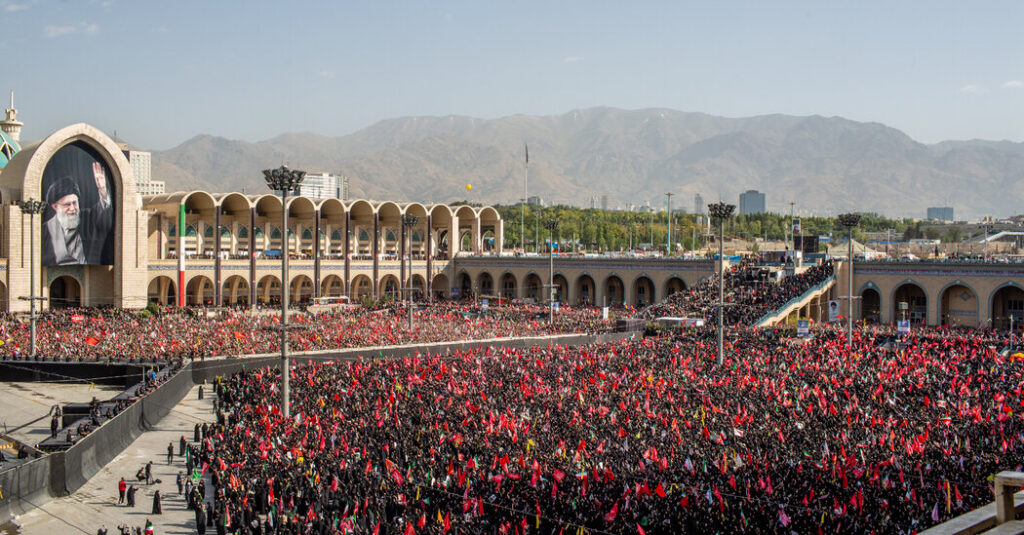
Huge crowds of Iranians gathered on Saturday to view the casket of Ayatollah Ali Khamenei at an elaborate state funeral for the former supreme leader, who dominated Iran for decades before being killed in the U.S.-Israeli war in late February.
Tens of thousands of people began arriving at dawn at the Grand Mosalla mosque in the capital, Tehran, for the start of six days of public ceremonies. Millions are expected to participate in the funeral as Ayatollah Khamenei’s body is transported to cities across the country.
Journalists for The New York Times at the event saw grieving supporters erupt in tears at the sight of the caskets of Ayatollah Khamenei and several family members who were killed along with him, including his daughter and two grandchildren. Encased in glass and draped in Iranian flags, the caskets were placed atop a stage, with the ayatollah’s coffin positioned above the others.
It is a turbulent moment for Iran, which has spiraled from crisis to crisis. Huge antigovernment protests this year were met with a brutal government crackdown, followed by months of war with the United States and Israel. Israeli airstrikes killed Ayatollah Khamenei, along with other top Iranian leaders, on the first day of the conflict.
While Ayatollah Khamenei’s supporters mourn him, many other Iranians view the lengthy and expensive funeral program with anger. Over 37 years of authoritarian rule, he harshly repressed dissent and allowed economic mismanagement and corruption to fester.
His son, Mojtaba Khamenei, was named the country’s new supreme leader. It is unclear whether the son would take part in any of the funeral ceremonies; he has not been publicly seen since his appointment.
Ayatollah Khamenei is being buried only now — more than four months after he was killed — in the wake of a cease-fire that the United States and Iran signed last month. Analysts say the Iranian authorities were most likely wary of organizing a mourning event featuring senior leaders when the threat of U.S. or Israeli attacks loomed. Foreign dignitaries, government officials and Iranian-backed militants from across the Middle East paid their respects before Ayatollah Khamenei’s flag-draped casket on Friday, according to state media.
Throughout Saturday, the crowd broke into chants of “death to America” and “God’s curse be on Israel.” Some mourners carried banners calling for revenge, and people posed for photos with a red anti-Trump banner.
Arash Emrani, 44, a poet, said he was angry at President Trump, accusing him of doing something “un-Christian” by waging the war that killed the supreme leader. “It is all very wrong and sad,” he said.
The New York Times was granted access to the funeral ceremonies by Iran’s government, which determined the ceremonies that the reporters could attend, accompanied by a translator and a guide who were provided by the government. The views expressed by people interviewed at these events may not be representative of many Iranians, while others may have felt unable to speak freely.
Temperatures on Saturday climbed above 90 degrees Fahrenheit, and the mosque grounds grew increasingly hot. Ambulances and medical workers stood by, and at least one person was seen being carried away on a stretcher. Overhead water sprinklers misted the crowds in an effort to cool people down. Volunteers also distributed water from large tubs packed with ice.
After a procession in Tehran on Monday, the ayatollah’s body will be taken to the city of Qom and then on to Karbala and Najaf in Iraq; all three cities hold sacred significance for Shiite Muslims. On Thursday, his remains will be buried in his hometown, Mashhad.
The event in Tehran was intended as a show of strength for Iran’s Islamic republic, which survived despite U.S. and Israeli hopes for regime change. Conservative supporters of Ayatollah Khamenei said they had slept in their cars overnight to avoid missing the ceremony.
But there were signs of criticism from religious hard-liners who see the cease-fire with the United States as a capitulation. Some mourners carried a banner that read, “What happened to revenge for the blood of our martyred Imam?” — a reference to the ayatollah, according to video posted by Iran’s state broadcaster.
Yeganeh Torbati and Leily Nikounazar contributed reporting.