

For one of the three World Cup hosts, the tournament is over.
While Mexico staged the opening game, and millions have wildly celebrated each Mexican victory, and the United States has basked in being the World Cup’s principal host nation, Canada has at times felt like an overlooked party guest by comparison.
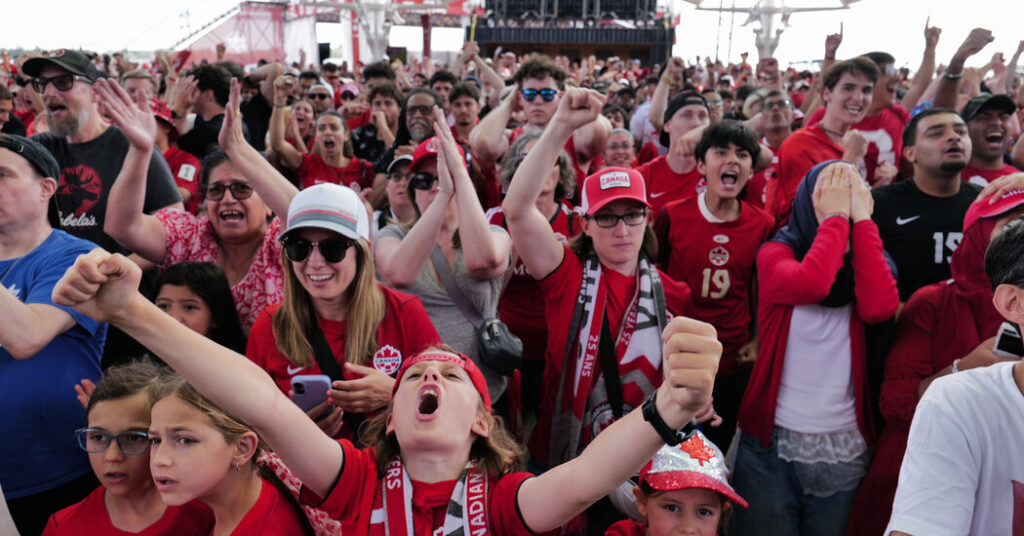
But like its co-hosts, the nation has made history of its own on and off the field. Huge crowds followed the Canadian team to its best performance ever — winning its first men’s World Cup games and qualifying for the knockout round. Immense street celebrations sprang up for a sport that, until this summer, had never been a Canadian obsession. The country embraced the tournament and its team with a hysteria normally reserved for hockey.
Canada’s run ended on Saturday in the round of 16, in a matchup that pushed one of the top teams in the tournament, Morocco, to play at its very best. Azzedine Ounahi scored two second-half goals for Morocco, and Soufiane Rahimi added a third at the last moment. Canada’s loss, 3-0, did not fully reflect its strong effort.
In Canada on Saturday, watch parties from Halifax to Vancouver were packed with nervous, excited fans wearing red, glued to enormous screens.
And there were roughly 10,000 Canada fans in the stadium in Houston — the “Sea of Red.” At the final whistle, some sitting behind the goal cheered and raised the flag. They rose as one to cheer once more as the players walked toward the stands, underscoring a bond between country and team that grew with each World Cup game.
“Nobody thought we were a soccer power, and now we are pushing back against one of the best countries in the world,” John Legge, who traveled from Vancouver with his adult son Rob to Houston, said at halftime. Thousands of others had made the same trip from Canada to Texas.
Even before the tournament — the first World Cup held in North America since it was played in the United States in 1994 — Canada drew little attention from organizers. FIFA’s president, Gianni Infantino, never lavished the kind of regard on Canada’s prime ministers as he did on President Trump, with whom he is close.
With their American coach, Jesse Marsch, the Canadian men’s team has grown into a national talking point, bringing the nation together in a way that few other events can do, in moments of both joy and anguish.
Many will long remember the image of the midfielder Ismaël Koné, his leg badly broken, being wheeled off on a gurney while giving a thumbs up to a cheering crowd in Vancouver. Another such moment: when his replacement celebrated a goal in a rout of Qatar by hoisting Koné’s jersey into the air.
Canada is the host for just 13 of the 104 tournament games, as is Mexico. (One game in Vancouver remains to be played on Tuesday, featuring Switzerland and Colombia.) But Canada’s draw was particularly unglamorous, leaving it without the marquee matchups it had hoped for since the three-nation bid won the right to the 2026 World Cup eight years ago.
Even so, the crowds kept coming, regardless of the teams playing or the cost, showcasing Canada’s diversity as fans of every background turned out. That was clear from the first game, a draw between Canada and Bosnia, to the tournament’s final game in Toronto, when the host nation finally got to showcase superstar players and superstar teams.
A pulsating game between Portugal and Croatia in Toronto will go down as one of the tournament’s best competitions. Led by their 40-something stars Cristiano Ronaldo for Portugal and Luka Modric for Croatia, the teams were buoyed by thousands of Canadians who could trace their ancestry to one of the countries. The game was decided by a controversial line call that will probably be debated for years to come.
Even before the matchup, Toronto’s large Portuguese community turned out in force, serenading its heroes outside the team’s hotel before chasing their bus on its way to the stadium.
“You can see from our soccer team there are people from all over the world, different heritages, and that’s what Canada is: a country that welcomes a lot of people, and we are getting behind our team,” Mr. Legge said.
But the lasting legacy may be what Canada’s national team accomplished on the field. The team was never expected to win the World Cup, but its march to the round of 16 captured the hearts of the nation and helped build a foundation for the sport to expand for generations.
“It will have an impact,” said the younger Mr. Legge. “The whole country is rallying behind it; we love this.”
Mr. Marsch said as much late last month after his team beat South Africa in Los Angeles, a legacy-defining win. Calling his players “Canadian heroes,” he told them, “The future of the sport in this country is huge because of you.”
Mr. Marsch has become something of a Canadian hero himself, leading the national team with visible emotion that has endeared him to his adopted country.
After the game he said, “My love of being the Canadian national team coach, and my love of this team, and these players, and of representing the country is immense.”
The outpouring of public support, and the bond forged with fans, moved even the most experienced player on the roster. Alphonso Davies, a veteran of Champions League soccer in Europe who missed the final game through injury, was not prepared for this.
“It was surreal because I’ve never seen so many Canadians at a football match before,” he said before the win against South Africa. “It brought tears to my eyes.”