

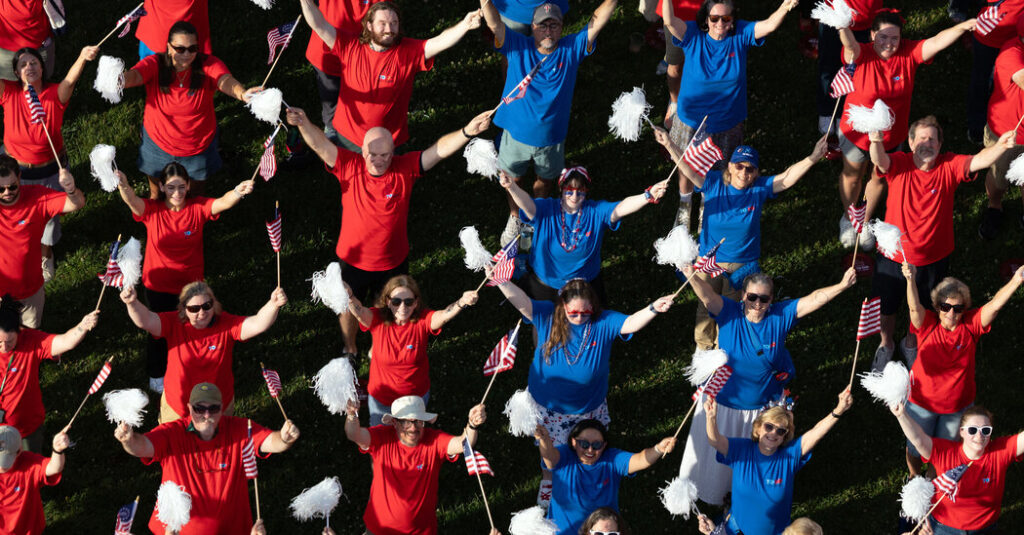
A quarter of a millennium into its experiment in self-governance, the United States finds itself living out twin realities.
The nation’s capital, mired in septic politics, has struggled to pull off a big Fourth of July party. There is algae in the Reflecting Pool, acrimony in the air, and a sense, in some quarters, that America is in deep peril if it cannot persuadethe 80s poodle-rocker Bret Michaels to sing for its official 250th birthday celebration. Mr. Michaels and other performers bowed out for fear that President Trump had made the affair overly partisan.
But beyond Washington, thousands of Fourth of July celebrations will run today on an old, familiar muscle memory, unblemished by scandal, factionalism or questions about the attendance of boldface names.
In Seward, Neb., population 7,600, the day will start with a community buffet breakfast at the club for Veterans of Foreign Wars. At 10:30 a.m., there will be a pie-eating contest in the town band shell. The grand parade is scheduled for late afternoon.
“We’re not the Rose Bowl, and we’re not the Orange Bowl on parade — we are in Nebraska,” said Clark Kolterman, 75, a retired English teacher who has organized Seward’s celebration since 1969. “If you come to our parade, you’re going to see some brand new, big tractors and combines that the owners are very proud of.”
This is the other American reality, with its abundance of modest Rockwellian charm, suggesting a nation that will endure the current pall of angst — a place with a proclivity for innovation, a pretty good economy, and a competitive national men’s soccer team.
On Saturday, much of the patriotism will be site-specific, taking on the flavors of the vast land — “not merely a nation but a teeming nation of nations,” as Walt Whitman put it — where there is still much that is marvelous, innocent, lovely and weird.
In Cody, Wyo., Matt Tarr, 41, will spend a chunk of his Independence Day hiding in a big aluminum barrel, under threat of having his brains kicked out by an angry bull. Mr. Tarr is a professional rodeo clown, and Cody, his hometown, honors American independence each year with a rodeo.
Mr. Tarr’s work is grueling, frightening and fun, and he said it shows American families the virtues he tries to live by.
“It’s dang-sure a God thing for me,” Mr. Tarr said of his work in a phone interview this week. It is also, he said, a patriotic thing, a manifestation of the cowboy culture that has become a global shorthand for American audacity and grit.
“Rodeo’s red, white and blue all the time,” he said.
Such thinking is rooted in Americans’ tendency toward optimism, a trait which, it has long been assumed, the European mind could not comprehend. But there are some signs that Americans’ tendency toward optimism is fading. Last year, a poll by The New York Times and Siena University showed that a large majority of Americans believe that the country has become too divided to solve its problems.
In the last few weeks, a little mood booster has come, remarkably, from European soccer fans visiting the U.S. for the World Cup. A number of them have been effusive, in online posts, in their praise of Waffle House, Taco Bell, the beer joints of Boston and the barbecue pits of Texas.
To Glenn Jacobs, the Republican mayor of Knox County, Tenn., those good reviews of America underscored “the disconnect between what we see on TV and what we all experience in our everyday lives,” and reminded Americans of all that is worth celebrating in daily life. “I think that’s one thing that the World Cup really helped with,” said Mr. Jacobs, a former professional wrestler.
The U.S. men’s soccer team has also lifted spirits as their gritty play has taken them to the World Cup’s round of 16. Heading into Independence Day, the chants of “U-S-A,” have been on the lips of both liberals and conservatives in sports bars and watch parties.
The team is notably diverse at a time when the idea of “celebrating diversity” sounds increasingly cringe to many on the left and the right. But here, too, America cannot seem to help itself.
In Del Rio, Texas, just across the U.S.-Mexican border, the city’s Fourth of July party will have hot-dog eating and skateboard competitions, and a slate of musical acts that are almost exclusively Hispanic, including the Tejano singer David Marez, who will be singing songs in Spanish.
In Houma, La., a small city southeast of New Orleans, Blayne Bergeron and his band, Bandit, will be the warm-up act for fireworks over the lake. Mr. Bergeron is Cajun, and the band can play swamp pop, a catchall category of regional styles, including songs in Cajun French.
“But this coming celebration we’re going back to the roots,” he said. “REO Speedwagon, Queen, Deep Purple, Led Zeppelin, Billy Squier.”
In Brattleboro, Vt., a city of 11,000 people, the parade will feature the American Legion band, veterans, community groups and a 14-foot papier-mâché replica of the Statue of Liberty, in honor of Richard Morris Hunt, a Brattleboro architect who designed the statue’s pedestal.
In a cherished town tradition, a well-known local figure, Alfred Hughes Jr., will bring up the rear. Mr. Hughes is a Black Republican in a city that is 92 percent white and overwhelmingly Democratic. Every year he wears a dress or a pantsuit to underscore a different patriotic theme.
Mr. Hughes, in an interview on Thursday, said this year’s theme was “Lady Liberty enlightening the world.” But he said he wasn’t going dress up like the Statue of Liberty.
“Of course not — I’m an original,” he said. “What I’m going to wear is something that says freedom.”
The post How Do You Celebrate America’s 250-Year Experiment? However You Want. appeared first on New York Times.