

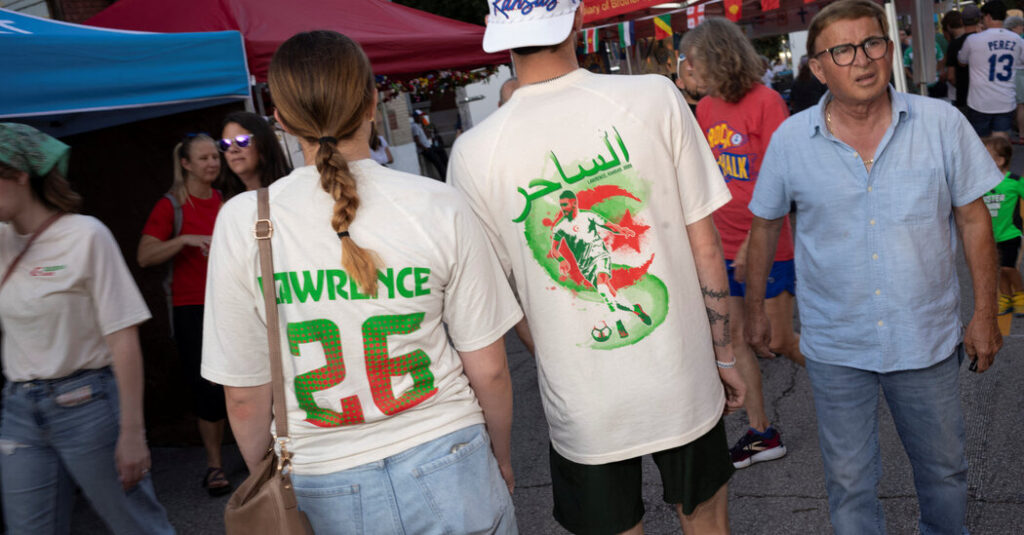
On Sundays, protesters assemble on the corner near the ACME Hot and Fresh T-shirt store in Lawrence, Kansas, incensed by an expanding array of causes: the Iran war, the Gaza war, the White House, ICE.
The protests draw honking horns of approval and the occasional jeers from the other sides of the debates.
But these days, there is just one dominant team to cheer in Lawrence, which is a boon for Hot and Fresh. “Everybody wants an Algerian shirt in Lawrence,” said David Sauter, a co-owner of the shop.
The small city, home to the University of Kansas, had a notable, if brief, surge in Algerian arrivals over the last few weeks as the Algerian national soccer team made Lawrence its World Cup headquarters. The university marching band played the Algerian anthem. The players received dignitaries’ escorts from the police, on motorcycles.
“Trying to get the democracy back hasn’t stopped,” Mr. Sauter said. But in the meantime: “Viva L’Algerie!,” as they say in Lawrence. “The distraction is lovely,” he said.
Yes, the Beautiful Game, as the great Pelé called the sport of soccer, is a lovely distraction from the rancorous noise that has become a national anthem.
If the face Americans show to each other lately — and that America often flashes the world — seems to be a scowl, its World Cup face is a wide, welcoming smile.
It is 60,000 fans in Miami watching tiny Uruguay and minuscule Cape Verde valiantly battle to a tie.
It is Dallas police officers sitting on the tarmac at the city’s airport, showing off their best “Viking row” to greet the Norwegian team’s plane.
It is Chattanooga’s only tapas joint providing sangria, bacon-wrapped dates and watermelon skewers to the Spanish athletes.
It is a Scottish fan in Boston, taking to Instagram to say, “We were expecting to be met by ICE agents, aggressive policing, the political climate we see on the news. That could not be further from what we are experiencing.”
The expectations were understandable. The celebration of the nation’s 250th birthday is a layer cake of contention and conflict. And the country is in the midst of the harshest campaign to detain and deport immigrants since World War II.
This week, Berto Aguayo, a Mexican American lawyer and community organizer from Chicago, was in Los Angeles for a knockout round match between Spain and Austria. (Spain won 3-0.)
Last year, as Mr. Aguayo knows well, federal immigration agents swarmed neighborhoods in both Chicago and Los Angeles and often scuffled with protesters. But on Thursday, Mr. Aguayo said he felt a sense of joy as he rode a shuttle to the game with a Taiwanese-American friend from law school and his Korean American partner, surrounded by people from across the country and the world.
“To me, that reflects the pluralism the tournament can represent and the kind of country we should aspire to be,” Mr. Aguayo said. “One where people from different backgrounds come together despite our differences.”
Simon Kuper, a British journalist and author of books on soccer, warned that these World Cup kumbaya moments rarely lead to lasting shifts in politics or culture. He recalled that after France won the World Cup in 1998 with a team of Black, white and Arab players, some predicted — wrongly — that it would spell the end of the French far right.
“The World Cup almost never changes anything; it illuminates the world,” Mr. Kuper said. “It shows us countries more clearly and what it is showing us about the United States is that it is a multicultural country and a lot of Americans take joy in that.”
They sure are taking joy in America’s multicultural team, whose roster reflects the current immigration laws that are the subject of such fierce debate and legal combat. Wednesday night’s game between the U.S. and Bosnia and Herzegovina was a tableau of national identities, with lines as blurry as the distinction between yellow and red card penalties.
Folarin Balogun, who scored the first of two U.S. goals and later was ejected with a red card, is American thanks to the 14th Amendment’s birthright citizenship clause, which earlier in the week a divided Supreme Court upheld in the face of a challenge by President Trump. He was born while his Nigerian parents, who lived in London, were visiting family in the United States.
The second U.S. goal came on a free kick after a foul against Sergino Dest, who holds dual citizenship. He was born in the Netherlands to a Dutch mother and a Surinamese-American father who served in the U.S. military.
And the player who scored that goal, Malik Tillman, was born in Nuremberg, Germany, also to an American serviceman and a German mother.
Cross-border stars are not unusual in soccer, which is by far the world’s most popular sport. And its globalist theme has previously turned off some on the political right. Glenn Beck, the right-wing commentator, once said of the sport, “I hate it so much, probably because the rest of the world likes it so much.”
But winning wins fans. Rep. Nathaniel Moran, a Texas Republican who has backed Mr. Trump’s assault on birthright citizenship, applauded the U.S. team on X after Wednesday’s victory for its “grit, determination, perseverance, and strength.”
Gov. Ron DeSantis of Florida, a tough-on-immigration Republican, hosted Shaun Alexander, a Scottish fan whose World Cup travel videos have gone viral, at Joe’s Stone Crab in Miami on the governor’s less-viral “Diners, Drive-ins & DeSantis” video series. When the prospect of a U.S. championship came up, Mr. DeSantis said, “it would be pretty neat if they were able to do it.”
Blue states and red have welcomed the brief foreign visitors. When the Iraqi team arrived in West Virginia, Senator Jim Justice, a Republican, called it “a really special day.”
The United States, of course, did not throw its arms open for everyone. A Somali referee was denied entry, and some fans were denied visas.
The Iranian team was permitted into the country for only about 48 hours to play its matches, and had to stay across the Mexican border, in Tijuana. Still, after playing their last match in Los Angeles, home to a large Persian diaspora that includes many fans of the Iranian team, the players left a positive message in the locker room via Post-it notepad.
“From the ancient Persia of thousands of years ago to the civilized Iran of today, the spirit of Iran remains alive and steadfast,” it said. “We came to Los Angeles with pride, competed with honor, and leave with dignity.”
Salvador G. Sarmiento, a Mexican American attorney in San Diego and a soccer fan, said the contrasting treatment for teams on each side of the border was striking, but not surprising.
“The World Cup is a global phenomenon, and like in any global phenomenon, it sharpens the contradictions we live in,” he said. “It makes them more visible.”
The dissonance between the country’s multicultural embrace of the World Cup and the administration’s hard-line isolationist policies is particularly challenging for those active in the immigrant community, like Andreina Malki.
Ms. Malki, who left Uruguay as a teenager, now works as an immigrant rights organizer in North Carolina. She’s had soccer games playing in the background these past few weeks while she answered calls reporting ICE activity across the state, and dispatched people to verify the sightings.
“It is very hard to see people celebrate the game on one stage but then to have people afraid to go to a pickup game on the other,” she said.
Ms. Malki loves the sport. Among her earliest memories of soccer are watching a match with her grandfather in her native city of Paysandú. When her family resettled in South Carolina in 2003 after the economy in Uruguay fell apart, soccer became one of the remaining ties to her native country.
The beautiful game resonates powerfully, for her and many others around the world, as an expression of struggle and hope.
“Things we might not be able to achieve in the real world, we can achieve on the field,” she said.