

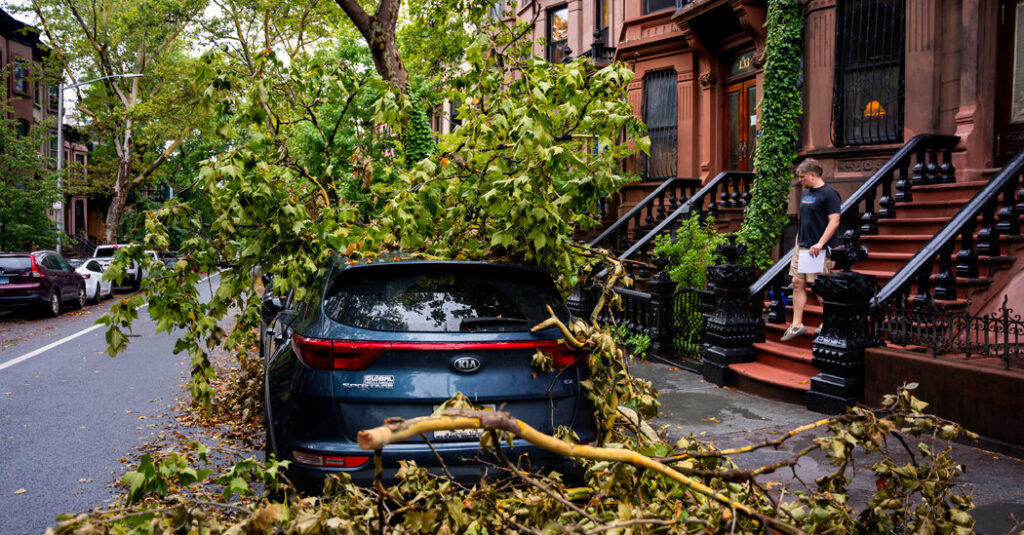
A deluge of rain this week flooded basements and transformed highways into rivers, submerging vehicles across parts of New York, New Jersey and Connecticut.
But for New York City, it could have been much worse: Central Park recorded just about an inch of rain.
The heaviest downpours hit areas immediately north and south of the city, according to Jim Connolly, a meteorologist with the National Weather Service in New York.
To the north, in Orange County, communities were hit by a “crazy amount” of rainfall, said Nick Bassill, the director of the New York State Weather Risk Communication Center, which operates weather recording stations across the state.
In Otisville, a village in Orange County, more than eight inches of rain fell over two days, while neighboring areas picked up five to six inches. “So that’s a significant amount of rain up there,” Mr. Connolly said.
Most of that deluge actually fell within a single 24-hour window, Dr. Bassill said. Weather station data showed that Otisville received 8.39 inches of rain from 8 p.m. on Sunday through 8 p.m. on Monday. That was the third-highest 24-hour precipitation total anywhere in the state since Dr. Bassill’s group began keeping records in 2015.
A Region Under Water
The heavy band of moisture stretched well beyond New York’s northern suburbs.
Connecticut: Four to five inches of rain fell from Sunday through Tuesday.
New Jersey: Multiple locations recorded more than two inches of rain, especially along the Jersey Shore.
Long Island and Brooklyn: Heavy totals clipped the southern edge of the metropolitan area, with south Brooklyn recording 4.26 inches.
The storm shattered daily rainfall records. Even at Kennedy International Airport, where the overall total was less than what some suburbs recorded, 1.75 inches of rain fell on Monday, breaking the previous daily record of 1.03 inches set in 2005.
Why the City Escaped Worse Flooding
While some totals were staggering, the flash flooding was somewhat mitigated because the rain was distributed over a longer period of time rather than falling all at once, Mr. Connolly said.
“When you draw it out and the rainfall rates are a little bit lower, even though you get the high totals, the flash flood impacts aren’t there because it’s allowing for a little bit better runoff,” he said.
New York City and Long Island certainly experienced flooding, Dr. Bassill said, but the areas “barely missed out” on the most catastrophic totals.
Radar estimates from Dr. Bassill’s center indicated that a band of rain just south of New York City dropped an estimated nine inches of rain over the open water. Had that band shifted just slightly to the north, the city most likely would have faced severe, widespread flooding.