

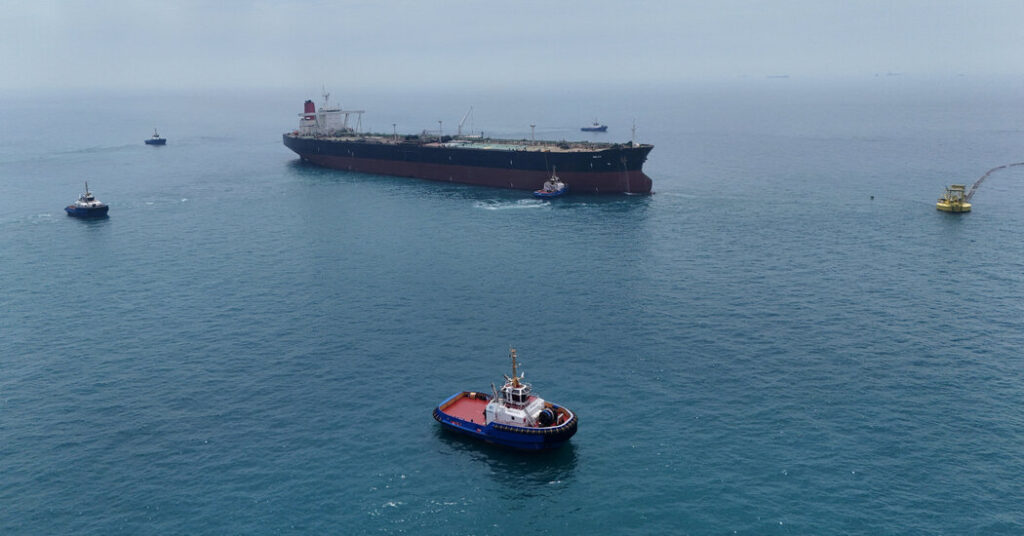
Oil prices surged on Wednesday after U.S. and Iranian forces traded strikes in and around the Persian Gulf and the Trump administration revoked a waiver that allowed the sale of Iranian oil in retaliation for attacks on three tankers in the Strait of Hormuz, a crucial conduit for the world’s energy flows.
U.S. Central Command said that it hit over 80 targets in Iran in an operation that concluded in the early hours of Wednesday morning in Iran. Among the targets were dozens of small boats used by the Iranian military, “to degrade Iran’s ability to continue attacking international commerce,” according to U.S. forces.
Iran’s military command responded by reiterating its claim to control traffic in the strait and pledging a “crushing response” to the latest U.S. strikes. Iran’s forces said they targeted 85 U.S. military sites in Bahrain and Kuwait on Wednesday, prolonging a retaliatory cycle that could derail the nascent recovery in shipping traffic in the region.
Oil prices rise sharply, breaking relative period of calm.
Brent crude oil, the international benchmark, rose nearly 6 percent, to above $76 a barrel, its highest level in two weeks. Although down significantly from its peak during the worst of the fighting, the recent jump pushed oil back above its prewar price of around $72 a barrel, where it had hovered for several days.
West Texas Intermediate crude, the U.S. benchmark, also jumped, to around $72 a barrel.
Gasoline prices don’t move in lock step with crude, usually tracking increases or drops with a delay. The U.S. national average price of gas was $3.79 a gallon on Tuesday, according to the AAA motor club. That price at the pump remains more than 27 percent higher than it was at the eve of the war in late February, amid signs that gas stations are maintaining wider profit margins amid the volatility.
A tentative recovery in shipping appears at risk.
The attacks this week on three commercial vessels, including a Saudi oil tanker and a Qatari liquefied natural gas carrier in the waters off the coast of Oman, threatened to throttle the flow of energy through the Strait of Hormuz, which had recovered somewhat as shipowners. Tehran has not claimed responsibility for the attacks.
On Monday, 36 ships passed through the strait in both directions, according to Kpler, a maritime data company. Before the war, more than 100 ships a day routinely passed through the narrow choke point between Iran and Oman.
Only three of the ships that transited on Monday took the Omani route, through which the U.S. Navy is providing guidance. Iran insists that vessels pass close to its coast, which some analysts see as a precursor to Tehran charging ships for passage. The middle of the strait is considered dangerous because of the risk of mines laid by Iran’s military.
Stock markets continue to shrug off the war.
Global stock markets were mixed on Wednesday, with investors generally more focused on the prospects for technology companies and the build-out of artificial intelligence systems than the effects of the war in Iran.
In Asia, markets in Japan and South Korea posted declines, while stocks in Hong Kong and Shanghai rose.
Futures for indexes in Europe and the United States were flat in premarket trading. The shares of major tech companies have recently been rattled by fears that enormous investments in A.I. systems may not pay off as handsomely as expected, with semiconductor companies coming under pressure in recent trading sessions.
Many market strategists remain bullish. “The A.I. theme is intact, and strong earnings are on the way,” Louis Navellier, a longtime money manager, wrote in a research note. “The Iran situation still casts a shadow, with the chance for sudden high escalation still not out of the question,” he added, but an eventual resolution would be “a strong catalyst for a meaningful relief rally.”