

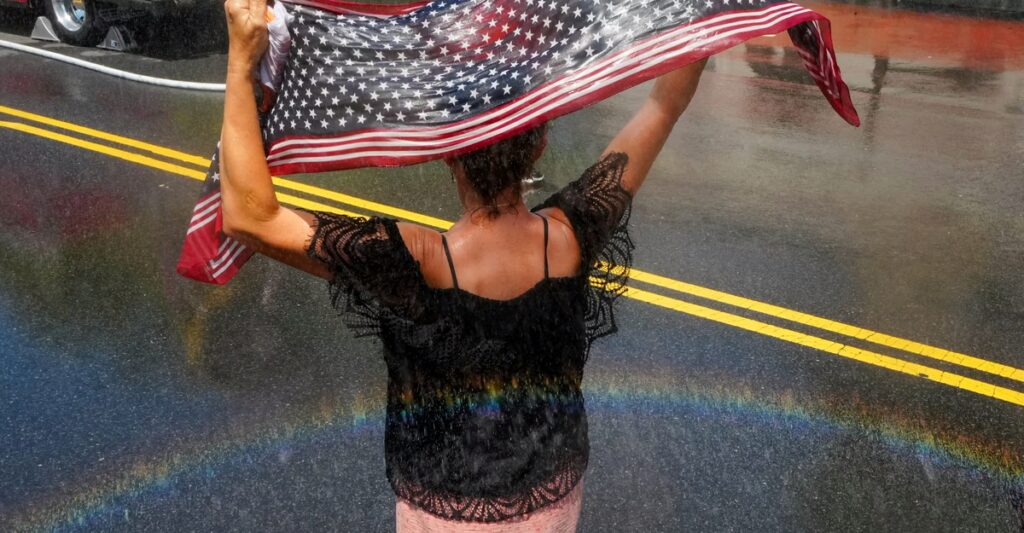
On the eve of the United States’ 250th birthday, in the nation’s capital, people were sweating through their shirts, and tourists were pressing electric fans directly to their foreheads. The record-breaking heat wave that roasted the Midwest earlier this week has turned Washington, D.C., into hell. Temperatures peaked at 102 degrees Fahrenheit, with a heat index of 117. The sky was cloudless, and the humidity was encouraging me to lie down and cry. It was difficult to believe that D.C. has been four degrees hotter than this twice before, in August 1918 and July 1930. Tomorrow may be even more surreal, with another day of oppressive heat and throngs of tourists in town to see what the president has billed as the biggest fireworks display in human history.
On Tuesday, August 6, 1918, “so hot was it that the asphalt paving of the downtown streets became so soft that in places the heel marks of pedestrians were left in it,” The Washington Herald reported at the time. Josephine Lehman, a young woman who’d come to D.C. to work as a secretary in the Department of War when World War I began, wrote home to her mother that “the cement pavements burned one’s feet through the soles of the shoes.” In an apparent first, the head of the city police decided to let his officers patrol without their jackets. Indoors, conditions were unbearable. Fifty government staffers in the State, War, and Navy Building—now called the Dwight D. Eisenhower Executive Office Building—were taken to the emergency room on account of the heat, the Evening Star reported at the time. City officials ordered ice-cream parlors to stop making ice cream in order to conserve the district’s ice supplies. They also waived occupancy limits at community pools, worried that people would pass out in line to swim. Each pool ended up holding 600 to 700 people.
The pools were packed to capacity as well on July 20, 1930—the second time D.C. hit 106 degrees. Thousands fled the city for the beach, which was “too hot for all but the most daring” anyway, the Herald reported. The paper also ran a photo of about a dozen kids splashing in the Reflecting Pool that day; a cop, standing in the background of the photo, seems happy to let them play. The Washington Daily News reported that “a Sunday throng” still showed up to the National Zoo, where staff hosed down the elephants and the hippo stayed in its bath. Meanwhile, thousands of people slept on benches, fire escapes, and parks across the city, especially in Potomac Park, just south of the National Mall. Those who chose to rest on the banks of the Potomac River could be seen by steamship passengers playing bridge and dancing in the river breeze. Just beyond the city, forest fires raged across Maryland. According to the the Washington Times, “sufficient help could not be mustered as volunteers were loath to brave the intense heat.”
Now, D.C. residents and visitors have the option of staying cool indoors with air conditioning. That’s good news, because many of the sites where residents cooled themselves in years past were closed to the public today. Yellow tape separated me from Potomac Park; when I made eye contact with a member of the park police, he wagged his finger at me. Because of fireworks and other planned festivities for the 250th, the National Mall is currently a maze of chain-link fences, megastages, Porta Potties, and temporary Greco-Roman structures. The incredibly shadeless Great American State Fair, where dozens of people were treated for heat-related problems today, was canceled until 5 p.m. At one point, I asked a member of the National Guard if it was possible to walk to the Lincoln Memorial, and he apologized for the heat. When I noted that he was the one covered in military fatigues (no officials seem to have loosened uniform standards in this heat wave), he admitted to “suffering” but said that he was surviving.
No one could cool off in the Reflecting Pool—a place where swimming is never encouraged and which is now additionally fenced off, thanks to the algae that bloomed after President Trump’s failed attempt to beautify it. Black bags of fireworks lined its perimeter, stationed for the spectacle to come. As close to the water as people could get were about five protesters in inflatable frog costumes, one of whom carried a sign that read TEAM ALGAE. As I spoke with one of the frog protesters, who gave her name only as Val and had stuffed ice packs into her sports bra to keep cool, about 20 fighter jets flew overhead, leaving a trail of red and blue smoke.
[Read: Science has a name for what’s plaguing the Reflecting Pool]
The fighter jets reappeared when I was checking on the wildlife at the National Zoo. No one was hosing off the elephants, but an employee told me that they have three wave pools to choose from and that staff will periodically run showers for them. The pachyderms seemed to be fine, if sluggish, until the sonic booms began. One of the elephants, 51-year old Swarna, began running around her enclosure in a circle, like a bucking bronco. As I waited for my Uber out, I sat next to a mother and daughter who had flown to D.C. for the Fourth of July and were advising Dad, who was still at the hotel, to skip the zoo: The heat was “worse than Disney.”
I ended my adventure at one of D.C.’s packed community pools. A mom of two, Lanay Brown, told me that she’d brought her kids and nieces to the pool most weeks since school had let out. Today was the first they’d had to wait in line to enter. Summery pop and rap blasted from a speaker. Max, who is turning 1 in four days, sat next to the kiddie pool in his own inflatable pool, biting it. His dad, Andre, who had moved to D.C. from Florida, told me that this is the hottest he’s felt since leaving the state five years ago.
I’m also a Floridian, but Florida, quite frankly, has never tried me like this. I waded into the pool in my dress and felt a relief I can only imagine was similar to what D.C. residents felt many summers ago. I went home thinking that this was maybe the most American day of my life, with the poolside rap and the warplanes and the many, many patriotic T-shirts. It was definitely the hottest.