

In cricket, there are the batsmen, who finesse the ball with a careful shot or bash it to the boundary.
There are the bowlers, who speed the ball past the batsmen or baffle them with a spinner.
And then there are that rare breed, the all-rounders, who do both things well.
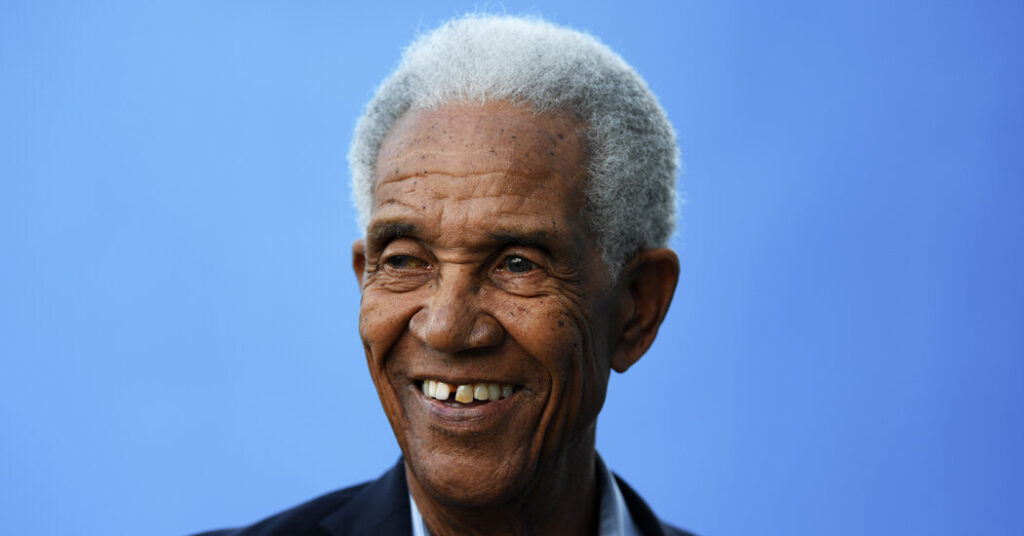
Garfield Sobers, who in the long history of cricket was quite possibly the best all-rounder of them all, has died. He was 89.
Cricket West Indies announced the death in a statement on Friday that did not cite a cause or say where he died.
Although initially considered primarily a spin bowler, Sobers, who was known as Garry, swiftly showed himself to be a brilliant batsman as well. He scored 365 runs against Pakistan in 1958 at just 21. It was the highest total in the history of Test matches, the most important games in international cricket. The feat took 10 hours.
Scoring 100 runs in an innings is considered a spectacular performance, while 50 is a great one. Sobers had an average score of 57 runs per innings in his 93 Test matches. He finished his career with 8,032 runs in Tests from 1953 to 1974, a record at the time.
As a bowler, he also excelled. He could bowl both fast balls and slower, spinning balls and get batters out by taking their wickets both ways — an unusual feat in the sport. He took four wickets on his debut and kept them coming throughout his career. He finished with 235 wickets in his 93 Test matches, the sixth-highest career total at the time.
To be considered an all-rounder, a player must bat and bowl well. But Sobers did more. He was also a great fielder and captained the West Indies team for much of his career, in a sport where captains are not mere figureheads but make numerous strategic decisions throughout a match.
Garfield St. Aubrun Sobers was born on July 28, 1936, in Bridgetown, Barbados, the fifth of six children of Shamont and Thelma Sobers. After his father, a seaman with the Canadian Merchant Navy, died in 1942, when his ship was sunk by the Germans during World War II, his mother raised the children on her own, on a small government pension.
Sobers was born with an extra finger on each hand. (He once said, “They didn’t inhibit me in any way at all.”) He removed the first when he was 9 or 10, with the help of a piece of catgut, and the other at 14 or 15, using a knife.
Growing up, Sobers played cricket on the beach with a ball made from tar. One Barbadian variant he played was called Lilliputian cricket, a game in which players knelt on one knee to play. “The Lilliputian cricket final in my neighborhood,” he told The Guardian in 2002, “was the fiercest competition I ever played in.”
Once he began playing more organized cricket, his bowling was honed by the profit motive: A coach would put a shilling on the stumps that bowlers aimed at and give it to young Garry if he knocked it off. “That was a lot of money in the early ’50s, especially for a young boy who was given four cents a day for his lunch,” he wrote in a 2002 memoir, “Garry Sobers: My Autobiography.” “A penny equaled two cents, so a shilling was worth 24 cents. Riches indeed!”
As a teenager, Sobers worked as an itinerant stevedore, loading and unloading cargo at his local port, before joining the West Indies team at 17.
He retired in 1974 and, unlike many stars, did not stay involved with the game, saying he found watching or commenting on cricket boring.
He was knighted the next year, and the revered cricket publication Wisden voted him one of the five best cricketers of the 20th century. He earned 90 of 100 possible votes, second only to the Australian batsman Donald Bradman.
Bradman himself called Sobers’s score of 254 against Australia in 1971 “the greatest innings ever played on Australian soil.”
Sobers is survived by three children, Matthew, Daniel and Genevieve Sobers. His marriage to Prudence Kirby ended in divorce.
Of all of his performances, the one that is perhaps most remembered came in 1968, not for the West Indies but for a club team, Nottinghamshire County Cricket Club, in England. Facing the first of the six balls that make up an “over,” Sobers smacked the ball out of the field of play to score six runs. He did the same on the next five balls as well.
Six balls, six sixes. Perfection. It was the first time in the long history of top-level cricket that it had ever been done.
“We were looking for quick runs,” Sobers recalled to CricInfo, now called ESPNcricinfo, in 1998. “It was only about the fifth six that I thought, ‘Here’s something that hasn’t been done. Why not try it?’”