

It was a plan House G.O.P. leaders hoped would satisfy everyone in their party: With a special budget bill, they would bypass Democratic opposition and provide tens of billions for the Iran war while imposing new election restrictions President Trump has demanded.
Instead, a day after the leaders released the plan, which hews closely to a spending request the White House sent to Capitol Hill last month, it became clear it is a product that no one really likes.
The measure, which House G.O.P. leaders are hoping to pass through the filibuster-proof reconciliation process, would provide up to $73 billion in additional military funding, $12 billion for farmers and $10 billion to enforce severe new voting restrictions championed by Mr. Trump.
On Thursday, even as the House Budget Committee voted along party lines to advance the blueprint, it appeared that fissures over the measure were opening by the minute inside the Republican Party.
Chief among them was a growing divide between the House and Senate, where Republicans have long been more skeptical of the endeavor. It would be the third time in 18 months that the party has turned to reconciliation — a maneuver created to help reduce federal deficits — to muscle through key elements of their agenda.
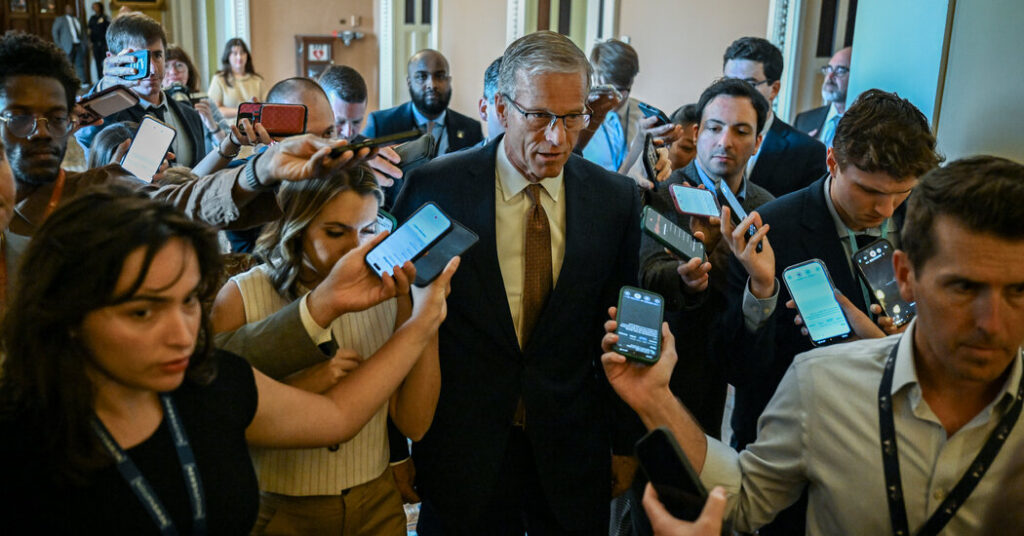
Senator John Thune of South Dakota, the majority leader, said there were open questions among G.O.P. senators over whether “the juice” needed to try to push the measure through was “worth the squeeze,” given that it would ultimately deliver far less military funding than Mr. Trump originally asked for.
In the Senate, Mr. Thune noted, unlocking the reconciliation process would require two marathon voting sessions that would allow Democrats to force votes on politically thorny issues just before the midterm elections.
“I’m not pooh-poohing it,” Mr. Thune said. “I’m just saying people need to think long and hard.”
In both the House and Senate, conservatives are frustrated that there are no cuts proposed to offset the costs of the new spending they are being asked to approve. That decision was made in the hopes of protecting vulnerable Republicans in tough re-election fights from the political perils of voting for spending cuts to popular government programs only months before facing voters.
But even without such cuts, the prospect of voting to pour tens of billions of dollars into an unpopular war is less than appealing to many Republicans running for re-election.
And at least four Republican senators have said they want the measure to be offset by new spending reductions, including Senator Ron Johnson of Wisconsin, who is in line to lead the Budget Committee following the death of a fellow Republican, Senator Lindsey Graham of South Carolina.
“I’m not for new government spending unless it’s offset by cutting other government spending,” Senator Rand Paul of Kentucky said.
While many center-leaning House Republicans facing competitive re-election races in November are reluctant to vote to fund a war that has already driven costs up, some of their more hawkish counterparts in safe seats are unhappy for the opposite reason: They don’t think the legislation provides enough money for the Pentagon.
Senator Roger Wicker, Republican of Mississippi and the chairman of the Armed Services Committee, told Bloomberg on Thursday that he opposed the measure because he wanted to deliver all $1.5 trillion in military spending that Mr. Trump requested for the coming year.
Further complicating the measure’s prospects is Mr. Trump and conservatives’ insistence that Republicans attach the SAVE Act, the elections overhaul bill that would require people to prove that they are U.S. citizens when they register to vote, impose new identification requirements when they vote and severely curb voting by mail.
It is far from clear that the measure can be paired with the reconciliation bill, which is subject to strict rules requiring that all provisions make direct changes to spending or revenue. And at least two Republican senators have said they oppose the voting restrictions measure altogether.
“It’s a waste of time,” Senator Thom Tillis, Republican of North Carolina, said. “It’s an exercise in futility. And those are the only positive things I can think of to say about it.”
Some conservatives in the House are already concerned that the amount of money the Budget Committee allocated to carry out that measure — $10 billion — will not be enough.
With Republicans split over the legislation, Vice President JD Vance visited the Capitol on Wednesday afternoon to meet with House Republicans. Afterward, he told reporters that he was there to bring “a message of unity.”
“We’ve got to stick together and accomplish one — at least one — very big thing for the American people, which is the president’s priority, the White House’s priority, the entire Trump administration’s priority, is to actually get the Save America Act passed,” Mr. Vance said.
Standing alongside him, Speaker Mike Johnson added: “There is nothing in this bill that every Republican in Congress cannot proudly get behind.”
Michael Gold contributed reporting.