

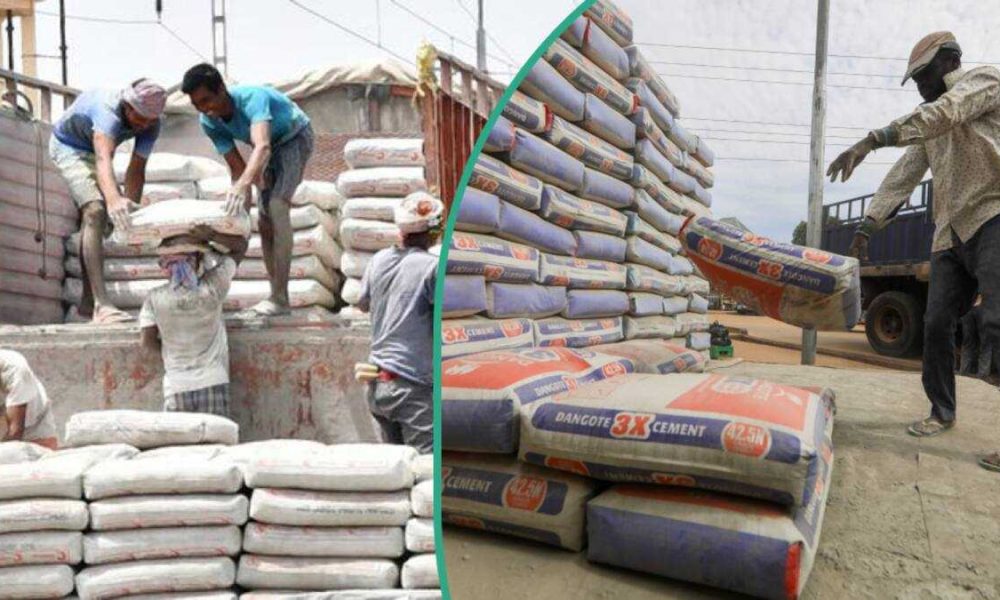
The Federal Competition and Consumer Protection Commission (FCCPC) has launched a fresh investigation into the Nigerian cement industry over preliminary findings suggesting possible price manipulation and other anti-competitive practices.
The investigation followed widespread complaints over the rising cost of cement, a critical input in Nigeria’s construction and real estate sectors.
According to the Commission, a three-month cross-border study conducted by its Anticompetitive Practices Department (ACP) produced a 40-page field report highlighting concerns about the disparity between cement prices in Nigeria and those in comparable markets.
The investigation examined cement markets across several African countries, including Kenya, Tanzania, South Africa, Egypt, Morocco and Algeria, using factors such as limestone availability, population, production capacity and domestic consumption.
The Commission said Nigeria’s cement prices appeared particularly high despite the country’s abundant limestone deposits, substantial local production capacity and what it described as significant excess installed capacity.
Publicly available estimates indicate that three major cement manufacturers control more than 90 per cent of Nigeria’s installed cement production capacity.
The FCCPC said all major cement manufacturers operating in the country cooperated with the investigation by making their records available, except one company.
Nigerian prices rise sharply
Market intelligence reviewed by the Commission showed that the retail price of a 50kg bag of cement increased significantly during the first half of 2026.
READ ALSO; NAFDAC, FCCPC others partners OSOA Foods advocacy on food safety, MSME growth
A bag that reportedly sold for between N9,300 and N9,700 in January rose to between N10,500 and N13,000 by the middle of the year.
By July, prices of between N13,000 and N15,000 were being reported in some parts of the country.
The development has raised questions about the factors driving cement prices, particularly against the backdrop of Nigeria’s substantial production capacity.
The FCCPC said Nigeria currently has installed cement production capacity of more than 60 to 65 million metric tonnes annually, compared with estimated domestic consumption of approximately 25 to 30 million metric tonnes.
Nigeria is also a net exporter of cement to neighbouring countries.
According to the Commission, the level of excess production capacity would ordinarily be expected to exert downward pressure on domestic prices in a competitive market.
The FCCPC’s cross-border assessment showed notable differences in cement prices across selected African markets.
In Kenya, which has a population of about 58.6 million, domestic cement demand was estimated at approximately 9.3 million metric tonnes per annum in 2025. A 50kg bag reportedly sold for about $5.40, equivalent to approximately N7,344.
Tanzania, with a population of about 66.3 million and similar estimated domestic demand of 9.3 million metric tonnes in 2025, recorded a retail price of about $4.80, or N6,528, per bag.
In Togo, where the country does not have significant limestone deposits, a bag of cement reportedly sold for approximately $6.75, equivalent to N9,180.
The Commission said the comparisons have intensified concerns about the factors responsible for the relatively high prices in Nigeria.
As part of the investigation, the FCCPC has issued Notices of Commencement of Investigation and Summons to Produce to key players in the cement industry.
The companies have been directed to provide information and records covering areas including their pricing methodologies, production levels, capacity utilisation, exports and relevant commercial relationships.
The Commission said the exercise was aimed at establishing whether the Nigerian cement market was operating competitively and whether consumers were receiving the benefits expected from effective competition.
Explaining the intervention, FCCPC Executive Vice Chairman and Chief Executive Officer, Tunji Bello, said the strategic importance of cement to the economy made it necessary for the regulator to examine persistent concerns over its pricing.
“Cement occupies a strategic place in the Nigerian economy. Its price affects the cost of building a home, developing commercial property, delivering public infrastructure and, ultimately, the cost of doing business,” Bello said.
He added that where concerns persisted about the functioning of such an important market, the Commission had a responsibility to investigate beyond assumptions and establish the facts.
Bello stressed that the investigation was not intended to dictate how businesses should make commercial decisions or prevent companies from earning legitimate returns on their investments.