

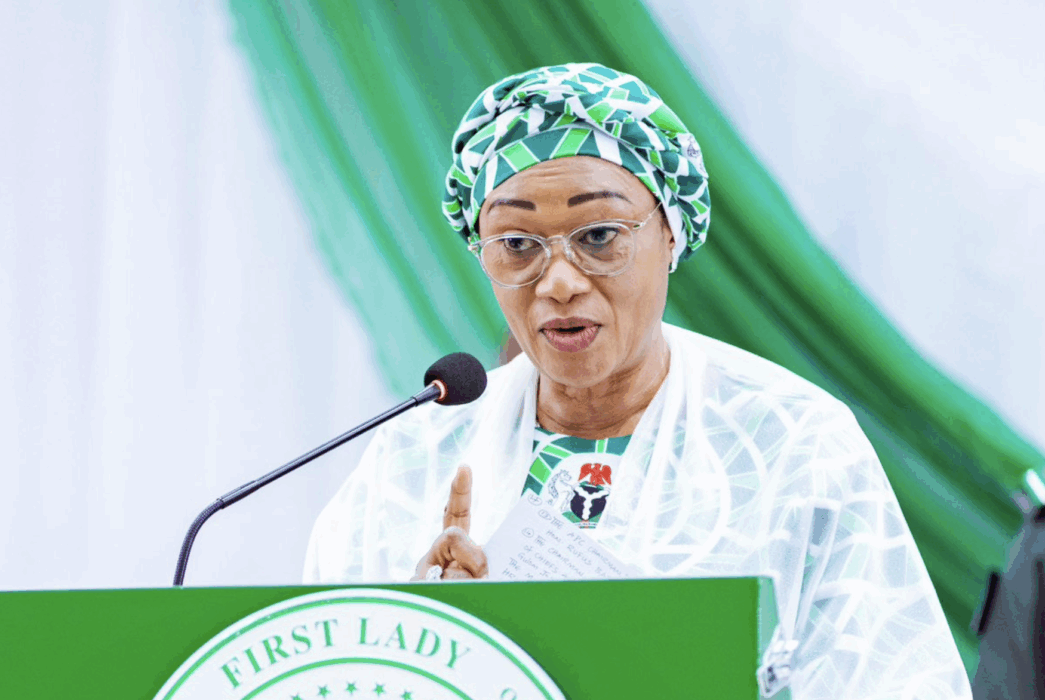
First Lady Oluremi Tinubu has said the Federal Government will ensure the national school feeding programme is properly established before the end of President Bola Tinubu’s tenure, describing investment in children as essential to Nigeria’s future.
Speaking while receiving a World Bank delegation at the State House in Abuja, the First Lady said the administration was committed to policies that improve the lives of Nigerians, particularly children.
According to a press release from her office, Senator Tinubu said, “The population size of Nigeria alone is our advantage, because Nigeria is a great nation.”
She said government ministries had continued to work together on programmes that improve public health and living conditions.
“The ministries have also been doing their best, for the benefit of our nation, with environment, sanitation because environmental cleanliness is very key, I worked with the Minister of Environment to an extent and that was why we started the Green Challenge.”
“You talked on multi sectoral approach, that is what we have been doing. I will say that Mr President has gotten himself a wonderful team, they got it.”
Highlighting the administration’s health interventions, she said, “When it comes to tuberculosis we went out for sensitisation, and promoted the campaign, and now, talking about our children, those are the joy of our nation, if we have to do a lot.”
The First Lady said her office would continue working with wives of state governors to support programmes that improve the wellbeing of children across the country.
“We are looking forward to school feeding. I can assure that before we finish our tenure, it would have been properly established because even Mr President is very passionate about this, even when he was the Governor in Lagos State,” she said.
World Bank Country Director for Nigeria, Dr Matthew Verghis, called for stronger collaboration with Nigerian leaders to advance Early Childhood Development (ECD), describing it as one of the country’s most important long-term investments.
He said the World Bank’s next five-year partnership framework places significant emphasis on investing in people through education, nutrition, healthcare and skills development.
“Every five or six years, we reframe our programmes in Nigeria. Nigeria is unsurprisingly one of World Bank’s largest partners and our office here is one of the largest in the world,” he said.
“In the framework, investing in people is an important focus of the World Bank. We are partners in education and nutrition programmes, we have programmes on skills. We recognise the importance of investing in people.”
Verghis said investments made from pregnancy until a child reaches the age of five deliver lasting economic and social benefits by improving cognitive development, reducing healthcare costs and helping families escape poverty.
He also urged the First Lady to use her platform to promote a multi-sectoral approach to Early Childhood Development across the country.
The World Bank delegation commended the alignment between the First Lady’s programmes, particularly her campaign against child malnutrition, and the bank’s development priorities.
Verghis described Nigeria as central to the World Bank’s global objectives.
“Nigeria is a very important partner for World Bank and her success is crucial for the World Bank to achieve its target.”
“We have targets for healthcare delivery, broadband access, energy access and for these various things, if Nigeria does not succeed, the World Bank is not succeeding.”
He added that sustained political leadership was necessary because the benefits of investing in young children often take years to materialise.
The five-member delegation visited the First Lady to brief her on the World Bank’s Early Childhood Development programme for Nigeria, which is currently in its technical and analytical phase ahead of implementation.
Faridah Abdulkadiri
Follow us on: