

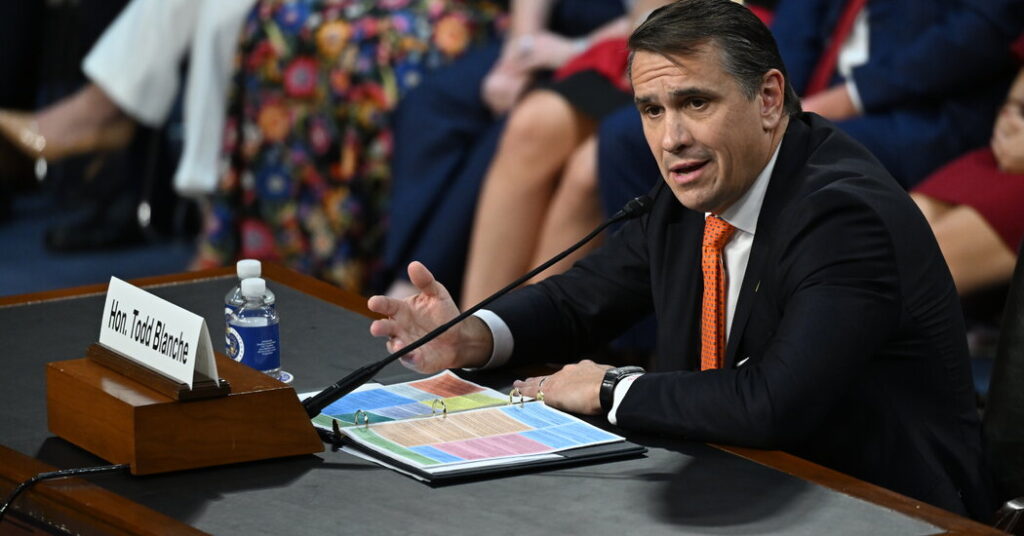
Todd Blanche, the acting attorney general, confirmed in writing on Sunday night that the Justice Department would abandon elements of the deal it struck with President Trump to resolve his lawsuit against the I.R.S., conceding to demands from Republican senators who had threatened to block his nomination as attorney general.
The Republican holdouts, Senators John Cornyn of Texas and Thom Tillis of North Carolina, had demanded that Mr. Blanche provide written assurances that the Justice Department had formally killed a planned $1.8 billion fund to pay those who claim they were unfairly persecuted by the government.
The senators also insisted that Mr. Blanche narrow the scope of the sweeping immunity from I.R.S. scrutiny that was granted to Mr. Trump, his family and their businesses under the same agreement.
Mr. Blanche posted two documents on social media on Sunday night: a signed memo in which he said that the Justice Department was formally rescinding an order that created the so-called “anti-weaponization fund” and an unsigned statement in which the Justice Department clarified the terms of the I.R.S. protections.
Mr. Blanche’s announcement comes just days before the Senate Judiciary Committee is scheduled to vote to advance his nomination on Tuesday, and could potentially clear his path to be confirmed.
“My team and I have met with committee members and Senators over the past several weeks and addressed any concerns or outstanding questions,” Mr. Blanche wrote. “We have enjoyed good faith discussions, and as a result issue the following order and update.”
A spokeswoman for Mr. Cornyn, Natalie Yezbick, said in a statement that Mr. Cornyn had reached an agreement with the Justice Department that included a “formal order permanently terminating the fund” and a “binding written document” limiting the scope of the audit settlement. Representatives for Mr. Tillis did not immediately respond to a request for comment.
In his social media post, Mr. Blanche included a copy of a memo establishing that the $1.8 billion fund “is rescinded and shall have no force or effect.” In June, he had promised lawmakers that the fund was dead, though he said at the time that he would not commit to “putting anything in writing.”
“Although the Acting Attorney General has repeatedly advised Congress through testimony, including under oath, as well as in written responses, that the Fund is not moving forward, and the Department has repeatedly represented to district courts that the Fund is not moving forward, today’s order officials rescinds the May 18, 2026 order,” read a statement from the attorney’s general office also posted by Mr. Blanche on Sunday.
Mr. Blanche posted a second statement saying that only Mr. Trump, two of his sons and the Trump Organization would be immune from audits, excluding a broader pool of Trump family members and their associates who appeared to be eligible for protection under the original Justice Department deal. Mr. Blanche also stipulated that their future tax returns could still be audited — another one of Mr. Cornyn’s demands.
Still, even in its new form, Mr. Blanche’s order for the I.R.S. to abandon any audits of Mr. Trump’s previous tax returns is an unprecedented and potentially illegal benefit to a sitting president, worth potentially tens of millions of dollars in lower taxes and avoided penalties.
The audit immunity and the fund — which the Trump administration said was established to compensate those it says were victims of “weaponization” under Democratic administrations — have faced criticism since their inception.
Democrats have slammed both provisions as corrupt handouts to the president and his allies, and many Republican senators privately expressed outrage that the fund could be used to reimburse people who were charged in connection with the Jan. 6, 2021, attack at the Capitol.
Mr. Cornyn and Mr. Tillis vowed that they would not confirm Mr. Blanche as attorney general unless he provided written assurances that the fund had been killed and no payouts would occur.
Mr. Trump sued the I.R.S. in January, initially demanding $10 billion over the leak of his tax returns during his first term. The Justice Department, which represents the I.R.S. in federal court, never contested Mr. Trump’s suit, instead agreeing to settle, even though lawyers at the I.R.S. thought the government had a clear defense against the president’s claims.