

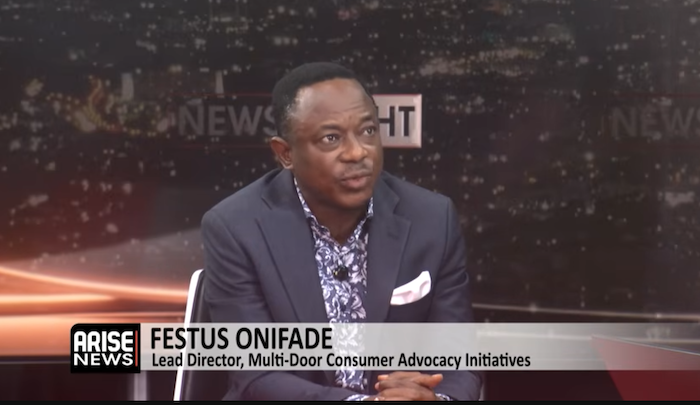
The lead director of Multi-Door Consumer Advocate Initiatives, Festus Onifade, has said the Federal Competition and Consumer Protection Commission, (FCCPC), lacks sufficient powers to effectively tackle persistent fuel price hikes, despite concerns over arbitrary profiteering by marketers.
He said this while speaking in an interview with ARISE NEWS on Friday.
Lamenting the persistent hike in fuel prices in the country, Onifade noted that petroleum retailers are quick to increase pump prices whenever global oil prices rise but often fail to reflect reductions when international prices decline.
“I have said it in some forums that the FCCPC is more like a toothless dog. They can rarely do much. Yes, they can rarely do much, the FCCPC can do little. They can’t do so much,” he stressed.
Adding, he called for a strengthening of the Federal Competition and Consumer Protection Act (FCCPA) 2018, arguing that the Commission lacks the enforcement powers needed to protect consumers from unjustified price increases and arbitrary profiteering.
“In Nigeria, what goes up does not come down. It is a sad reality of our economy. In a way, I am beginning to think maybe it’s cultural. When things go up, and when the inputs through which they get those things come down, it doesn’t reflect. So it’s sad, and I am beginning to think maybe it’s becoming a cultural thing in Nigeria.
“At the inception of this crisis, around a month ago when the crisis subsided, a lot of Nigerians began to say, ‘Okay, let’s see the effect now. Let this thing come down. Let it reflect in the petroleum pump price.’ But it didn’t reflect. Rather, the price stabilized in a way, and it calls for concern. The FCCPC, NMDPRA, all these stakeholders, they began to hold meetings here and there on how we drive this thing down. So, it’s a thing of serious concern.
“The FCCPA—Federal Competition and Consumer Protection Act of 2018—should be strengthened more,” he said.
Urging the Federal Government to introduce measures to cushion the impact of rising fuel prices, Onifade called for alternative forms of subsidy rather than a return to fuel subsidy.
He argued that the shortcomings of the naira-for-crude policy had forced local refineries to source crude in dollars, driving up production costs and pump prices.
According to him, the government should ensure that increased crude oil revenues translate into tangible relief for Nigerians, as the rising cost of petrol continues to affect virtually every sector of the economy, especially the informal sector.
“Maybe we have to rethink this whole policy altogether. And when I say subsidy might return, or should return, or advocating for it to return, we are not saying fuel subsidy. There are other subsidies that can be done. The transport subsidy we are hearing about, we have not seen anything.
“The major reason why Nigerians are really feeling the brunt is because of the policy of ‘Naira for Crude,’ a policy that in a way seems to be failing.
“This is what we are saying: the government needs to step in and look at other forms of subsidy that can cushion this effect. The benchmark for the projection was $75 or $68 per barrel, but the price at which they are selling now at the international market is over $100. The government is making more money, which should ordinarily translate to the prosperity of Nigerians. But Nigerians are not feeling it.
“The government should be deliberate about how to cushion this effect all around so that the effect will be a little less than what we are feeling. The price of petroleum affects virtually every sector, particularly the informal sector—the barbers, the traders, the welders, everybody is affected,” he stressed.
Onifade also called for stronger regulatory oversight across the petroleum distribution chain, saying the government should empower relevant agencies to intensify monitoring, enforcement, and sanctions against unfair pricing practices.
“The chain between where petrol lands at the depot and when it gets to the consumer is a bit chaotic. This is an area where we need to empower the agencies involved to do more monitoring, more enforcement, and apply more penalties when they are adequately armed from the legal perspective.
“As it is today, Section 17 of the FCCPA says that only the President can fix prices. What it means is that only the President of the Federal Republic of Nigeria can fix prices in any sector, so you cannot fix prices arbitrarily. What we can do is to make an example of people who practice predatory pricing, discriminatory pricing, and sharp practices. When you empower the agency more, they will be able to take action and identify culprits in the chain. The agency’s responsibility should be more empowered to cushion the effect,” he insisted.
Speaking on alternatives to petrol, Onifade said that most Nigerians have few or no viable options, especially those in the informal sector. He noted that while some consumers may switch to electric vehicles, such alternatives remain beyond the reach of many, highlighting the need for government measures to ease rising fuel costs.
“As Nigerians, we really have very few or no alternatives, especially for the very informal sectors. For me and you, we can begin to think about getting an electric car for our next vehicle to deemphasize reliance on petrol products. However, there are a whole lot of people who cannot do without this consumption, and that’s where the problem is.”
Calling for urgent government action, Onifade urged authorities to fast-track promised intervention measures to cushion the impact of rising fuel prices. He warned that Nigerians would continue to bear the burden unless the interventions are implemented without delay.
“It is an unfortunate situation. We will really continue to bear the brunt and plead to the government that the interventions they promised should be quickly hastened,” he urged.
Favour Odima
Follow us on: