

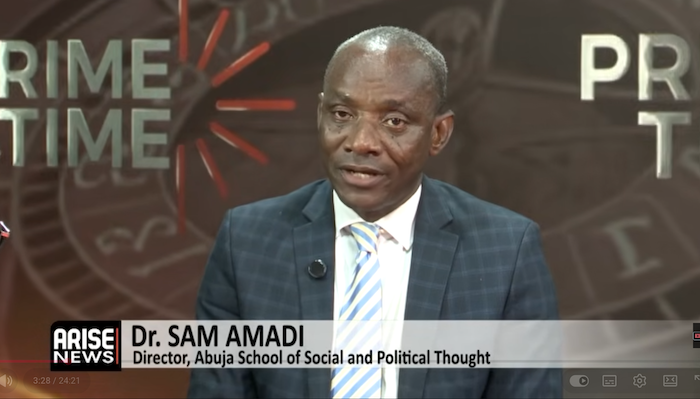
The Director, Abuja School of Social and Political Thought, and Arise News Analyst, Dr Sam Amadi, has said Nigeria’s security challenges cannot be resolved by expanding the size of the military alone, arguing that the country needs a comprehensive review of its security strategy.
Speaking on ARISE NEWS on Friday, while reacting to President Bola Tinubu’s approval for the expansion of the Nigerian Army, Dr Amadi said the effectiveness of the move would depend on broader reforms, including improved military morale, efficiency, and strategic planning.
“Again, a military of course deployed for peacekeeping, for all kinds of things on the road, for even managing the roads, because our roads are now impassable—there are criminals everywhere. Will this lead to more security? It depends also if this is coupled with real security strategy re-mapping and re-imagining. I think there’s something wrong with Nigerian security strategy. Again, there’s something wrong with morale,” he lamented.
“The question is, is the Nigerian military—with more additional men, material, and finances—capable of having an efficient military with all the disorientation and demoralization?”, he questioned.
Commenting on President Bola Tinubu’s decision to retain Vice President Kashim Shettima as his running mate for the 2027 presidential election, Dr Amadi said the move was expected, arguing that the President had limited political options.
“I think it was bound to happen. I mean, the President didn’t have much choices. So there were two options: to drop him or maybe pick an existing Muslim. Every option, as they say, had a lot of consequences. So I didn’t think that really he would drop Shettima. It was going to be very possible. But at the end of the day, every candidate makes up his mind: what’s the best option out there? I think Mr. President probably made the right choice because he hasn’t got other better options,” he said.
On Northern governors’ endorsement of President Bola Tinubu, Dr Amadi argued that although the federal and state governments now have more money following the removal of fuel subsidy, the increased revenue has not translated into better development outcomes. He said Nigeria’s infrastructure, per capita income and human development indicators have not improved sufficiently, maintaining that the additional resources have had little meaningful impact on citizens’ welfare.
“I think Tinubu has executed the role of mother-of-mine for himself and for the governors, but at a larger waste. If you look at the Infrastructure Development Index, Nigeria is 24th out of 26 states assessed, meaning Nigeria’s index—for 24 out of 26—Infrastructure Development Index has not improved since Buhari. More money, less impact.
“Yes, more money is generated. Of course, some of them fit into elephant projects, some of them fit into stolen wealth. Look at the NNPC issue you are talking about. Since this government came to power, governors have more money, but the index of development, whether in terms of market economics or human development, is not good enough. So yes, there’s so much money. That’s perhaps why they are not governing well,” he asserted.
Reiterating his support for zoning and power rotation, the analyst said the arrangement was important for political stability and inclusion, although it was not constitutionally mandated.
“I’ve always been a supporter of zoning. Even in 2023, zoning is important. Zoning is good, desirable, but not constitutionally mandated. But politically it makes sense,” he stressed.
Speaking on the 2027 presidential election, he said Peter Obi’s commitment to a single four-year term was a valid political position, but stressed that voters would ultimately decide.
“And so, Peter Obi has always argued he’s going to do four years. And there was some skepticism around whether that’s possible. Because people think, again, some sophistry: you can’t fix a nation in eight years; Buhari did not. So four years is your mandate, and Peter Obi has now said, ‘I will do four years and concretize it.’ Let him contest. It is up to the voters.”
On the issue of the Presidential Foreign Intervention Promotion Council, (PFIPC) controversy, Dr Amadi said the matter could be resolved by establishing the facts through sworn testimonies from relevant officials and institutions.
He argued that the focus should be on determining who approved the initiative, who knew about it, and how it operated, adding that the controversy raises questions about the integrity, competence, and accountability of governance.
“I think that this crisis is very simple. There are facts that need to be deposed on oath. So you don’t even have to have ICPC. This guy is on ballot, who put him there? Depose oath. Senate has to tell us what happened, National Assembly. Chief of Staff, what did you know? Secretary to Government, what did you know?
“So this whole molehill out of a mountain… The critical thing is that this challenges the integrity of governance, the competence of governance. If you are asking me, I think the presidency should come out clean, either to show that there was real external infiltration, otherwise this shows that the office of the President needs to be restructured. That’s gross incompetence or gross corruption in the presidency,” he said.
Favour Odima
Follow us on: