

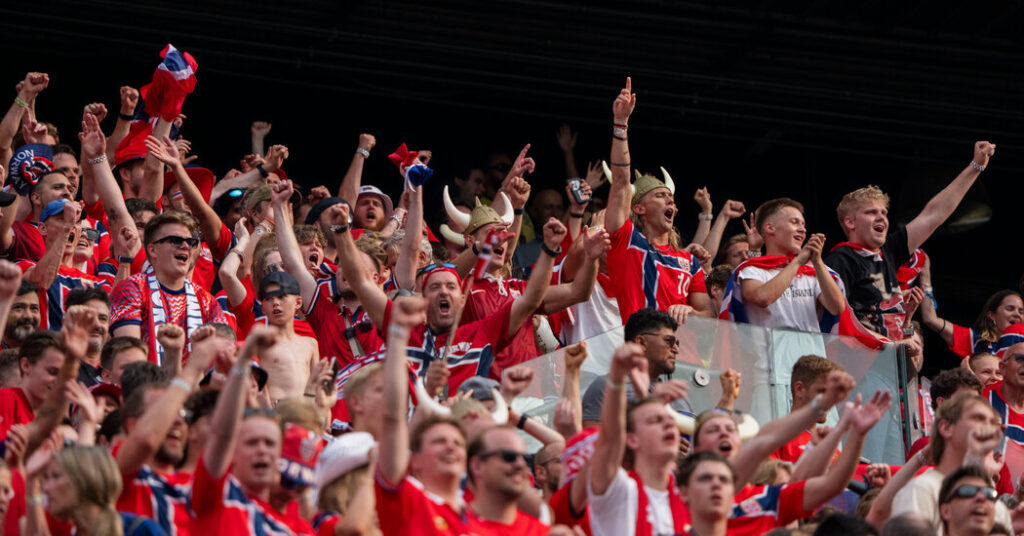
For nearly half their lives, Geir Martinsen and Richard Stott have bonded over their love of soccer, Manchester City Football Club and their adopted home of Oslo.
But on Saturday, the friends will go their own ways. Norway and England are clashing in the FIFA World Cup quarterfinals.
“You can’t change your country of birth,” said Mr. Stott, 58, who moved from Manchester, England, to Norway over a quarter-century ago.
“It’s as they say, you can never change your kids or your football team,” added Mr. Martinsen, 53, who moved to Oslo from southeastern Norway the same year as Mr. Stott’s arrival. “Although he lived in Norway for many, many years, I fully understand why he supports England.”
For 90 minutes, at least, they will be at odds — as another chapter is decided in the deep relationship of England and Norway, which has been defined by rivalry, conflict, cross-country settlement and friendship for over a thousand years.
Even before the Viking raids that began in the late eighth century, traders regularly crossed the North Sea, building ties among the era’s fractious kingdoms.
Then, the violence of the Viking Age shaped large parts of Britain for centuries to come, as early English kings fought and forged peace with Scandinavian raiders and settlers. (Norwegian influence can still be seen in the language and culture in regions like the Orkney Islands.)
In the modern age, relations grew — again through trade, as Norwegians brought British luxury goods, but also as Britain supported Norway’s bid for independence from Sweden in 1905. The links included each country’s royal family: Maud Alexandria, the youngest daughter of King Edward VII of England, became queen of Norway, ruling alongside King Haakon VII.
The two countries were allies during World War II, with Norwegian royals exiled in London as Nazi forces occupied Norway. As a token of thanks, Norway sends a Christmas tree to London each year, and the city holds it in pride of place in Trafalgar Square.
In soccer, fans frequently cross the North Sea to watch a game on home soil, and Norway’s greatest players have made their mark in the English leagues.
The magnetic Norwegian player Erling Haaland plays for Manchester City and was born in Leeds, where his father, Alf-Inge Haaland, played in the 1990s. Just this spring, Norway’s team captain, Martin Odegaard, lifted the Premier League trophy for London club Arsenal, where he is also the captain.
“I’ve supported England as if I were English ever since the 1990 World Cup,” said Martin Molden, a psychologist and a supporter of Sheffield United Football Club. “But I’m Norwegian, and this Saturday I’m 100 percent behind Norway.”
The rivalry this week has so far mostly stayed friendly. On the side of a NATO summit in Turkey, the prime ministers of each country posed in their team jerseys, and the British Embassy in Norway replied drolly to an open letter in the Norwegian press predicting England’s failure.
“Should Norway win, we shall congratulate you graciously. Shortly afterward, we reserve the right to blame the weather. Nothing personal. Merely tradition,” the embassy said in a Facebook post. “Should England win, we trust you will remember that football is, after all, coming home. It simply has a habit of taking the scenic route.”
“Football’s Coming Home” is a refrain England has repeated since it won the World Cup for the first and only time in 1966. Each generation has yearned to realize the phrase — piling pressure on the national team and breaking many fans’ hearts.
“England are very good at letting the fans down, aren’t they?” he said Terry Milnes, who heads the Arsenal North West Supporters Club. Mr. Milnes, 70, said he cannot help but hope that the national team wins on Saturday, but that its decades of failure had made him cautious.
Norway, meanwhile, is enjoying its most successful run at the World Cup ever. Its players and its fans’ Viking Row have become a sensation, winning new admirers.
“I am rooting for Norway’s team,” said Owen Cross, 27, who moved from England to Norway three years ago. “England had a lot of shots to win the title and it’s time for Norway to get a shot.”
Skiing, not soccer, is Norway’s unofficial national sport, while in England football is the common language. Analysts can’t decide whether Norway’s winning team is an exceptional case, like the squad that beat Germany at the 1936 Olympics, or the result of extensive investment in sports development fueled by the wealth that followed the discovery of oil in 1967.
“We’ve gone from being an amateur football nation to becoming a professional one,” said Arne Scheie, 82, a football commentator who has followed decades of World Cup play.
Some of England’s closest neighbors — with their own histories of conflict — have thrown their lot with Norway, too.
Scotland’s supporters, known as the Tartan Army, have rowed with Norway’s plastic-helmeted Vikings. Many Welsh and Irish fans have also joined in.
One of them, Maeve Brereton, an Irish citizen, rushed around London this week trying to find a Norway jersey. She found the Women’s Team jersey in a size for 13- to 15-year-old boys. If that doesn’t fit, she has a red T-shirt she plans to customize with the letters NORGE, spelling Norway in Norwegian.
“One of them is going to fit me on Saturday,” said Ms. Brereton, who has lived in England for more than six years. (Ireland didn’t qualify for the World Cup.)
“Everyone seems nice, and it seemed like a wholesome thing to get involved in,” she said. “Sometimes, especially with England football fans, it’s not that inclusive as an environment.”
But the rivalry promises to remain friendly. Fans of club soccer are already looking beyond Saturday and beyond the World Cup. Mr. Milnes will still go to regular Arsenal games with a Norwegian friend who lives in England. Mr. Martinsen and Mr. Stott plan to meet up to dissect the game.
“Whatever happens,” Mr. Stott said, “we’re not going to fall out.”
Henrik Pryser Libell and Louise Krüger contributed reporting.